Pleuromutilins: Potent Drugs for Resistant Bugs-Mode of Action and Resistance
- PMID: 27742734
- PMCID: PMC5204327
- DOI: 10.1101/cshperspect.a027110
Pleuromutilins: Potent Drugs for Resistant Bugs-Mode of Action and Resistance
Abstract
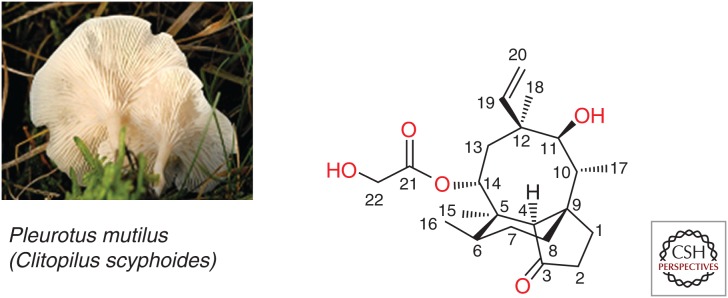
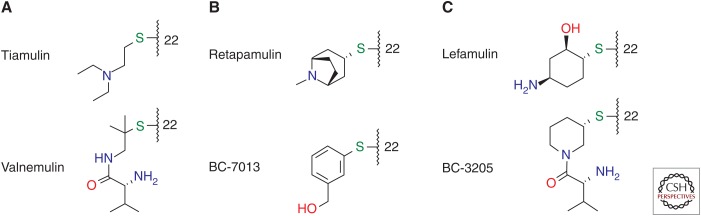
Pleuromutilins are antibiotics that selectively inhibit bacterial translation and are semisynthetic derivatives of the naturally occurring tricyclic diterpenoid pleuromutilin, which received its name from the pleuromutilin-producing fungus Pleurotus mutilus Tiamulin and valnemulin are two established derivatives in veterinary medicine for oral and intramuscular administration. As these early pleuromutilin drugs were developed at a time when companies focused on major antibacterial classes, such as the β-lactams, and resistance was not regarded as an issue, interest in antibiotic research including pleuromutilins was limited. Over the last decade or so, there has been a resurgence in interest to develop this class for human use. This has resulted in a topical derivative, retapamulin, and additional derivatives in clinical development. The most advanced compound is lefamulin, which is in late-stage development for the intravenous and oral treatment of community-acquired bacterial pneumonia and acute bacterial skin infections. Overall, pleuromutilins and, in particular, lefamulin are characterized by potent activity against Gram-positive and fastidious Gram-negative pathogens as well as against mycoplasmas and intracellular organisms, such as Chlamydia spp. and Legionella pneumophila Pleuromutilins are unaffected by resistance to other major antibiotic classes, such as macrolides, fluoroquinolones, tetracyclines, β-lactam antibiotics, and others. Furthermore, pleuromutilins display very low spontaneous mutation frequencies and slow, stepwise resistance development at sub-MIC in vitro. The potential for resistance development in clinic is predicted to be slow as confirmed by extremely low resistance rates to this class despite the use of pleuromutilins in veterinary medicine for >30 years. Although rare, resistant strains have been identified in human- and livestock-associated environments and as with any antibiotic class, require close monitoring as well as prudent use in veterinary medicine. This review focuses on the structural characteristics, mode of action, antibacterial activity, and resistance development of this potent and novel antibacterial class for systemic use in humans.
Copyright © 2017 Cold Spring Harbor Laboratory Press; all rights reserved.
Figures
References
-
- Alba P, Feltrin F, Cordaro G, Porrero MC, Kraushaar B, Argudin MA, Nykasenoja S, Monaco M, Stegger M, Aarestrup FM, et al. 2015. Livestock-associated methicillin resistant and methicillin susceptible Staphylococcus aureus sequence type (CC)1 in European farmed animals: High genetic relatedness of isolates from Italian cattle herds and humans. PLoS ONE 10: e0137143. - PMC - PubMed
-
- Anchel M. 1952. Chemical studies with pleuromutilin. J Biol Chem 199: 133–139. - PubMed
-
- Andemichael YW, Chen J, Clawson JS, Dai W, Diederich A, Downing SV, Freyer AJ, Liu P, Oh LM, Patience DB, et al. 2009. Process development for a novel pleuromutilin-derived antibiotic. Org Process Res Dev 13: 729–738.
-
- Arigoni D. 1962. The structure of a new class of terpene. Gazz Chim Ital 92: 884–901.
-
- Arigoni D. 1968. Some studies in the biosynthesis of terpenes and related compounds. Pure Appl Chem 17: 331–348. - PubMed
Publication types
MeSH terms
Substances
LinkOut - more resources
Full Text Sources
Other Literature Sources
Medical
Research Materials
Miscellaneous