A score of low-grade inflammation and risk of mortality: prospective findings from the Moli-sani study
- PMID: 27742767
- PMCID: PMC5394885
- DOI: 10.3324/haematol.2016.144055
A score of low-grade inflammation and risk of mortality: prospective findings from the Moli-sani study
Abstract
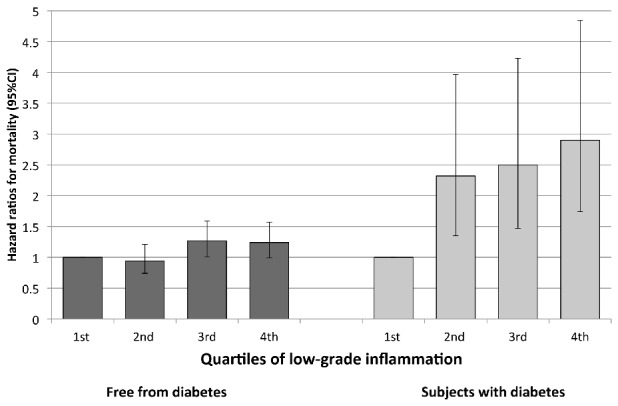
Low-grade inflammation is associated with an increased risk of chronic degenerative disease, but its relationship with mortality is less well explored. We aimed at evaluating, at a large epidemiological level, the possible association of low-grade inflammation, as measured by a composite score, with overall mortality risk. We conducted a population-based prospective investigation on 20,337 adult subjects free from major hematological disease and acute inflammatory status, randomly recruited from the general population of the Moli-sani study. A low-grade inflammation score was obtained from the sum of 10-tiles of plasmatic (C-reactive protein) and cellular (leukocyte and platelet counts, granulocyte/lymphocyte ratio) biomarkers of low-grade inflammation; higher levels indicated increased low-grade inflammation. Hazard ratios were calculated using multivariable Cox proportional hazard models with 95% confidence intervals. At the end of follow-up (median 7.6 years), 837 all-cause deaths were recorded. As compared to subjects in the lowest quartile of the low-grade inflammation score, those in the highest category had a significantly increased risk in overall mortality (HR=1.44; 1.17-1.77), independently of possible confounders, including the presence of chronic diseases and a number of health-related behaviors. The magnitude of the association of low-grade inflammation with mortality was relatively higher in type 2 diabetic patients (HR=2.90; 1.74-4.84) and in individuals with a history of cardiovascular disease (HR=2.48; 1.50-4.11) as compared to their counterparts who were free from the disease. In conclusion, an elevated degree of low-grade inflammation, as measured by a composite score of inflammatory biomarkers, is an independent risk factor for total mortality in an apparently healthy adult general population.
Copyright© Ferrata Storti Foundation.
Figures
References
-
- Barbaresko J, Koch M, Schulze MB, Nöthlings U. Dietary pattern analysis and biomarkers of low-grade inflammation: a systematic literature review. Nutr Rev. 2013;71 (8):511–527. - PubMed
-
- Engstrom G, Hedblad B, Stavenow L, et al. Inflammation-Sensitive Plasma Proteins and Incidence of Myocardial Infarction in Men With Low Cardiovascular Risk. Arterioscler Thromb Vasc Biol. 2004;24(8):1498–1502. - PubMed
-
- Lind L. Circulating markers of inflammation and atherosclerosis. Atherosclerosis. 2003;169(2):203–214. - PubMed
Publication types
MeSH terms
Substances
LinkOut - more resources
Full Text Sources
Other Literature Sources
Research Materials