Review
. 2018 Jan;9(1):33-46.
doi: 10.1007/s13238-016-0323-0. Epub 2016 Oct 14.

Antibody-drug conjugates: recent advances in conjugation and linker chemistries

Affiliations
Review

Antibody-drug conjugates: recent advances in conjugation and linker chemistries

Kyoji Tsuchikama et al. Protein Cell. 2018 Jan.

Abstract

The antibody-drug conjugate (ADC), a humanized or human monoclonal antibody conjugated with highly cytotoxic small molecules (payloads) through chemical linkers, is a novel therapeutic format and has great potential to make a paradigm shift in cancer chemotherapy. This new antibody-based molecular platform enables selective delivery of a potent cytotoxic payload to target cancer cells, resulting in improved efficacy, reduced systemic toxicity, and preferable pharmacokinetics (PK)/pharmacodynamics (PD) and biodistribution compared to traditional chemotherapy. Boosted by the successes of FDA-approved Adcetris® and Kadcyla®, this drug class has been rapidly growing along with about 60 ADCs currently in clinical trials. In this article, we briefly review molecular aspects of each component (the antibody, payload, and linker) of ADCs, and then mainly discuss traditional and new technologies of the conjugation and linker chemistries for successful construction of clinically effective ADCs. Current efforts in the conjugation and linker chemistries will provide greater insights into molecular design and strategies for clinically effective ADCs from medicinal chemistry and pharmacology standpoints. The development of site-specific conjugation methodologies for constructing homogeneous ADCs is an especially promising path to improving ADC design, which will open the way for novel cancer therapeutics.

Keywords: antibody-drug conjugates; cancer; chemotherapy; conjugation; linker; site-specific conjugation.


Figures

Figure 1
Figure 1
Structure and mechanism of action of ADC. (A) A general structure of an ADC containing a humanized/human monoclonal antibody (mAb), a cleavable/non-cleavable chemical linker, and a cytotoxic payload. The linker is covalently linked to the mAb at the conjugation site. (B) A general mechanism of action of ADCs. The ADC binds to its target cell-surface antigen receptor (Step 1) to form an ADC-antigen complex, leading to endocytosis of the complex (Step 2). The internalized complex undergoes lysosomal processing (Step 3) and the cytotoxic payload is released inside the cell (Step 4). The released payload binds to its target (Step 5), leading to cell death (Step 6)
Figure 2
Figure 2
Structures of FDA-approved ADCs: Mylotarg ® , Adcetris ® , and Kadcyla ® (blue: linker, red: payload)
Figure 3
Figure 3
Lysine amide coupling. An activated carboxylic acid moiety reacts with a lysine residue, which results in amide bond linkage between mAb and the payload. Optimized conjugation conditions give an average drug-to-antibody ratio (DAR) value of 3.5–4 with distribution between 0–7
Figure 4
Figure 4
Cysteine coupling. (A) Maleimide alkylation. A maleimide moiety reacts with a reduced cysteine residue of a mAb (distribution of DAR: 2, 4, 6, and 8 or predominant at 2 with THIOMAB technology). (B) Rebridging of interchain disulfide bonds. The dibromo (or disulfonate) reagent reacts with the reduced interchain disulfides to provide rebridged mAbs (DAR: predominant at 4). (C) Cysteine arylation using palladium complexes. Aryl-palladium complex reagents undergo aryl-thiol coupling, which affords mAbs containing arylcysteines (average DAR: 4.4)
Figure 5
Figure 5
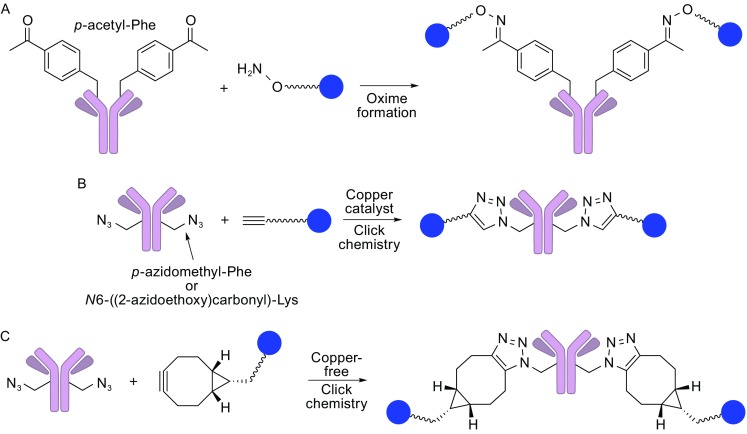
Non-natural amino acid incorporation by genetic engineering into mAbs and subsequent chemical conjugation. (A) Oxime ligation. (B) Copper-catalyzed or (C) strain-promoted (copper-free) azide-alkyne cyclization. The site-specific conjugation method gives a defined DAR value depending on the number of non-natural amino acid residues that are genetically incorporated
Figure 6
Figure 6
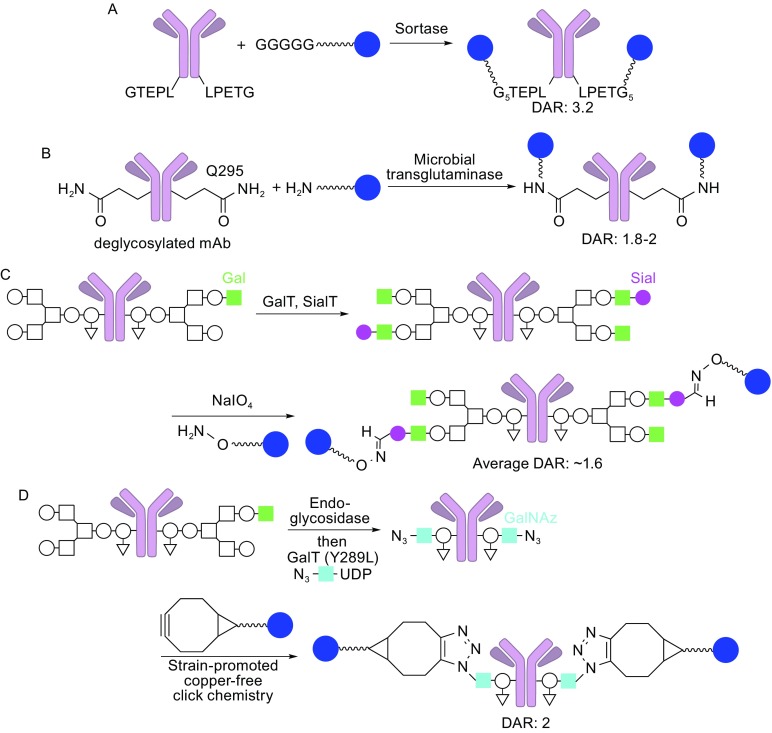
Site-specific (chemo)enzymatic conjugation. (A) Sortase-mediated conjugation. Sortase attaches oligoglycine-functionalized linkers to LPETG tags on the mAb. (B) Microbial transglutaminase-mediated conjugation. The enzyme attaches an ADC linker possessing a primary amine to Q295 of the heavy chain (DAR: 1.8–2, high homogeneity). (C) Conjugation using β-1,4-galactosyltransferase (GalT) and α-2,6-sialyltransferase (SialT) (light green square: β-1,4-galactose, magenta circle: sialic acid). The aldehyde groups installed react with alkoxyamine-functionalized linkers (average DAR: ~1.6). (D) GlycoConnect technology using endoglycosidase, galactosyltransferase, and N-azidoacetylgalactosamine (GalNAz, light blue square). The azide groups installed react with strained cyclooctyne-functionalized linkers (DAR: 2, high homogeneity)
Figure 7
Figure 7
Cleavable linkers. (A) Hydrazone linker. This linker is cleaved in the acidic environment (i.e., endosome and lysosome). (B) Cathepsin B-cleavable peptide linker such as valine-citrulline-p-aminobenzyloxycarbonyl (PABC) and valine-alanine-PABC. The PABC moiety enables release of free payload molecules in a traceless manner. (C) Disulfide-containing linker. The disulfide bond is reduced by intracellular reducing molecules (e.g., glutathione) to release the payload. (D) Pyrophosphate diester. This stable, hydrophilic linker is cleaved in lysosomes and free payload molecules are released
Figure 8
Figure 8
Non-cleavable linker. The chemical stability of the non-cleavable linker withstands proteolytic degradation. Cytosolic/lysosomal degradation of the mAb moiety liberates the payload molecule linked to an amino acid residue derived from the degraded mAb

References

    1. An Z. Monoclonal antibodies—a proven and rapidly expanding therapeutic modality for human diseases. Protein Cell. 2010;1:319–330. doi: 10.1007/s13238-010-0052-8. - DOI - PMC - PubMed
    1. Axup JY, Bajjuri KM, Ritland M, Hutchins BM, Kim CH, Kazane SA, Halder R, Forsyth JS, Santidrian AF, Stafin K, et al. Synthesis of site-specific antibody-drug conjugates using unnatural amino acids. Proc Natl Acad Sci USA. 2012;109:16101–16106. doi: 10.1073/pnas.1211023109. - DOI - PMC - PubMed
    1. Beerli RR, Hell T, Merkel AS, Grawunder U. Sortase enzyme-mediated generation of site-specifically conjugated antibody drug conjugates with high in vitro and in vivo potency. PLoS ONE. 2015;10:e0131177. doi: 10.1371/journal.pone.0131177. - DOI - PMC - PubMed
    1. Behrens CR, Ha EH, Chinn LL, Bowers S, Probst G, Fitch-Bruhns M, Monteon J, Valdiosera A, Bermudez A, Liao-Chan S, et al. Antibody-drug conjugates (ADCs) derived from interchain cysteine cross-linking demonstrate improved homogeneity and other pharmacological properties over conventional heterogeneous ADCs. Mol Pharm. 2015;12:3986–3998. doi: 10.1021/acs.molpharmaceut.5b00432. - DOI - PMC - PubMed
    1. Bouchard H, Viskov C, Garcia-Echeverria C. Antibody–drug conjugates—a new wave of cancer drugs. Bioorg Med Chem Lett. 2014;24:5357–5363. doi: 10.1016/j.bmcl.2014.10.021. - DOI - PubMed

Publication types