


Clinical management of pregnancy in the obese mother: before conception, during pregnancy, and post partum
- PMID: 27743977
- PMCID: PMC6691730
- DOI: 10.1016/S2213-8587(16)30278-9
Clinical management of pregnancy in the obese mother: before conception, during pregnancy, and post partum
Abstract
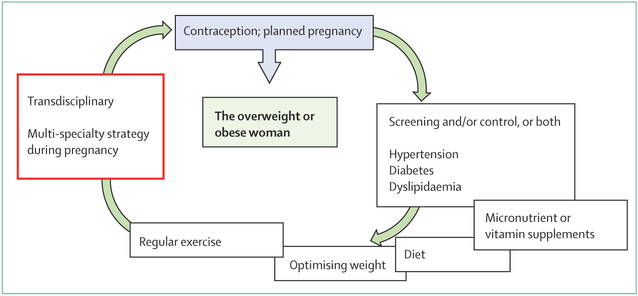
The global epidemic of obesity has led to an increasing number of obese women of reproductive age. Obesity is associated with reduced fertility, and pregnancies complicated by maternal obesity are associated with adverse outcomes, including increased risk of gestational diabetes, pre-eclampsia, preterm birth, instrumental and caesarean births, infections, and post-partum haemorrhage. The medical and obstetric management of obese women is focused on identifying, addressing, and preventing some of these associated complications, and is a daunting challenge given the high percentage of patients with obesity and few therapeutic options proven to improve outcomes in this population. The UK's National Institute for Health and Care Excellence guidelines and the American College of Obstetricians and Gynecologists recommend that all pregnant women follow a healthy diet, and consider at least half an hour of moderate physical activity per day during pregnancy. However, although obese women are often directed to seek the advice of a nutritionist and to limit gestational weight gain, guidelines for the management of pregnancy and delivery in this high-risk group are lacking. The post-partum period represents an important opportunity to optimise maternal health before the next pregnancy. As many of the physiological changes of pregnancy associated with maternal obesity are present from early pregnancy onward, reducing maternal obesity before conception is probably the best strategy to decrease the health burden associated with maternal obesity.
Copyright © 2016 Elsevier Ltd. All rights reserved.
Conflict of interest statement
Declaration of interests
HDM reports personal fees from Novo Nordisk, AstraZeneca Australia, and Eli Lilly Australia, outside the submitted work. All other authors declare no competing interests.
Figures
Comment in
-
Obesity and the health of future generations.Lancet Diabetes Endocrinol. 2016 Dec;4(12):966-967. doi: 10.1016/S2213-8587(16)30098-5. Epub 2016 Oct 12. Lancet Diabetes Endocrinol. 2016. PMID: 27743979 No abstract available.
References
-
- Ma RCW, Gluckman PD, Hanson MA. Maternal obesity and developmental priming of risk In: Mahmood T, Arulkumaran S, eds. Obesity: a ticking time bomb for reproductive health, 1st edn. London: Elsevier, 2013: 193–212.
-
- Rahman MM, Abe SK, Kanda M, et al. Maternal body mass index and risk of birth and maternal health outcomes in low- and middle-income countries: a systematic review and meta-analysis. Obes Rev 2015; 16: 758–70. - PubMed
Publication types
MeSH terms
Grants and funding
LinkOut - more resources
Full Text Sources
Other Literature Sources
Medical
Research Materials
