


Discovery of novel plasma proteins as biomarkers for the development of incisional hernias after midline incision in patients with colorectal cancer: The ColoCare study
- PMID: 27745870
- PMCID: PMC5560863
- DOI: 10.1016/j.surg.2016.08.025
Discovery of novel plasma proteins as biomarkers for the development of incisional hernias after midline incision in patients with colorectal cancer: The ColoCare study
Abstract
Background: Ventral incisional hernia is the most common long-term complication after an abdominal operation. Among newly diagnosed colorectal cancer patients, we screened the preoperative plasma proteome to explore predictive markers for the development of an incisional hernia.
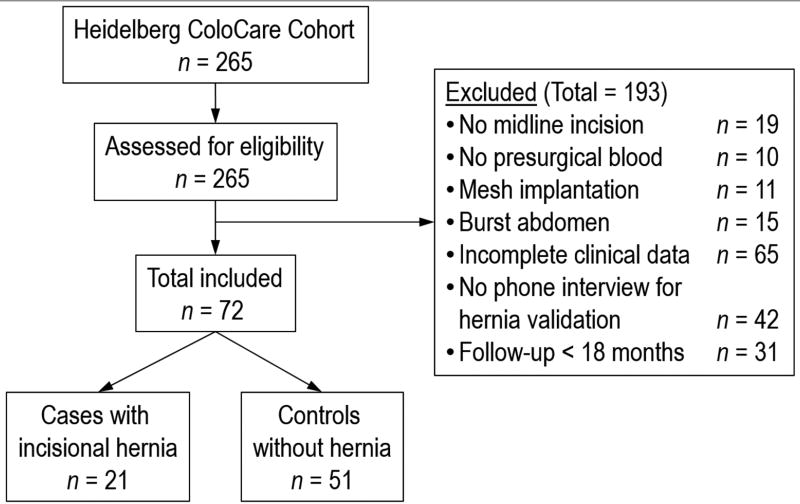
Methods: We utilized preoperative plasma samples of 72 newly diagnosed colorectal cancer patients who underwent midline incision for tumor resection between 2010 and 2013. A total of 21 patients with incisional hernia occurrence were matched with 51 patients with at least 18 months follow-up without an incisional hernia by sex, age, and body mass index. To assess predictive markers of incisional hernia risk, we screened the plasma proteome for >2,000 distinct proteins using a well-validated antibody microarray test. Paired t tests were used to compare protein levels between cases and controls. A gene-set-enrichment analysis (Gene Ontology and Kyoto Encyclopedia of Genes and Genomes) was applied to test for differences in signaling pathways between the 2 groups.
Results: The proteome screen identified 25 proteins that showed elevated or reduced plasma levels in the hernia group compared to the control group (nominal P values < .05). Several proteins were in pathways associated with wound healing (CCL21, SHBG, BRF2) or cell adhesion (PCDH15, CDH3, EPCAM).
Conclusion: Our study shows that there are multiple individual and groups of plasma proteins that could feasibly predict the personal hernia risk prior to undergoing an operation. Further investigations in larger, independent sample sets are warranted to replicate findings and validate clinical utility of potential biomarkers. After validation, such a biomarker could be incorporated into a multifactorial risk model to guide clinical decision-making.
Copyright © 2016 Elsevier Inc. All rights reserved.
References
-
- Park AE, Roth JS, Kavic SM. Abdominal wall hernia. Current problems in surgery. 2006;43(5):326–75. - PubMed
-
- Le Huu Nho R, Mege D, Ouaissi M, Sielezneff I, Sastre B. Incidence and prevention of ventral incisional hernia. Journal of visceral surgery. 2012;149(5 Suppl):e3–14. Epub 2012/11/13. - PubMed
-
- Diener MK, Voss S, Jensen K, Buchler MW, Seiler CM. Elective midline laparotomy closure: the INLINE systematic review and meta-analysis. Annals of surgery. 2010;251(5):843–56. Epub 2010/04/17. - PubMed
-
- Pereira JA, Pera M, Grande L. Incidence of incisional hernia after open and laparoscopic colorectal cancer resection. Cirugia espanola. 2013;91(1):44–9. Epub 2012/07/10. Elevada incidencia de hernia incisional tras reseccion abierta y laparoscopica por cancer colorrectal. - PubMed
-
- Skipworth JR, Khan Y, Motson RW, Arulampalam TH, Engledow AH. Incisional hernia rates following laparoscopic colorectal resection. International journal of surgery (London, England) 2010;8(6):470–3. Epub 2010/07/07. - PubMed
Publication types
MeSH terms
Substances
Grants and funding
LinkOut - more resources
Full Text Sources
Other Literature Sources
Medical
Miscellaneous
