


National Incidence, Management and Survival of Urachal Carcinoma
- PMID: 27746878
- PMCID: PMC5064294
- DOI: 10.4081/rt.2016.6257
National Incidence, Management and Survival of Urachal Carcinoma
Abstract
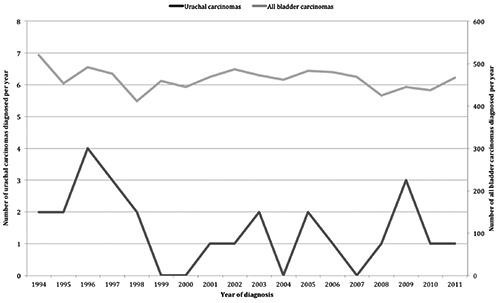
Urachal carcinoma is an uncommon cancer whose rarity has precluded its study and evidence-based management strategies are lacking. This study assessed all urachal carcinomas in Ireland and clinical parameters in order to improve understanding. Urachal carcinomas diagnosed from 1994 to 2011 were identified from the National Cancer Registry in Ireland. Data obtained included patient age, gender, diagnostic year, pathology, tumor stage, patient treatment strategies and survival. Twenty-six urachal carcinomas were identified, the majority being adenocarcinoma. This comprised 0.3% of all invasive bladder tumors. Patients were predominantly male (62%) and over 50 years of age (58%). Twenty-two patients (85%) underwent surgery, with only six (23%) undergoing chemotherapy. On average, median overall survival was 2.6 years (range 0-15.2 yrs). Survival was longer in women (5 vs. 1.9 yrs), patients under 50 years of age (3.6 vs. 1.9 yrs), those without confirmed metastasis (4.1 vs. 0.7 yrs) and those who received chemotherapy (3.6 vs. 2.6 yrs). The overall survival of urachal carcinoma in Ireland is less than expected from published literature. This study highlights the need for centralization of rare tumors with international collaboration to identify the optimal treatment strategy and improve outcome.
Keywords: Urachal carcinoma; epidemiology; management; survival.
Conflict of interest statement
the authors declare no potential conflict of interest.
Figures
References
-
- NCCN. Guidelines in Oncology (NCCN Guidelines). Bladder Cancer 2013. Available from: https://www.nccn.org/professionals/physician_gls/f_guidelines.asp
-
- Sheldon CA, Clayman RV, Gonzalez R, et al. Malignant urachal lesions. J Urol 1984;131:1-8. - PubMed
-
- Hayashi T, Yuasa T, Uehara S, et al. Clinical outcome of urachal cancer in Japanese patients. Int J Clin Oncol 2016;21:133-8. - PubMed
-
- Hue L, Jacquin M. Cancer colloide de la lombille et de paroi abdominale anterieure ayant envahi la vessie. Union Med de la Siene-Inf Rouen 1863;6:418-20.
-
- Siefker-Radtke AO, Gee J, Shen Y, et al. Multimodality management of urachal carcinoma: the M.D. Anderson Cancer Center experience. J Urol 2003;169:1295-8. - PubMed
LinkOut - more resources
Full Text Sources
Other Literature Sources
