Review
. 2015 Jun;2(1):1-16.
doi: 10.1007/s40744-015-0010-2. Epub 2015 Mar 17.

Ustekinumab in the Treatment of Psoriasis and Psoriatic Arthritis

Affiliations
Review

Ustekinumab in the Treatment of Psoriasis and Psoriatic Arthritis

Laura J Savage et al. Rheumatol Ther. 2015 Jun.

Abstract

Biologics have revolutionized the therapy of the psoriatic disease spectrum. These new classes of drugs also allow deeper insight into the pathogenesis of the disease and highlight the existence of distinct "molecular" disease subgroups as evidenced by the spectrum of clinical response seen. Molecules associated with both the interleukin (IL)-17 and interferon (IFN)γ pathways have important functions in psoriatic inflammation, and both are targeted by drugs acting on the p40 subunit shared by IL-12 and IL-23. These IL-12 family members are upstream of pathways characterized by the production of IFNγ and IL-17 related molecules, including IL-17, IL-22, and CCL20. We here summarize the mode of action and clinical studies of the p40 inhibitor ustekinumab with focus on both psoriasis and psoriatic arthritis.

Keywords: IL-12/IL-23 inhibition; Psoriasis; Psoriatic arthritis; Treatment; Ustekinumab.


Figures
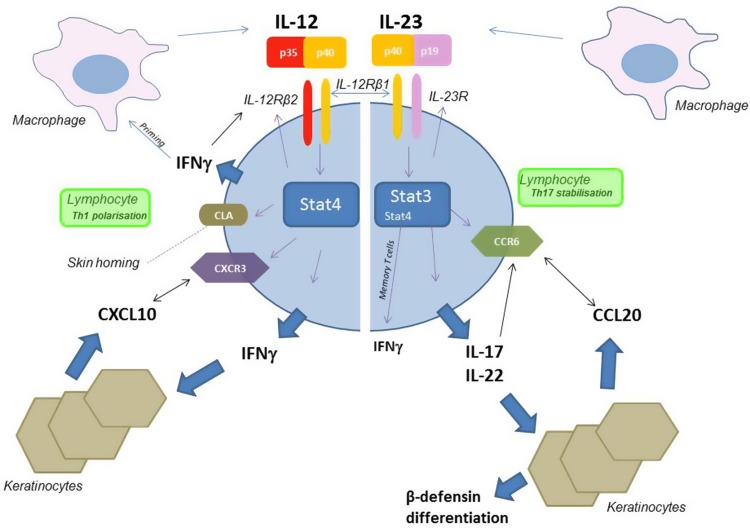
Fig. 1
Fig. 1
Schematic, simplified overview of IL-12/IL-23 dependent action on molecules involved in psoriatic inflammation. Only positive/activating pathways are depicted. Both IL-12 and IL-23 are produced by activated APCs including macrophages. Upon receptor ligation, these heterodimeric cytokines activate the Stat4/3 pathways ultimately resulting in upregulation of cell surface receptors and secretion of cytokines. Of importance, type 17 cells, which are dependent on IL-23 stimulation, express high levels of CCR6 which enables the cell to follow a chemokine gradient build by CCL20 which is produced by IL-17/IL-22 stimulated keratinocytes. Thus type 17 cells will home into CCL20 rich tissues. On the other hand, IL-12, via activation of Stat4, acts on expression of the skin homing receptor CLA but also CXCR3 which interacts with the chemokines CXCL9, 10, 11 which are all highly expressed by keratinocytes which have been exposed to IFNs. IFNγ is one of the strongest priming signal for APC to induce the production of the IL-12 family members IL-12 and IL-23. Negative regulatory feedback actions are not depicted in this figure. However, there is significant negative cross-regulation between type 1 and type 17 cells. Blocking the p40 subunit of both IL-12 and IL-23 could therefore result in “paradoxical” effects where this negative regulatory influence plays an important role in disease pathology. APC Antigen presenting cell, CLA Cutaneous lymphocyte antigen, IFN Interferon, IL Interleukin

References

    1. Chiricozzi A, Guttman-Yassky E, Suárez-Fariñas M, et al. Integrative responses to IL-17 and TNF-alpha in human keratinocytes account for key inflammatory pathogenic circuits in psoriasis. J Invest Dermatol. 2011;131:677–687. doi: 10.1038/jid.2010.340. - DOI - PubMed
    1. Vignali DA, Kuchroo VK. IL-12 family cytokines: immunological playmakers. Nature immunol. 2012;13:722–728. doi: 10.1038/ni.2366. - DOI - PMC - PubMed
    1. O’Rielly DD, Rahman P. Genetics of susceptibility and treatment response in psoriatic arthritis. Nat Rev Rheumatol. 2011;7:718–732. doi: 10.1038/nrrheum.2011.169. - DOI - PubMed
    1. Wu CY, Gadina M, Wang K, O’Shea J, Seder RA. Cytokine regulation of IL-12 receptor beta2 expression: differential effects on human T and NK cells. Eur J Immunol. 2000;30:1364–1374. doi: 10.1002/(SICI)1521-4141(200005)30:5<1364::AID-IMMU1364>3.0.CO;2-U. - DOI - PubMed
    1. Nishikomori R, Usui T, Wu CY, Morinobu A, O’Shea JJ, Strober W. Activated STAT4 has an essential role in Th1 differentiation and proliferation that is independent of its role in the maintenance of IL-12R beta 2 chain expression and signaling. J Immunol. 2002;169:4388–4398. doi: 10.4049/jimmunol.169.8.4388. - DOI - PubMed
