


Classification of epileptic EEG signals based on simple random sampling and sequential feature selection
- PMID: 27747606
- PMCID: PMC4883170
- DOI: 10.1007/s40708-016-0039-1
Classification of epileptic EEG signals based on simple random sampling and sequential feature selection
Abstract
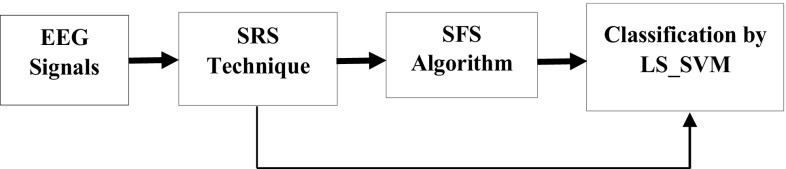
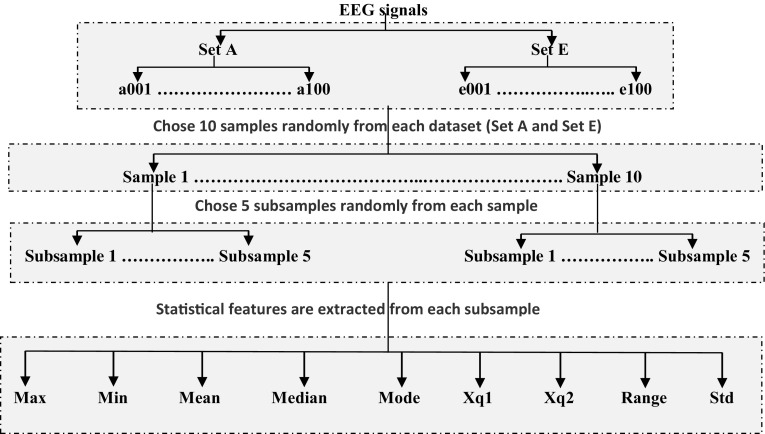
Electroencephalogram (EEG) signals are used broadly in the medical fields. The main applications of EEG signals are the diagnosis and treatment of diseases such as epilepsy, Alzheimer, sleep problems and so on. This paper presents a new method which extracts and selects features from multi-channel EEG signals. This research focuses on three main points. Firstly, simple random sampling (SRS) technique is used to extract features from the time domain of EEG signals. Secondly, the sequential feature selection (SFS) algorithm is applied to select the key features and to reduce the dimensionality of the data. Finally, the selected features are forwarded to a least square support vector machine (LS_SVM) classifier to classify the EEG signals. The LS_SVM classifier classified the features which are extracted and selected from the SRS and the SFS. The experimental results show that the method achieves 99.90, 99.80 and 100 % for classification accuracy, sensitivity and specificity, respectively.
Keywords: Electroencephalogram; Epileptic seizures; Least square support vector machine; Sequential feature selection; Simple random sampling.
Figures

References
-
- World Health Organization (WHO) (2011). Report: WHO. http://www.who.int/mediacentre/factssheets/fs999/en/index.html. Accessed Dec 2015
-
- Mcgrogan N (1999) Neural network detection of epileptic seizures in the electroencephalogram. http://www.new.ox.ac.uk/~nmcgroga/work/transfer
-
- Boer H, Engel J, Prilipko L (2005) Global campaign against epilepsy. Epilepsy Atlas 82–83
LinkOut - more resources
Full Text Sources
Other Literature Sources
