


Oxidative Stress in Female Athletes Using Combined Oral Contraceptives
- PMID: 27747795
- PMCID: PMC5031583
- DOI: 10.1186/s40798-016-0064-x
Oxidative Stress in Female Athletes Using Combined Oral Contraceptives
Abstract
Background: Oxidative stress in female athletes is understudied. We investigated oxidative stress in sportswomen of different disciplines according to combined oral contraceptive (OC) use and lifestyle/alimentary habits.
Methods: Italian sportswomen (n = 144; mean age 23.4 ± 4.2 years; body mass index 21.2 ± 2.2 kg m-2; sport activity 9.2 ± 4.1 h week-1) were analyzed; 48 % were volleyball players, 12.5 % soccer players, 10.4 % track-and-field sports, and followed by other disciplines' athletes. Oxidative stress was evaluated by free oxygen radical test (FORT) assessing blood hydroperoxides and free oxygen radical defense (FORD) assay evaluating antioxidant capacity in OC users (n = 42) compared to non-OC users.
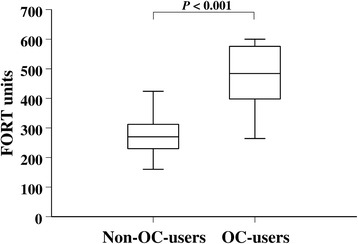
Results: Elevated oxidative stress levels (≥310 FORT units) were found in 92.9 % of OC users and in 23.5 % of non-OC users (crude OR = 42, 95 % CI 12-149, p < 0.001; adjusted OR = 60, 95 % CI 11-322, p < 0.001). Continuous values of hydroperoxides were twofold higher in OC users versus non-OC users (median 484 versus 270 FORT units, p < 0.001) and were inversely related to FORD units in OC users (p = 0.01). Hydroperoxides were not associated with weekly hours of exercise. In OC users, lifestyle/alimentary habits were not correlated to hydroperoxides. In non-OC users only, hydroperoxide values were positively correlated with weight and BMI and inversely correlated with chocolate and fish consumption.
Conclusions: The markedly elevated oxidative stress we revealed in OC-user athletes could be detrimental to physical activity and elevate cardiovascular risk (as thromboembolism). Further research is needed to extend our results, to clarify the biochemical pathways leading to increased hydroperoxides (mainly lipid peroxides) and reduced antioxidant defense, and to elucidate the potential effects on athletic performance. OC use should be considered when developing gender-focused strategies against oxidative stress.
Keywords: Alimentary habits; Antioxidant defense; Contraceptive pill; Desogestrel, Drospirenone, Cyproterone, Hormonal contraception; Estrogen; Free radicals; Lipid peroxidation; Physical activity; Progestin; Third generation pill.
Figures
References
-
- Kerksick C, Zuhl M. Mechanisms of oxidative damage and their impact on contracting muscle. In: Lamprecht M, editor. Antioxidants in sport nutrition. Bota Raton: CRC Press, Taylor & Francis; 2015. p. Chapter 1. - PubMed
LinkOut - more resources
Full Text Sources
Other Literature Sources
