


mTORC1 and mTORC2 in cancer and the tumor microenvironment
- PMID: 27748764
- PMCID: PMC5393956
- DOI: 10.1038/onc.2016.363
mTORC1 and mTORC2 in cancer and the tumor microenvironment
Abstract
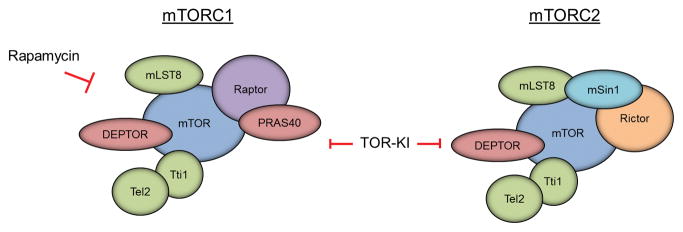
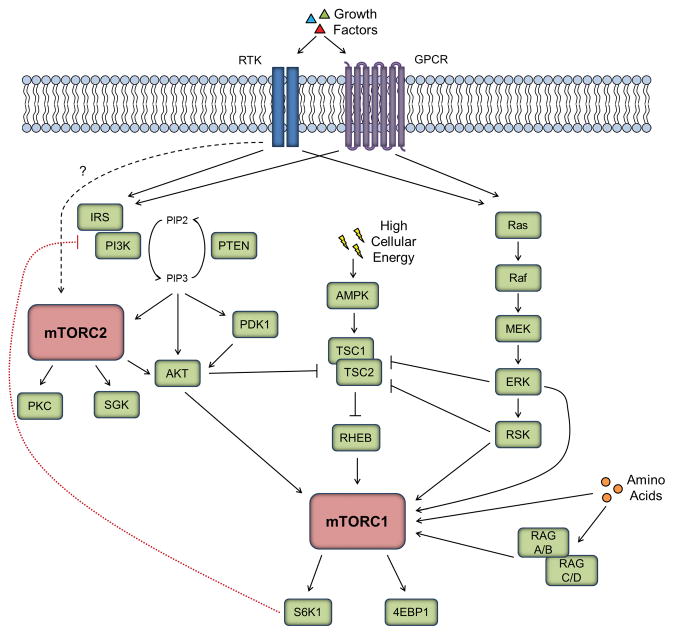
The mammalian target of rapamycin (mTOR) is a crucial signaling node that integrates environmental cues to regulate cell survival, proliferation and metabolism, and is often deregulated in human cancer. mTOR kinase acts in two functionally distinct complexes, mTOR complex 1 (mTORC1) and 2 (mTORC2), whose activities and substrate specificities are regulated by complex co-factors. Deregulation of this centralized signaling pathway has been associated with a variety of human diseases including diabetes, neurodegeneration and cancer. Although mTORC1 signaling has been extensively studied in cancer, recent discoveries indicate a subset of human cancers harboring amplifications in mTORC2-specific genes as the only actionable genomic alterations, suggesting a distinct role for mTORC2 in cancer as well. This review will summarize recent advances in dissecting the relative contributions of mTORC1 versus mTORC2 in cancer, their role in tumor-associated blood vessels and tumor immunity, and provide an update on mTOR inhibitors.
Conflict of interest statement
Figures
References
-
- Brown EJ, Albers MW, Bum Shin T, ichikawa K, Keith CT, Lane WS, et al. A mammalian protein targeted by G1-arresting rapamycin–receptor complex. Nature. 1994 Jun 30;369(6483):756–8. - PubMed
-
- Sabatini DM, Erdjument-Bromage H, Lui M, Tempst P, Snyder SH. RAFT1: A mammalian protein that binds to FKBP12 in a rapamycin-dependent fashion and is homologous to yeast TORs. Cell. 1994 Jul;78(1):35–43. - PubMed
-
- Hanahan D, Weinberg RA. Hallmarks of cancer: the next generation. Cell. 2011 Mar 4;144(5):646–74. - PubMed
-
- Sarbassov DD, Ali SM, Kim D-H, Guertin DA, Latek RR, Erdjument-Bromage H, et al. Rictor, a novel binding partner of mTOR, defines a rapamycin-insensitive and raptor-independent pathway that regulates the cytoskeleton. Curr Biol. 2004 Jul 27;14(14):1296–302. - PubMed
-
- Jacinto E, Loewith R, Schmidt A, Lin S, Rüegg MA, Hall A, et al. Mammalian TOR complex 2 controls the actin cytoskeleton and is rapamycin insensitive. Nat Cell Biol. 2004 Nov;6(11):1122–8. - PubMed
Publication types
MeSH terms
Substances
Grants and funding
LinkOut - more resources
Full Text Sources
Other Literature Sources
Miscellaneous
