. 2016 Nov;14(5):4659-4665.
doi: 10.3892/mmr.2016.5840. Epub 2016 Oct 12.

Protective effect of resveratrol on spermatozoa function in male infertility induced by excess weight and obesity

Affiliations

Protective effect of resveratrol on spermatozoa function in male infertility induced by excess weight and obesity

Xiangrong Cui et al. Mol Med Rep. 2016 Nov.

Abstract

Male infertility is a complex, multifactorial and polygenic disease that contributes to ~50% cases of infertility. Previous studies have demonstrated that excess weight and obesity factors serve an important role in the development of male infertility. An increasing number of studies have reported that resveratrol may regulate the response of cells to specific stimuli that induce cell injury, as well as decrease germ cell apoptosis in mice or rats. In the present study, the semen quality and serum sex hormone levels were evaluated in 324 men, which included 73 underweight, 82 normal weight, 95 overweight and 74 obese men. All patients were referred to The Reproductive Medicine Center of Shanxi Women and Infants Hospital (Taiyuan, China) between January 2013 and January 2015. The aim of the present study was to investigate the effects of resveratrol treatment on the motility, plasma zinc concentration and acrosin activity of sperm from obese males. The sperm concentration, normal sperm morphology, semen volumes, DNA fragmentation rates and testosterone levels in men from the overweight and obese groups were markedly decreased when compared with men in the normal weight group. In addition, the progressive motility, seminal plasma zinc concentration and spermatozoa acrosin activity were notably decreased in the obese group compared with the normal weight group. However, estradiol levels were significantly increased in the overweight, obese and underweight groups compared with the normal weight group. Notably, semen samples from obese males with astenospermia treated with 0‑100 µmol/l resveratrol for 30 min demonstrated varying degrees of improvement in sperm motility. When these semen samples were treated with 30 µmol/l resveratrol, sperm motility improved when compared to other doses of resveratrol. Therefore, 30 µmol/l resveratrol was selected for further experiments. Upon treatment of semen samples with resveratrol (30 µmol/l) for 30 min, the seminal plasma zinc concentration and spermatozoa acrosin activity increased significantly in the experimental group compared with the control group. These data suggest that male obesity negatively impacts on male reproductive potential, not only through altering hormone levels, but also by directly altering sperm function. In addition, resveratrol may have a therapeutic and protective effect against obesity-induced abnormalities in semen.


Figures
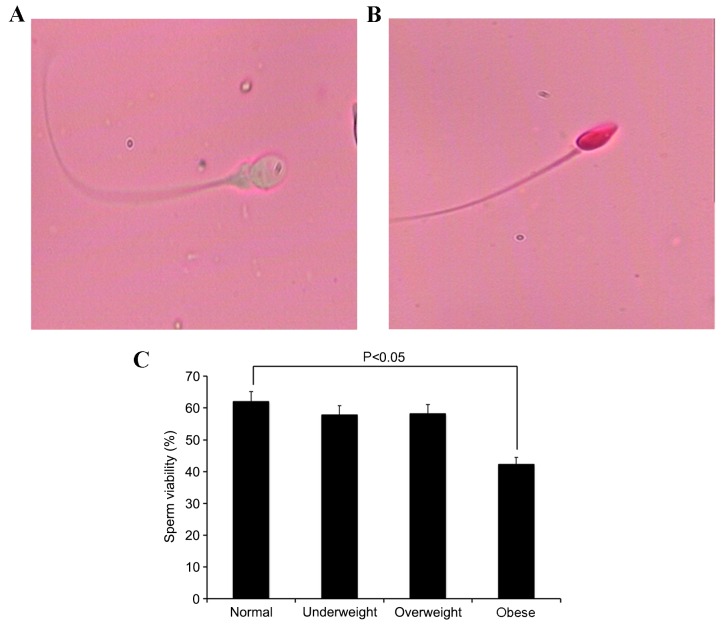
Figure 1.
Figure 1.
Comparison of sperm viability among BMI groups. Sperm viability was analyzed by eosin Y staining. Microscope images (magnification, ×20) of (A) viable sperm (unstained sperm head) and (B) non-viable sperm (stained sperm head). (C) The obese group demonstrated a significant decrease in the number of viable sperm (P<0.05).
Figure 2.
Figure 2.
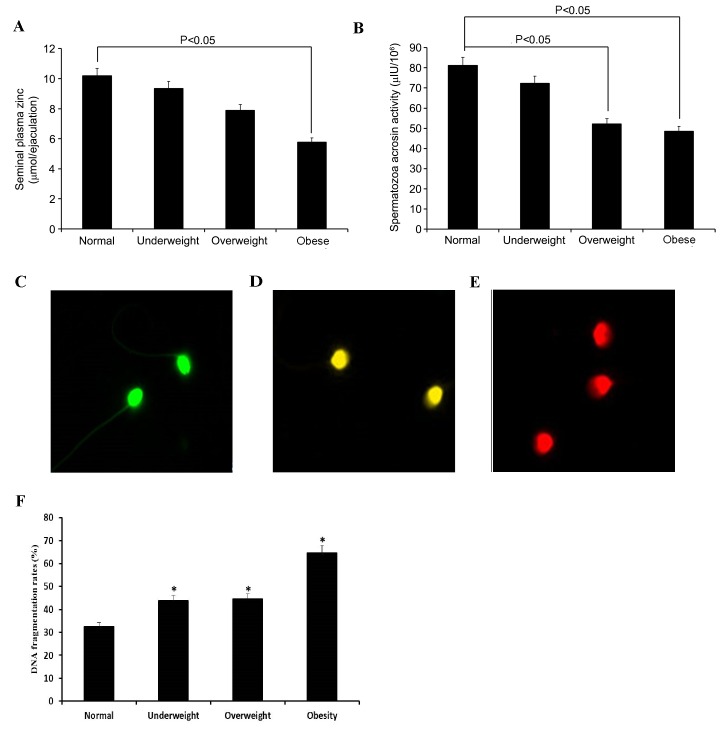
Plasma zinc concentration, spermatozoa acrosin activity and DNA fragmentation rates among BMI groups. (A) The seminal plasma zinc concentration was significantly reduced in the obese group compared with normal weight group (P=0.018). (B) The overweight and obese groups demonstrated a significant decrease in spermatozoa acrosin activity compared with the normal weight group (P=0.031 and P=0.021, respectively). Representative fluorescence images of spermatozoa with (C) normal DNA integrity, and (D and E) abnormal DNA integrity are shown. DNA fragmentation rates were analyzed using acridine orange staining. (F) Spermatozoa from the underweight, overweight and obese groups demonstrated a significant increase in DNA fragmentation rates compared with those of the normal weight group (P=0.039, P=0.042, P=0.026, respectively). *P<0.05 vs. the normal weight group.
Figure 3.
Figure 3.
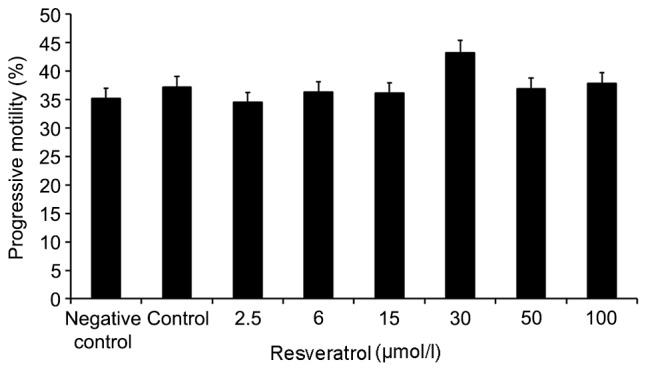
Alterations in the progressive motility of sperm treated with increasing concentrations of resveratrol. Semen samples from obese patients with astenospermia (60 cases) were treated with 0–100 µmol/l resveratrol for 30 min, and sperm motility was altered to varying degrees. Exposure to 30 µmol/l resveratrol demonstrated the most notable improvement in progressive motility compared with control and negative control samples. The control and negative control groups were treated with Quinn's Advantage™ Fertilization (HTF) Medium and Quinn's Advantage™ Fertilization (HTF) Medium plus 0.1% dimethyl sulfoxide, respectively.
Figure 4.
Figure 4.
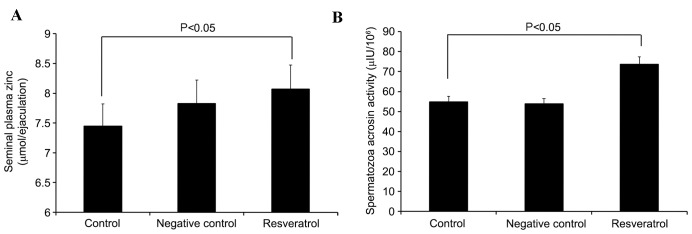
Effect of resveratrol on the plasma zinc concentration and spermatozoa acrosin activity. The resveratrol group exhibited a significant increase in (A) seminal plasma zinc concentrations and (B) spermatozoa acrosin activity when compared with the control group (P=0.023 and P=0.031, respectively).

References

    1. Drobnis EZ, Johnson M. The question of sperm DNA fragmentation testing in the male infertility work-up: A response to Professor Lewis' commentary. Reprod Biomed Online. 2015;31:138–139. doi: 10.1016/j.rbmo.2015.05.004. - DOI - PubMed
    1. Whitfield M, Pollet-Villard X, Levy R, Drevet JR, Saez F. Posttesticular sperm maturation, infertility, and hypercholesterolemia. Asian J Androl. 2015;17:742–748. - PMC - PubMed
    1. Hammoud AO, Wilde N, Gibson M, Parks A, Carell DT, Meikle AW. Male obesity and alteration in sperm parameters. Fertil Steril. 2008;90:2222–2225. doi: 10.1016/j.fertnstert.2007.10.011. - DOI - PubMed
    1. Ring JD, Lwin AA, Köhler TS. Current medical management of endocrine-related male infertility. Asian J Androl. 2016;18:357–363. doi: 10.4103/1008-682X.179252. - DOI - PMC - PubMed
    1. Cissen M, Bensdorp A, Cohlen BJ, Repping S, de Bruin JP, van Wely M. Assisted reproductive technologies for male subfertility. Cochrane Database Syst Rev. 2016;2:CD000360. - PMC - PubMed