


Portable Myoelectric Brace Use Increases Upper Extremity Recovery and Participation But Does Not Impact Kinematics in Chronic, Poststroke Hemiparesis
- PMID: 27749154
- PMCID: PMC5470353
- DOI: 10.1080/00222895.2016.1152220
Portable Myoelectric Brace Use Increases Upper Extremity Recovery and Participation But Does Not Impact Kinematics in Chronic, Poststroke Hemiparesis
Abstract
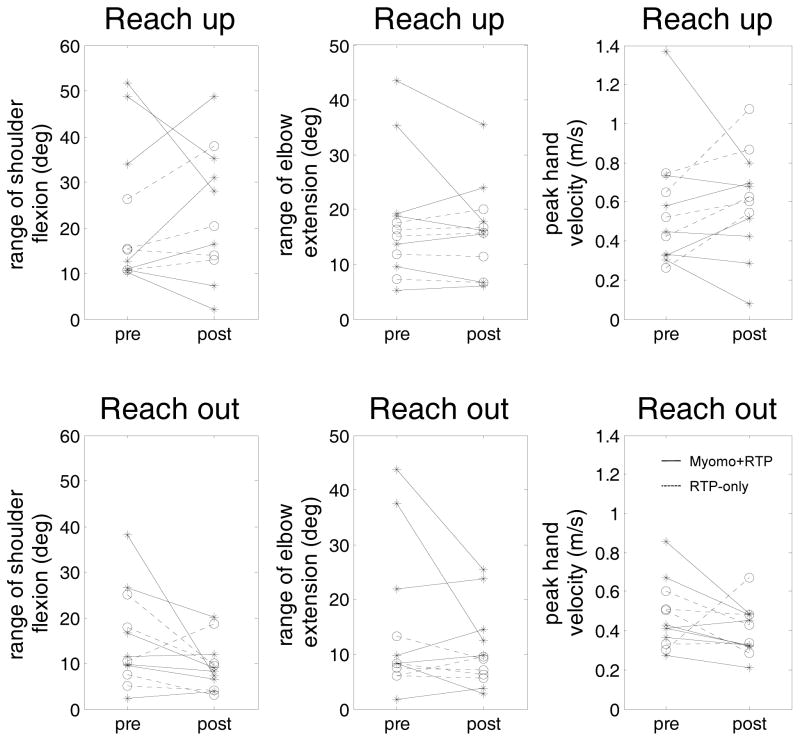
The authors examined the efficacy of an 8-week regimen combining repetitive task-specific practice (RTP) with a myoelectric brace (RTP+Myomo) on paretic upper extremity (UE; use in valued activities, perceived recovery, and reaching kinematics) in 12 subjects (4 men; M age = 53.5 years; mean time poststroke = 61.7 months). Seven subjects were administered RTP+Myomo therapy, and 5 were administered RTP only. Both groups participated in individualized, 45-min therapy sessions occurring 3 days/week over an 8-week period. The arm, hand ability, activities of daily living, and perceptions of recovery subscales of the Stroke Impact Scale (SIS), as well as UE reaching kinematics, assessed before and after the intervention. Subjects in the RTP+Myomo group showed greater improvements on all SIS subscales, with the recovery scale reaching statistical significance (p = .03). Subjects in the RTP-only group showed a greater increase in hand velocity in the reach up task (p = .02), but no changes were observed in the range of shoulder flexion or elbow extension during reaching. None of the changes in kinematic outcome measures significantly correlated with any of the changes in SIS subscales. RTP integrating myoelectric bracing may be more beneficial than RTP only in improving self-reported function and perceptions of overall recovery. The authors observed no changes in the range of elbow extension, and no relationship between self-reported improvements and changes in reaching kinematics.
Keywords: hemiplegia; kinematics; neurorehabilitation; stroke.
Figures
References
-
- Gresham G, Fitzpatrick T, Wolf P, McNamara P, Kannel W, Dawber T. Residual disability in survivors of stroke--the Framingham study. N Engl J Med. 1975;293:954–956. - PubMed
-
- Kelly-Hayes M, Beiser A, Kase CS, Scaramucci A, D’Agostino RB, Wolf PA. The influence of gender and age on disability following ischemic stroke: The Framingham study. J Stroke Cerebrovasc Dis. 2003;12:119–126. - PubMed
-
- Wolf SL, Winstein CJ, Miller JP, Taub E, Uswatte G, Morris D, Giuliani C, Light KE, Nichols-Larsen D EXCITE Investigators. Effect of constraint-induced movement therapy on upper extremity function 3 to 9 months after stroke: the EXCITE randomized clinical trial. JAMA. 2006 Nov 1;296(17):2095–104. - PubMed
-
- Page SJ, Levine P, Leonard A. Mental practice in chronic stroke: Results of a randomized, placebo controlled trial. Stroke. 2007 Apr;38(4):1293–7. - PubMed
-
- Page SJ, Levine P, Leonard AC, Szaflarski J, Kissela B. Modified constraint-induced therapy in stroke: Results of a single blinded, randomized controlled trial. Phys Ther. 2008;88(3):333–40. - PubMed
Publication types
MeSH terms
Grants and funding
LinkOut - more resources
Full Text Sources
Other Literature Sources
Medical