


Greatest Challenges of Rectal Cancer Survivors: Results of a Population-Based Survey
- PMID: 27749476
- PMCID: PMC5226258
- DOI: 10.1097/DCR.0000000000000695
Greatest Challenges of Rectal Cancer Survivors: Results of a Population-Based Survey
Abstract
Background: Eliciting the priorities of cancer survivors is essential to address the specific needs of cancer survivor subgroups.
Objective: The purpose of this study was to describe the greatest challenges related to treatment for long-term rectal cancer survivors.
Design: This was an observational study with a cross-sectional survey.
Settings: The study included members of Kaiser Permanente Northern California and Northwest health plans.
Patients: A survey was mailed to long-term (≥5 years postdiagnosis) survivors of rectal cancer who had an anastomosis, temporary ostomy, or permanent ostomy.
Main outcome measures: The main outcome was measured with an open-ended question about the greatest challenge related to cancer surgery. We categorized responses using a grounded theory approach with double coding for reliability. Bonferroni-adjusted χ values were used to assess differences in the proportions of subgroups who mentioned challenges within each response category.
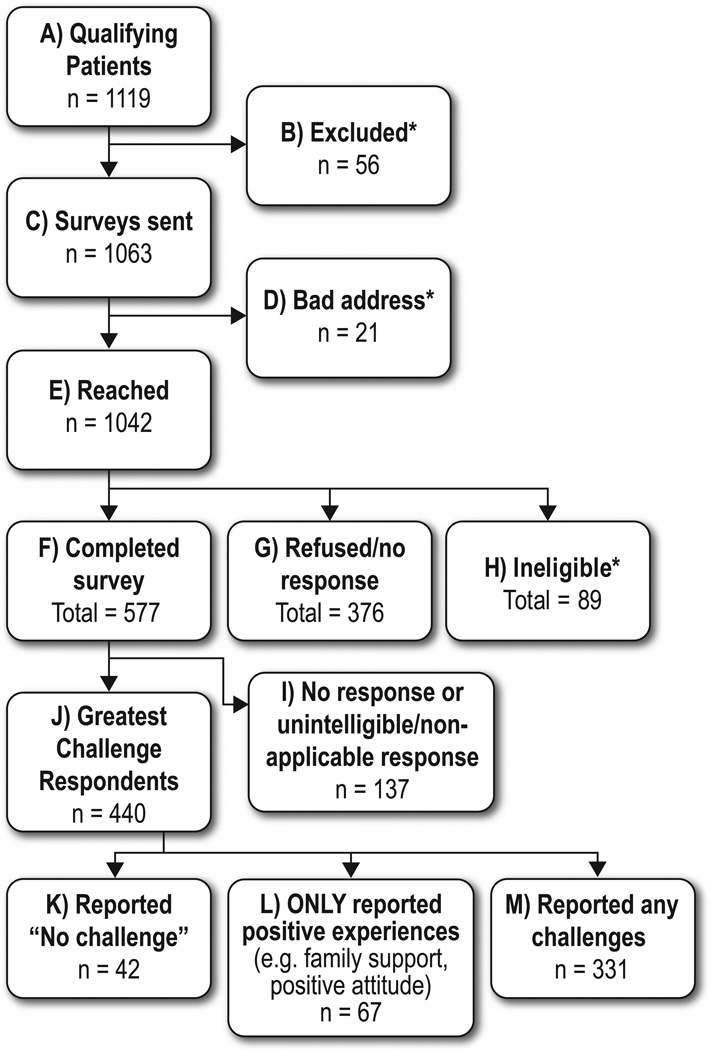
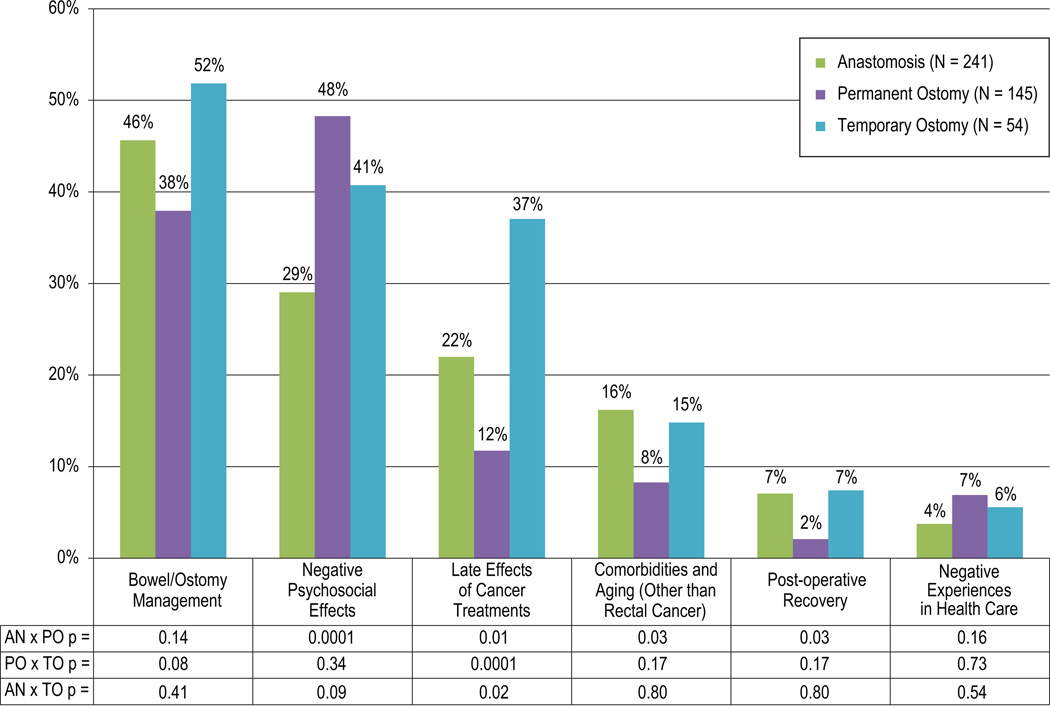
Results: The survey completion rate was 61% (577/953); 76% (440/577) of participants responded to the greatest challenge question. The greatest challenges for respondents were bowel/ostomy management (reported by 44%), negative psychosocial effects (37%), late effects of treatment (21%), comorbidities and aging (13%), postoperative recovery (5%), and negative healthcare experiences (5%). Survivors with temporary ostomy or anastomosis were more likely than survivors with permanent ostomy to report late effects (p < 0.0001 and p = 0.01). Survivors with anastomosis were less likely than survivors with permanent ostomy to report negative psychosocial impacts (p = 0.0001).
Limitations: Generalizability is restricted by the lack of ethnically and racially diverse, uninsured (non-Medicare-eligible population), and non-English-speaking participants. Because the survey was cross-sectional and included respondents at different times since diagnosis, we could not adequately address changes in the greatest challenges over time.
Conclusions: Our results reveal the need for bowel/ostomy management, psychosocial services, and surveillance for late effects in survivorship and supportive care services for all survivors of rectal cancer, regardless of ostomy status. The perspective of long-term survivors with anastomosis reveals challenges that may not be anticipated during decision making for treatment (see Video, Supplemental Digital Content 1, http://links.lww.com/DCR/A254).
Conflict of interest statement
The other authors have no conflicts of interest to disclose.
Figures
References
-
- DeSantis CE, Lin CC, Mariotto AB, et al. Cancer treatment and survivorship statistics, 2014. CA Cancer J Clin. 2014;64(4):252–271. - PubMed
-
- National Cancer Institute. [Accessed 2006];SEER Cancer Statistics Review, 1975–2003. http://seer.cancer.gov/csr/1975_2003.
-
- Burg MA, Adorno G, Lopez ED, et al. Current unmet needs of cancer survivors: Analysis of open-ended responses to the American Cancer Society Study of Cancer Survivors II. Cancer. 2015;121(4):623–630. - PubMed
-
- Downing A, Morris EJ, Richards M, et al. Health-Related Quality of Life After Colorectal Cancer in England: A Patient-Reported Outcomes Study of Individuals 12 to 36 Months After Diagnosis. J Clin Oncol. 2015;33(6):616–624. - PubMed
Publication types
MeSH terms
Grants and funding
LinkOut - more resources
Full Text Sources
Other Literature Sources
Medical
