


A case report of biotin-thiamine-responsive basal ganglia disease in a Saudi child: Is extended genetic family study recommended?
- PMID: 27749535
- PMCID: PMC5059037
- DOI: 10.1097/MD.0000000000004819
A case report of biotin-thiamine-responsive basal ganglia disease in a Saudi child: Is extended genetic family study recommended?
Abstract
Background: Biotin-thiamine-responsive basal ganglia disease (BTRBGD) is a neurometabolic autosomal recessive (AR) disorder characterized by subacute encephalopathy with confusion, convulsions, dysarthria, and dystonia. The disease is completely reversible if treated early with biotin and thiamine, and can be fatal if left untreated.We herein present our experience with in an extended family study of an index case of BTRBGD aiming to support its AR mode of inheritance, diagnose asymptomatic and missed symptomatic cases, and provide family screening with proper genetic counseling.
Methods: An index case of BTRBGD and his family underwent thorough clinical and radiological assessment along with genetic molecular testing.
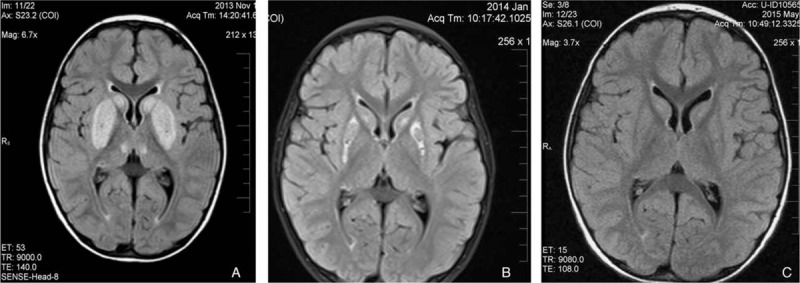
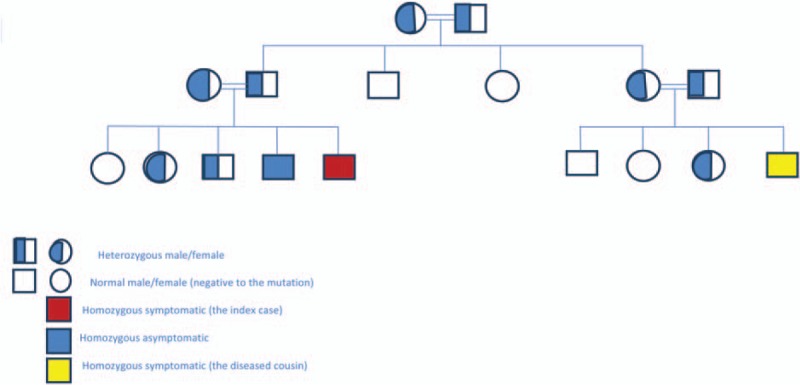
Results: Two-and-half years old Saudi male child whose parents are consanguineous fulfilled the clinical and magnetic resonance imaging (MRI) criteria of BTRBGD. He was proved by molecular genetic testing to have homozygous mutation of c.1264A>G (p.Thr422Ala) in the SLC19A3 gene of BTRBGD. Extended clinical, radiological, and genetic family study revealed 2 affected members: a neglected symptomatic cousin with subtle neurological affection and an asymptomatic brother carrying the disease mutation in homozygous status. Heterozygous pattern was detected in his parents, his grandma and grandpa, his aunt and her husband, 2 siblings, and 1 cousin while 1 sibling and 2 cousins were negative to this mutation.Treatment of the patient and his diseased cousin with biotin and thiamine was initiated with gradual improvement of symptoms within few days. Treatment of his asymptomatic brother was also initiated.
Conclusion: BTRBGD requires high index of suspicion in any child presenting with unexplained subacute encephalopathy, abnormal movement, and characteristic MRI findings. Extended family study is crucial to diagnose asymptomatic diseased cases and those with subtle neurological symptoms.
Conflict of interest statement
The authors have no funding and conflicts of interest to disclose.
Figures
References
-
- Ozand PT, Gascon GG, Al Essa M, et al. Biotin-responsive basal ganglia disease: a novel entity. Brain 1998; 121:1267–1279. - PubMed
-
- Perez-Duenas B, Serrano M, Rebollo M, et al. Reversible lactic acidosis in a newborn with thiamine transporter-2 deficiency. Pediatrics 2013; 131:e1670–e1675. - PubMed
-
- Kono S, Miyajima H, Yoshida K, et al. Mutations in a thiamine-transporter gene and Wernicke's-like encephalopathy. N Engl J Med 2009; 360:1792–1794. - PubMed
Publication types
MeSH terms
Substances
Supplementary concepts
LinkOut - more resources
Full Text Sources
Other Literature Sources
Research Materials
