


Meta Analysis of Etiology and its Clinical and Radiological Correlation in Cases of Craniomaxillofacial Trauma
- PMID: 27752203
- PMCID: PMC5048330
- DOI: 10.1007/s12663-015-0862-6
Meta Analysis of Etiology and its Clinical and Radiological Correlation in Cases of Craniomaxillofacial Trauma
Abstract
Aim: The present study was planned to investigate the etiology of injuries and to analyze correlation between clinical and radiological findings in cases of craniomaxillofacial trauma.
Study design: An 18 months cross-sectional study was done and 325 patients with maxillofacial fractures were analyzed from January 2013 to June 2014 who reported to the department of oral and maxillofacial surgery, Aligarh, Uttar Pradesh. Data was recorded in a preformed case sheet which included: patient's demographic data, cause of injury, type of injury, treatment plan.
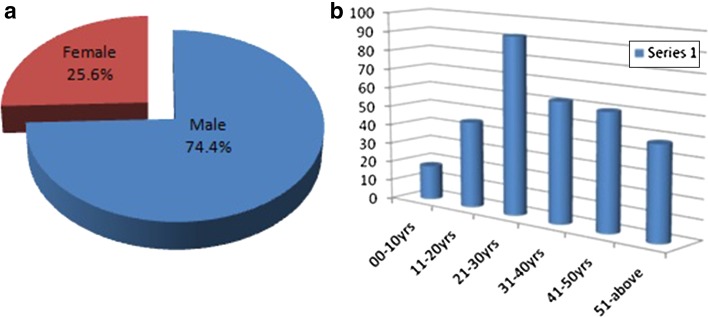
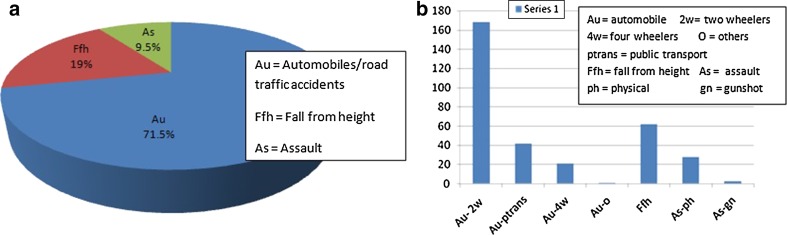
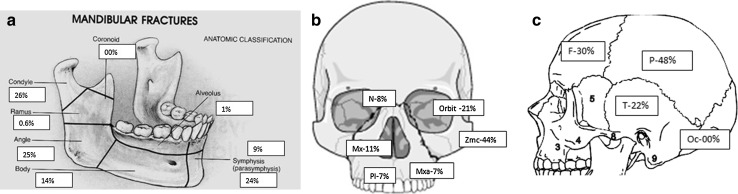
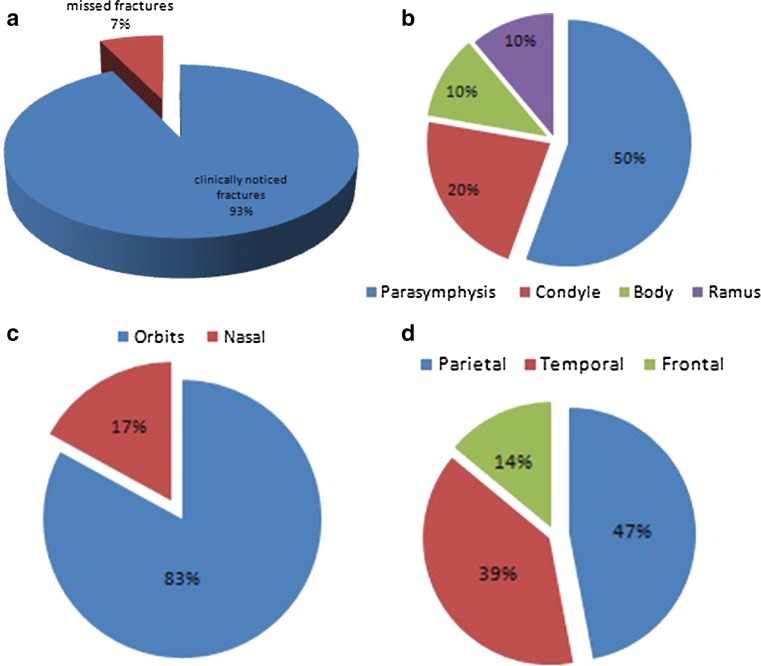
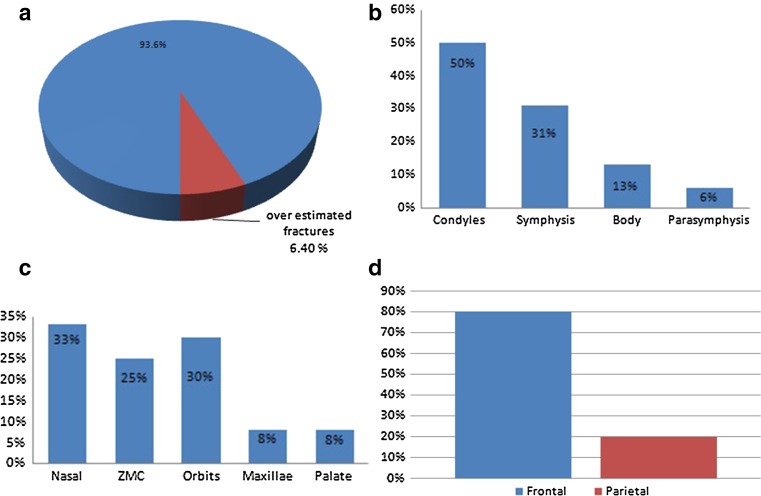
Results: Out of the 325 patients, 74.4 % were males with a male: female ratio of 2.91:1. The 21-30 year age group was found to be maximum. Road traffic accidents accounted for 71.3 %, followed by fall from height (19 %) and assault (9.5 %). Most commonly involved vehicles were two wheelers followed by public transport. Mandibular fractures (65 %) were most prevalent, followed by zygomaticomaxillary complex (44.27 %), parietal bone (48 %) and orbital fractures (21.3 %). Thirty-seven fractures (7.14 %) were missed clinically which were confirmed later by radiographic technique. Maximum were in cranium region (57 %) followed by mandible (27 %), mid face region (16.21 %). Thirty-three fractures (6.37 %) were overestimated or suspected clinically which could not be confirmed by radiographic technique. Maximum were in mandible (48.5 %) followed by mid face (36.33 %) and cranium (15.15 %).
Conclusion: The idea behind this article is to analyze the various trends and affecting factors and correlation between clinical and radiological findings. A better understanding of the above said would help in future treatment planning and management of facial injuries.
Keywords: Assault; Clinical diagnosis; Craniomaxillofacial trauma; Meta analysis; RTA; Sensitivity; Specificity.
Figures
Similar articles
-
Study of the pattern of maxillofacial fractures seen at a tertiary care hospital in north India.J Maxillofac Oral Surg. 2015 Mar;14(1):32-9. doi: 10.1007/s12663-013-0578-4. Epub 2013 Sep 4. J Maxillofac Oral Surg. 2015. PMID: 25729224 Free PMC article.
-
Patterns of maxillofacial fractures in goa.J Maxillofac Oral Surg. 2015 Jun;14(2):138-41. doi: 10.1007/s12663-013-0583-7. Epub 2013 Oct 1. J Maxillofac Oral Surg. 2015. PMID: 26028827 Free PMC article. Review.
-
Emerging Trends of Zygomaticomaxillary Complex Fractures and Their Etiological Analysis in a Tertiary Health Centre from Eastern India: A Retrospective Study.J Maxillofac Oral Surg. 2021 Mar;20(1):70-75. doi: 10.1007/s12663-019-01295-w. Epub 2019 Oct 5. J Maxillofac Oral Surg. 2021. PMID: 33584045 Free PMC article.
-
Single Institute Audit of Maxillofacial Trauma Cases Before and During COVID-19 Pandemic.Craniomaxillofac Trauma Reconstr. 2023 Jun;16(2):102-111. doi: 10.1177/19433875211064514. Epub 2022 Apr 20. Craniomaxillofac Trauma Reconstr. 2023. PMID: 37222976 Free PMC article.
-
Craniomaxillofacial trauma in children: a review of 3,385 cases with 6,060 injuries in 10 years.J Oral Maxillofac Surg. 2004 Apr;62(4):399-407. doi: 10.1016/j.joms.2003.05.013. J Oral Maxillofac Surg. 2004. PMID: 15085503 Review.
Cited by
-
Incidence, Aetiology, and Associated Fracture Patterns of Infraorbital Nerve Injuries Following Zygomaticomaxillary Complex Fractures: A Retrospective Analysis of 272 Patients.Craniomaxillofac Trauma Reconstr. 2022 Jun;15(2):139-146. doi: 10.1177/19433875211022569. Epub 2021 Jun 17. Craniomaxillofac Trauma Reconstr. 2022. PMID: 35633769 Free PMC article.
References
-
- Alvi A, Dohert T, Lewen G. Facial fractures and concomitant injuries in trauma patients. Laryngoscope. 2003;113:102–106. - PubMed
-
- Ellis E, Moos KF, EL-Attar A. Ten years of mandibular fractures. An analysis of 2137 cases. Oral Surg. 1985;59:120–129. - PubMed
-
- Adebayo, et al. The pattern of fractures of facial skeleton in Kaduna, Nigeria. Oral Surg Oral Med Oral Path. 1980;49:491–495. - PubMed
-
- Mayer D. Essential evidence based medicine. Cambridge: Cambridge University Press; 2004.
LinkOut - more resources
Full Text Sources
Other Literature Sources