Admission rates for emergency department patients with venous thromboembolism and estimation of the proportion of low risk pulmonary embolism patients: a US perspective
- PMID: 27752630
- PMCID: PMC5065336
- DOI: 10.15441/ceem.15.096
Admission rates for emergency department patients with venous thromboembolism and estimation of the proportion of low risk pulmonary embolism patients: a US perspective
Abstract
Objective: Introduction of target specific anticoagulants and recent guidelines encourage outpatient management of low risk patients with venous thromboembolism. We describe hospital admission rates over time for patients presenting to US emergency departments (EDs) with deep vein thrombosis (DVT) and pulmonary embolism (PE) and estimate the proportion of low-risk PE patients who could potentially be managed as outpatients.
Methods: We performed a structured analysis of the National Hospital Ambulatory Medical Care Survey (a nationally representative weighted sampling of US ED visits) database for the years 2006-2010 including all adult patients with a primary diagnosis of DVT or PE. Simplified pulmonary embolus scoring index (sPESI) scores were determined in patients with PE to identify low risk patients.
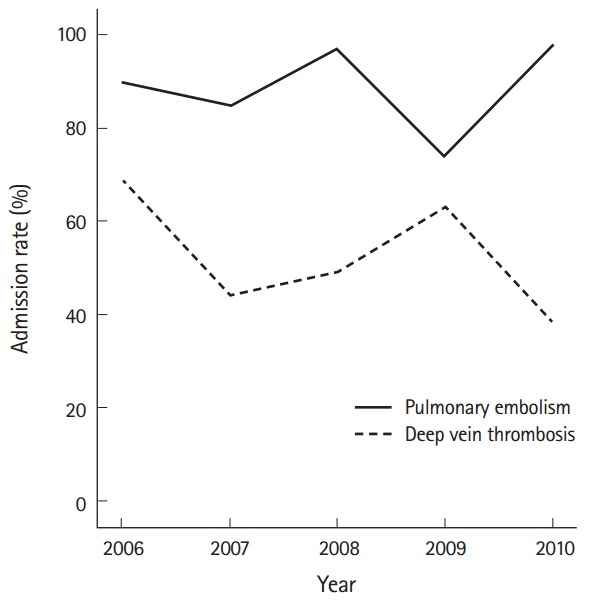
Results: There were an estimated 652,000 and 394,000 ED visits for DVT and PE over the 5-year period (0.17%). Mean (SE) age was 59 (1.3), 50% were female, and 40% were > 65 years. Admission rates for DVT and PE were 52% and 90% respectively with no significant changes over time. In patients with DVT, predictors for admission were age (odds ratio, 1.03 per year of age [95% confidence interval, 1.01 to 1.05]) and race (odds ratio, 4.1 [95% confidence interval, 0.9 to 19.8] for Hispanics and 2.9 [1.2 to 7.4] for Blacks). Of all ED patients with PE, 51% were low risk based on sPESI scores.
Conclusion: Admission rates for DVT and PE have remained high and unchanged, especially with PE, minorities, and in older patients. Based on sPESI scores, up to half of PE patients might be eligible for early discharge or outpatient therapy.
Keywords: Emergency service, hospital; Low-risk; Outpatients; Pulmonary embolism; Simplified pulmonary embolus scoring index score.
Conflict of interest statement
No potential conflict of interest relevant to this article was reported.
Figures
References
-
- Centers for Disease Control and Prevention Venous thromboembolism in adult hospitalizations: United States, 2007-2009. MMWR Morb Mortal Wkly Rep. 2012;61:401–4. - PubMed
-
- Stein PD, Matta F. Epidemiology and incidence: the scope of the problem and risk factors for development of venous thromboembolism. Clin Chest Med. 2010;31:611–28. - PubMed
-
- Murphy SL, Kochanek KD, Xu J, Heron M. Deaths: final data for 2012 [Internet] Atlanta, GA: Centers for Disease Control and Prevention; 2015. [cited 2016 Feb 1]. Available from: http://www.cdc.gov/nchs/data/nvsr/nvsr63/nvsr63_09.pdf. - PubMed
-
- Office of the Surgeon General . The Surgeon General’s call to action to prevent deep vein thrombosis and pulmonary embolism [Internet] Bethesda, MD: National Center for Biotechnology Information; 2008. [cited 2016 Feb 1]. Available from: http://www.ncbi.nlm.nih.gov/books/NBK44178/ - PubMed
LinkOut - more resources
Full Text Sources
Other Literature Sources