


Early childhood caries among 5- to 6-year-old children in Southeast Asia
- PMID: 27753083
- PMCID: PMC5396273
- DOI: 10.1111/idj.12261
Early childhood caries among 5- to 6-year-old children in Southeast Asia
Abstract
Objective: The aim of this study was to examine the prevalence and experience of early childhood caries among 5- to 6-year-old children in Southeast Asia.
Methods: A literature search was conducted of three electronic databases (PubMed, EMBASE and ISI Web of Science) to identify publications from the years 2006 to 2015. Additional hand searches of government reports and national studies were performed. Both primary and secondary data sources were included in the study. The inclusion criterion was the findings reported on the caries prevalence and/or caries experience in decayed, missing or filled tooth (dmft) or decayed, missing or filled surface (dmfs) scores of 5- to 6-year-old children in Southeast Asian countries. The papers retrieved were assessed by two independent reviewers, and the final decision was made by consensus.
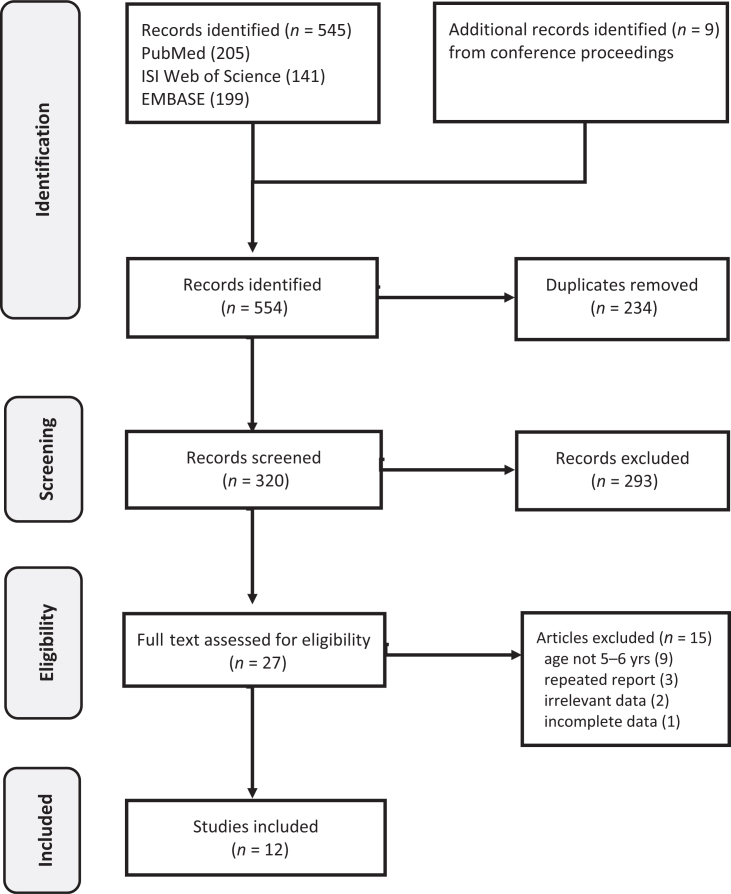
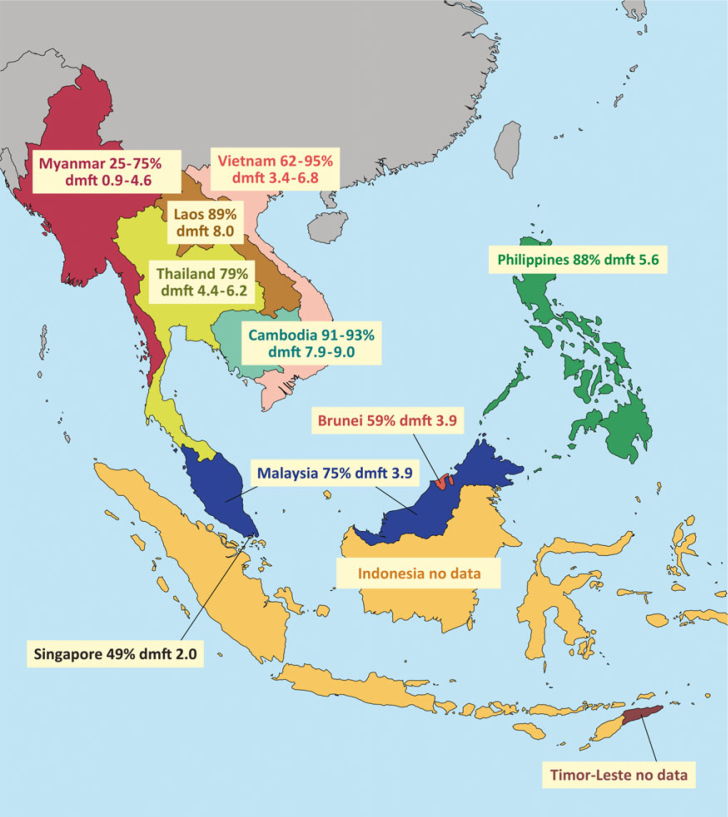
Results: The search identified 320 papers for screening; 293 were excluded and 27 full papers were retrieved and reviewed. Of those, 12 were included. Among the countries, variations were found in caries prevalence and caries experience. The caries prevalence of 5- to 6-year-old children ranged from 25% to 95%, and the caries experience (given as mean dmft score) ranged from 0.9 to 9.0. The median caries prevalence and caries experience (mean dmft score) of children 5-6 years of age were 79% and 5.1, respectively.
Conclusion: Based on the included studies, which are limited in quality and quantity, there is evidence that caries prevalence and experience are high amongst preschool children in Southeast Asia.
Keywords: Dental caries; Southeast Asia; preschool children; primary teeth.
© 2016 The Authors. International Dental Journal published by John Wiley & Sons Ltd on behalf of World Dental Federation.
Figures
References
-
- Schwendicke F, Dorfer CE, Schlattmann P, et al. Socioeconomic inequality and caries: a systematic review and meta-analysis. J Dent Res. 2015;94:10–18. - PubMed
-
- Edelstein BL. Solving the problem of early childhood caries: a challenge for us all. Arch Pediatr Adolesc Med. 2009;163:667–668. - PubMed
-
- Wong HM, McGrath CP, King NM, et al. Oral health-related quality of life in Hong Kong preschool children. Caries Res. 2011;45:370–376. - PubMed
-
- Chu CH. Treatment of early childhood caries: a review and case report. Gen Dent. 2000;48:142–148. - PubMed
MeSH terms
LinkOut - more resources
Full Text Sources
Other Literature Sources
Medical
