


Clinical and demographic characteristics related to onset site and spread of cervical dystonia
- PMID: 27753188
- PMCID: PMC5154862
- DOI: 10.1002/mds.26817
Clinical and demographic characteristics related to onset site and spread of cervical dystonia
Abstract
Background: Clinical characteristics of isolated idiopathic cervical dystonia such as onset site and spread to and from additional body regions have been addressed in single-site studies with limited data and incomplete or variable dissociation of focal and segmental subtypes. The objectives of this study were to characterize the clinical characteristics and demographics of isolated idiopathic cervical dystonia in the largest standardized multicenter cohort.
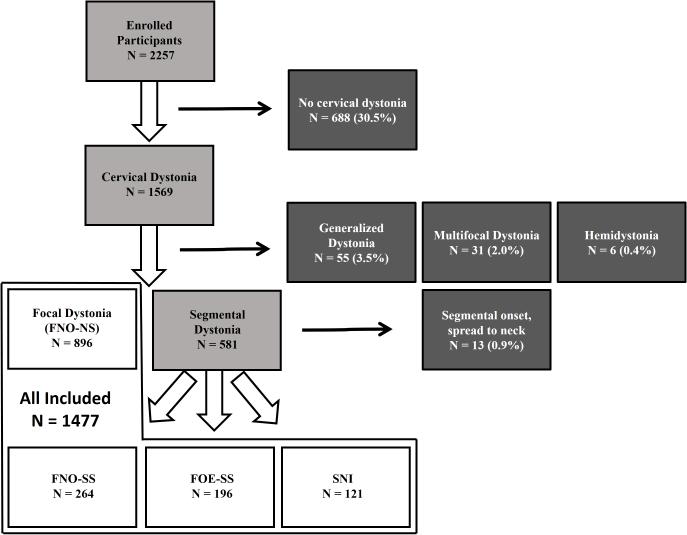
Methods: The Dystonia Coalition, through a consortium of 37 recruiting sites in North America, Europe, and Australia, recruited 1477 participants with focal (60.7%) or segmental (39.3%) cervical dystonia on examination. Clinical and demographic characteristics were evaluated in terms of the body region of dystonia onset and spread.
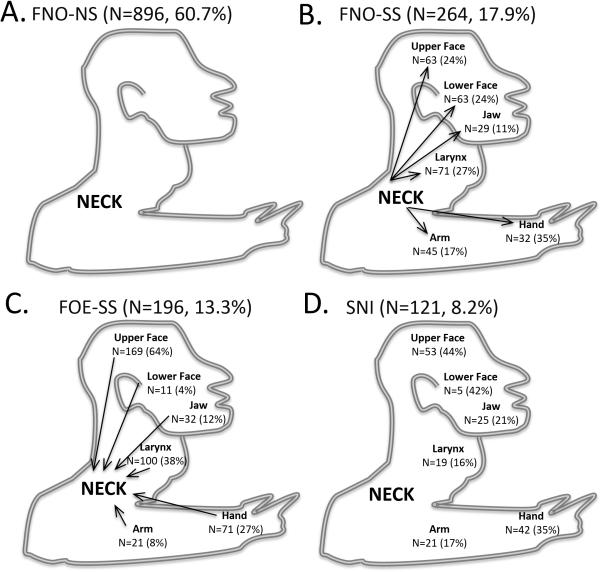
Results: Site of dystonia onset was: (1) focal neck only (78.5%), (2) focal onset elsewhere with later segmental spread to neck (13.3%), and (3) segmental onset with initial neck involvement (8.2%). Frequency of spread from focal cervical to segmental dystonia (22.8%) was consistent with prior reports, but frequency of segmental onset with initial neck involvement was substantially higher than the 3% previously reported. Cervical dystonia with focal neck onset, more than other subtypes, was associated with spread and tremor of any type. Sensory tricks were less frequent in cervical dystonia with segmental components, and segmental cervical onset occurred at an older age.
Conclusions: Subgroups had modest but significant differences in the clinical characteristics that may represent different clinical entities or pathophysiologic subtypes. These findings are critical for design and implementation of studies to describe, treat, or modify disease progression in idiopathic isolated cervical dystonia. © 2016 International Parkinson and Movement Disorder Society.
Keywords: focal; geste antagoniste; neck; segmental; spasmodic torticollis.
© 2016 International Parkinson and Movement Disorder Society.
Figures
References
Publication types
MeSH terms
Grants and funding
- KL2 TR001080/TR/NCATS NIH HHS/United States
- R01 NS075321/NS/NINDS NIH HHS/United States
- R01 MH102224/MH/NIMH NIH HHS/United States
- UL1 TR001082/TR/NCATS NIH HHS/United States
- R01 NS058714/NS/NINDS NIH HHS/United States
- KL2 TR001448/TR/NCATS NIH HHS/United States
- RF1 NS075321/NS/NINDS NIH HHS/United States
- L30 NS089426/NS/NINDS NIH HHS/United States
- K23 MH092735/MH/NIMH NIH HHS/United States
- R01 NS041509/NS/NINDS NIH HHS/United States
- U54 TR001456/TR/NCATS NIH HHS/United States
- R01 DK103691/DK/NIDDK NIH HHS/United States
- U54 NS065701/NS/NINDS NIH HHS/United States
- WT_/Wellcome Trust/United Kingdom
- R01 NS074343/NS/NINDS NIH HHS/United States
