. 2016 Oct 19;15(1):177.
doi: 10.1186/s12934-016-0576-6.

BcsZ inhibits biofilm phenotypes and promotes virulence by blocking cellulose production in Salmonella enterica serovar Typhimurium

Affiliations

BcsZ inhibits biofilm phenotypes and promotes virulence by blocking cellulose production in Salmonella enterica serovar Typhimurium

Irfan Ahmad et al. Microb Cell Fact. .

Abstract

Background: Cellulose, a 1,4 beta-glucan polysaccharide, is produced by a variety of organisms including bacteria. Although the production of cellulose has a high biological, ecological and economical impact, regulatory mechanisms of cellulose biosynthesis are mostly unknown. Family eight cellulases are regularly associated with cellulose biosynthesis operons in bacteria; however, their function is poorly characterized. In this study, we analysed the role of the cellulase BcsZ encoded by the bcsABZC cellulose biosynthesis operon of Salmonella enterica serovar Typhimurium (S. Typhimurium) in biofilm related behavior. We also investigated the involvement of BcsZ in pathogenesis of S. Typhimurium including a murine typhoid fever infection model.

Result: In S. Typhimurium, cellulase BcsZ with a putative periplasmic location negatively regulates cellulose biosynthesis. Moreover, as assessed with a non-polar mutant, BcsZ affects cellulose-associated phenotypes such as the rdar biofilm morphotype, cell clumping, biofilm formation, pellicle formation and flagella-dependent motility. Strikingly, although upregulation of cellulose biosynthesis was not observed on agar plate medium at 37 °C, BcsZ is required for efficient pathogen-host interaction. Key virulence phenotypes of S. Typhimurium such as invasion of epithelial cells and proliferation in macrophages were positively regulated by BcsZ. Further on, a bcsZ mutant was outcompeted by the wild type in organ colonization in the murine typhoid fever infection model. Selected phenotypes were relieved upon deletion of the cellulose synthase BcsA and/or the central biofilm activator CsgD.

Conclusion: Although the protein scaffold has an additional physiological role, our findings indicate that the catalytic activity of BcsZ effectively downregulates CsgD activated cellulose biosynthesis. Repression of cellulose production by BcsZ subsequently enables Salmonella to efficiently colonize the host.

Keywords: BcsZ; Biofilm; Cellulase; Cellulose; CsgD; Salmonella.


Figures
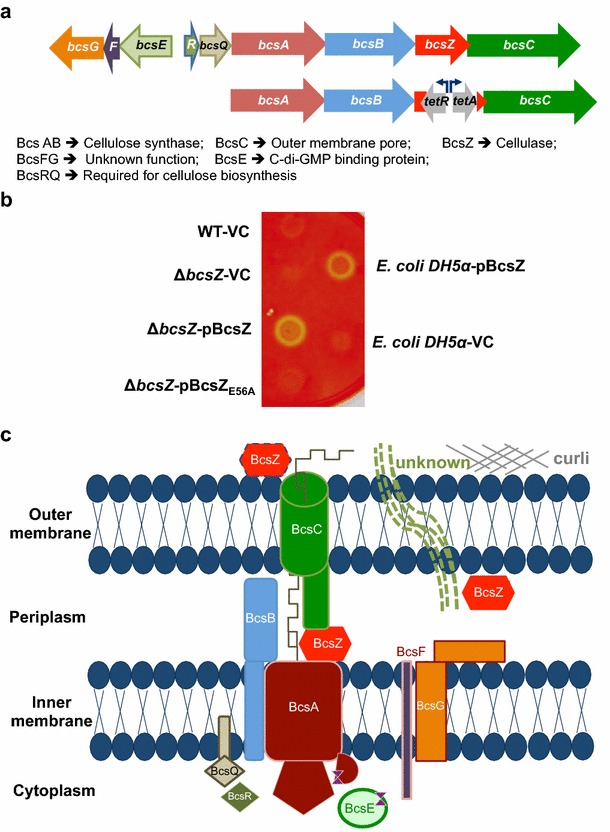
Fig. 1
Fig. 1
The cellulose biosynthesis operon, gene organization, proteins and functions. a Upper line Organization of the cellulose biosynthesis operon bcsEFG-bcsRQABZC in S. Typhimurium. bcsA and bcsB encode the cellulose synthase and bcsZ encodes a cellulase. bcsEFG and bcsR are characteristic for class II cellulose operons, while bcsQ is also found in class I operons [25]. Lower line Construction scheme of the non-polar bcsZ mutant using the tetRA gene cassette. b Detection of cellulase activity upon deletion and overexpression of BcsZ in S. Typhimurium UMR1 wildtype (WT). Bacterial cells were grown on carboxymethyl (CMC)-containing LB without salt agar plates. Yellow spots indicate cellulase activity through CMC degradation. Residual cellulase activity is seen in the wild type UMR1. BcsZ overexpression shows pronounced cellulase activity, abolished in the catalytic mutant BcsZE56A. Positive control E. coli DH5α pBcsZ and negative control E. coli DH5α VC. VC = pBAD30; pBcsZ = BcsZ cloned in pBAD30; pBcsZE56A = BcsZE56A cloned in pBAD30. c The cellulose secretion apparatus of S. Typhimurium modified after [25]. BcsA and BcsB form the active cellulose synthase complex. BcsC is supposed to be a pore in the outer membrane. BcsZ is a cellulase potentially located in the periplasm, but is found secreted in other cellulose producing/non-producing bacteria. Curli might aid the production of another unknown periplasmic/extracellular component requiring BcsZ. BcsE is a c-di-GMP binding protein required for optimal cellulose biosynthesis. The function of BcsF and BcsG is unknown. BcsQ and BcsR are also required for cellulose biosynthesis
Fig. 2
Fig. 2
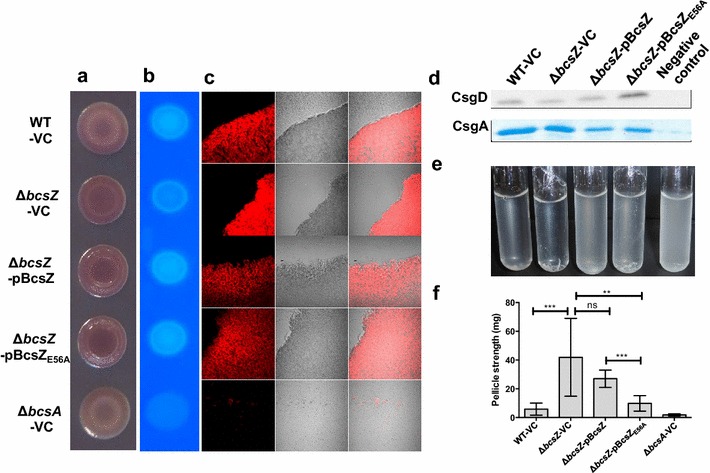
Biofilm phenotypes of the bcsZ deletion mutant of S. Typhimurium UMR1. a Rdar morphotype formation and b Calcofluor (CF) binding of S. Typhimurium UMR1 wildtype (WT) is enhanced upon deletion of bcsZ. Interestingly, overexpression of BcsZ did not complement the phenotype. c Calcofluor staining of colonies grown on agar plates indicates higher cellulose production in the bcsZ mutant. Overexpression of BcsZ complemented the phenotype, while overexpression of the catalytic mutant BcsZE56A showed a more patchy distribution of Calcofluor staining. d Expression of the biofilm regulator CsgD and the subunit of curli fimbriae CsgA is not altered upon deletion of bcsZ. e Cell clumping and biofilm formation of S. Typhimurium WT is enhanced upon deletion of bcsZ upon growth in M9 minimal medium for 16 h. Overexpression of BcsZ, but not of the catalytic mutant BcsZE56A complemented the phenotype. acde: S. Typhimurium WT and derivatives were grown on LB without salt agar plates for 48 h at 28 °C. B: S. Typhimurium WT and derivatives were grown on LB without salt agar plates for 16 h at 28 °C. f Pellicle strength of S. Typhimurium in standing culture is enhanced upon deletion of bcsZ. S. Typhimurium WT and derivatives were grown in LB without salt standing culture for 48 h at 28 °C. Shown is a representative experiment with n = 24 for WT-VC and ΔbcsZ-VC and n = 6 technical replicates for the other derivatives. Error bar indicates SD. ***p < 0.0005, **p<0.001, *p < 0.05; ns not significant using Student’s paired t-test. Sample order remains for ac (as shown on the left panel) and de (as shown on the top panel). VC pBAD30; pBcsZ BcsZ cloned in pBAD30; pBcsZ E56A BcsZ catalytic mutant cloned in pBAD30. ΔcsgD-VC and ΔbcsA-VC serves as negative controls for d and e respectively
Fig. 3
Fig. 3
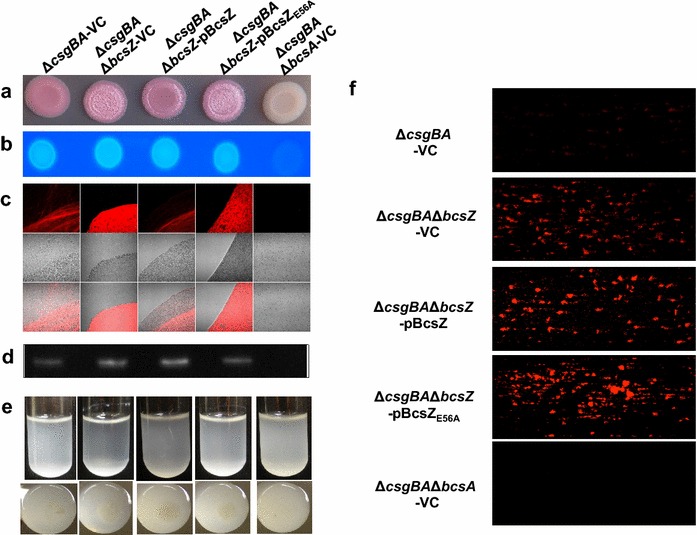
Biofilm phenotypes of the bcsZ deletion mutant of curli deficient S. Typhimurium derivatives of UMR1. a Pdar morphotype formation indicative for the expression of cellulose and b Calcoflour binding of S. Typhimurium UMR1ΔcsgBA is enhanced upon deletion of bcsZ, but could be complemented by overexpression of BcsZ. c Calcofluor staining of cells resuspended from colonies grown on agar plates indicate higher cellulose production in the bcsZ mutant. Overexpression of BcsZ complemented the phenotype, while overexpression of the catalytic mutant BcsZE56A showed a patchy distribution of Calcofluor staining. d CsgD expression is not altered upon deletion and overexpression of bcsZ. e Cell clumping and biofilm formation of S. Typhimurium UMR1 ΔcsgBA is enhanced upon deletion of bcsZ upon growth in M9 minimal medium for 16 h. Overexpression of BcsZ, but not of the catalytic mutant BcsZE56A complemented the phenotype. f Biofilm formation of UMR1 ΔcsgBA and derivatives in microfluidic chambers. Enhanced biofilm formation was not complemented by BcsZ overexpression, and further enhanced by overexpression of the catalytic mutant BcsZE56A. Sample order remains for ae as shown on the top panel. VC pBAD30; pBcsZ BcsZ cloned in pBAD30; pBcsZ E56A BcsZ catalytic mutant cloned in pBAD30
Fig. 4
Fig. 4
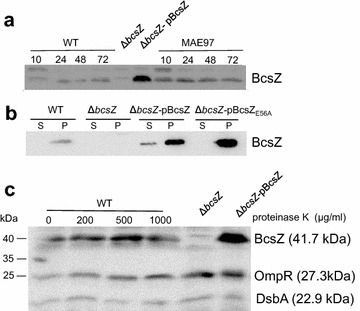
Expression and localization of BcsZ. a BcsZ is expressed throughout the growth phase of S. Typhimurium UMR1(WT) and MAE97. Expression of BcsZ was analyzed after growth on LB without salt agar plates from 10 to 72 h. b Analysis of BcsZ expression in the supernatant and cell pellet indicates BcsZ to be mainly cell associated. c BcsZ is not a surface associated protein. Treatment of the bacterial pellet with different concentrations of proteinase K does not alter the BcsZ signal at 41.7 kDa. Detection of cytoplasmic OmpR (27.3 kDa) and periplasmic DsbA (22.9 kDa) were cell integrity controls
Fig. 5
Fig. 5
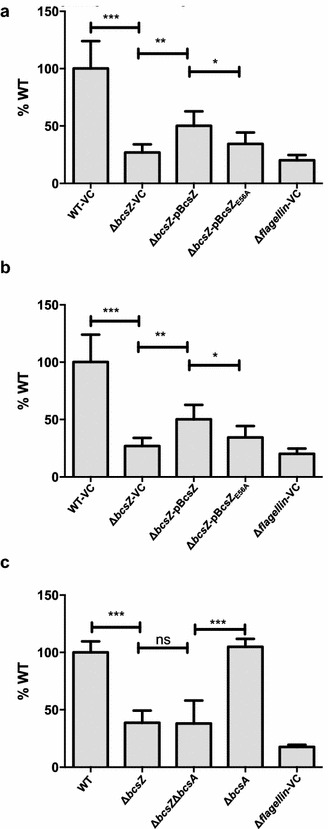
Swimming and swarming motility upon deletion of bcsZ in S. Typhimurium UMR1. a Swimming and b swarming motility of S. Typhimurium UMR1 (WT) was downregulated upon deletion of bcsZ. The phenotype cannot be complemented by overexpression of BcsZ or the BcsZE56A mutant. c The motility phenotype of a bcsZ mutant is not relieved upon deletion of bcsA. Plates were incubated at 37 °C. VC, VC pBAD30; pBcsZ BcsZ cloned in pBAD30; pBcsZ E56A BcsZ catalytic mutant cloned in pBAD30; Δflagellin, negative control ΔfliC ΔfljB. Bars show the means of at least three independent experiments each in duplicate. Error bar indicates standard deviation (SD). ***p < 0.0005, **p<0.001, *p < 0.05; ns not significant using paired t-test
Fig. 6
Fig. 6
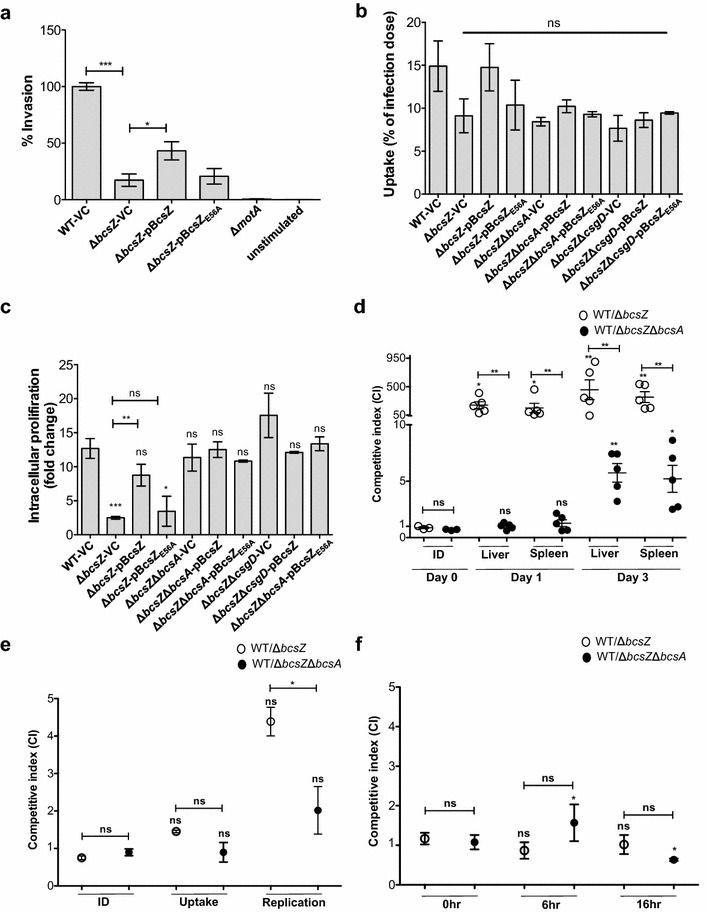
Host interaction phenotypes upon deletion of bcsZ in S. Typhimurium UMR1. a Invasion of epithelial cells by UMR1 (WT) and bcsZ mutant derivatives. b Uptake of UMR1 (WT) and bcsZ mutant derivatives in IFN-γ activated murine RAW264.7 macrophages at 2 h post infection (MOI of 10). For a and b, error bar indicates SD. c Intracellular proliferation (as fold change of uptake) of bcsZ mutant derivatives at 16 h post infection. Error bar indicates SD for two independent experiments, each in triplicates. For ac, ***p < 0.0005, **p<0.001, *p < 0.05; ns not significant compared to WT-VC unless specified using paired t-test. d Competitive index (CI) of virulence of UMR1 (WT) against bcsZ mutant derivatives in organs of 6–8 week old female BALB/c mice (5 per group) on day 1 and 3 post oral infection. Each circle represents an individual mouse and error bar indicates SEM. Infection dose (ID) used for inoculation with a strain ratio of 1:1 for UMR1 (WT) and bcsZ mutant derivatives. Significance calculated for mean CI in organs at different time points compared to the inoculum and for the difference in CI for bcsZ mutant derivatives in the same organ at one time point. Difference between inocula is not statistically significant. e CI of fitness of UMR1 (WT) against bcsZ mutant derivatives for uptake (2 h) and proliferation (16 h) in IFN-gamma activated murine RAW264.7 macrophages (MOI of 10). All results are the means and error bar indicates SD for independent experiments, each in triplicates. Significance calculated for the average CI in uptake and proliferation compared to the inoculum and for the difference in CI for bcsZ mutant derivatives for uptake and proliferation. Difference between inocula is not statistically significant. *p < 0.05, ns not significant. f CI of fitness of UMR1 (WT) against bcsZ mutant derivatives in LB broth at 6 h and 16 h post inoculation. All results are the means and error bar indicates SD of two independent experiments, each in triplicates. Significance calculated for the average CI at different time points after inoculation compared to the inoculum and for the difference in CI for bcsZ mutant derivatives at different time points. Difference between inocula is not statistically significant. For df, ***p < 0.0005, **p<0.001, *p < 0.05; ns not significant using Kruskal–Wallis assessment with subsequent Dunn’s test to compare to inoculum and one-tailed unpaired t-test to compare two samples at the same time point

References

    1. Römling U. Molecular biology of cellulose production in bacteria. Res Microbiol. 2002;153:205–212. doi: 10.1016/S0923-2508(02)01316-5. - DOI - PubMed
    1. Barnhart DM, Su S, Baccaro BE, Banta LM, Farrand SK. CelR, an ortholog of the diguanylate cyclase PleD of Caulobacter, regulates cellulose synthesis in Agrobacterium tumefaciens. Appl Environ Microbiol. 2013;79:7188–7202. doi: 10.1128/AEM.02148-13. - DOI - PMC - PubMed
    1. Kawano Y, Saotome T, Ochiai Y, Katayama M, Narikawa R, Ikeuchi M. Cellulose accumulation and a cellulose synthase gene are responsible for cell aggregation in the cyanobacterium Thermosynechococcus vulcanus RKN. Plant Cell Physiol. 2011;52:957–966. doi: 10.1093/pcp/pcr047. - DOI - PubMed
    1. Recouvreux DO, Carminatti CA, Pitlovanciv AK, Rambo CR, Porto LM, Antonio RV. Cellulose biosynthesis by the beta-proteobacterium, Chromobacterium violaceum. Curr Microbiol. 2008;57:469–476. doi: 10.1007/s00284-008-9271-0. - DOI - PubMed
    1. Bassis CM, Visick KL. The cyclic-di-GMP phosphodiesterase BinA negatively regulates cellulose-containing biofilms in Vibrio fischeri. J Bacteriol. 2010;192:1269–1278. doi: 10.1128/JB.01048-09. - DOI - PMC - PubMed

MeSH terms

LinkOut - more resources