. 2016 Oct 18;15(1):63.
doi: 10.1186/s12943-016-0549-8.

Spatio-temporal mutation profiles of case-matched colorectal carcinomas and their metastases reveal unique de novo mutations in metachronous lung metastases by targeted next generation sequencing

Affiliations

Spatio-temporal mutation profiles of case-matched colorectal carcinomas and their metastases reveal unique de novo mutations in metachronous lung metastases by targeted next generation sequencing

Valentina Kovaleva et al. Mol Cancer. .

Abstract

Background: Targeted next generation sequencing (tNGS) has become part of molecular pathology diagnostics for determining RAS mutation status in colorectal cancer (CRC) patients as predictive tool for decision on EGFR-targeted therapy. Here, we investigated mutation profiles of case-matched tissue specimens throughout the disease course of CRC, to further specify RAS-status dynamics and to identify de novo mutations associated with distant metastases.

Methods: Case-matched formalin-fixed and paraffin-embedded (FFPE) resection specimens (n = 70; primary tumours, synchronous and/or metachronous liver and/or lung metastases) of 14 CRC cases were subjected to microdissection of normal colonic epithelial, primary and metastatic tumour cells, their DNA extraction and an adapted library protocol for limited DNA using the 48 gene TruSeq Amplicon Cancer PanelTM, MiSeq sequencing and data analyses (Illumina).

Results: By tNGS primary tumours were RAS wildtype in 5/14 and mutated in 9/14 (8/9 KRAS exon 2; 1/9 NRAS Exon 3) of cases. RAS mutation status was maintained in case-matched metastases throughout the disease course, albeit with altered allele frequencies. Case-matched analyses further identified a maximum of three sequence variants (mainly in APC, KRAS, NRAS, TP53) shared by all tumour specimens throughout the disease course per individual case. In addition, further case-matched de novo mutations were detected in synchronous and/or metachronous liver and/or lung metastases (e.g. in APC, ATM, FBXW7, FGFR3, GNAQ, KIT, PIK3CA, PTEN, SMAD4, SMO, STK11, TP53, VHL). Moreover, several de novo mutations were more frequent in synchronous (e.g. ATM, KIT, PIK3CA, SMAD4) or metachronous (e.g. FBXW7, SMO, STK11) lung metastases. Finally, some de novo mutations occurred only in metachronous lung metastases (CDKN2A, FGFR2, GNAS, JAK3, SRC).

Conclusion: Together, this study employs an adapted FFPE-based tNGS approach to confirm conservation of RAS mutation status in primary and metastatic tissue specimens of CRC patients. Moreover, it identifies genes preferentially mutated de novo in late disease stages of metachronous CRC lung metastases, several of which might be actionable by targeted therapies.

Keywords: Colorectal cancer; FFPE; Metastases; Next generation sequencing.


Figures
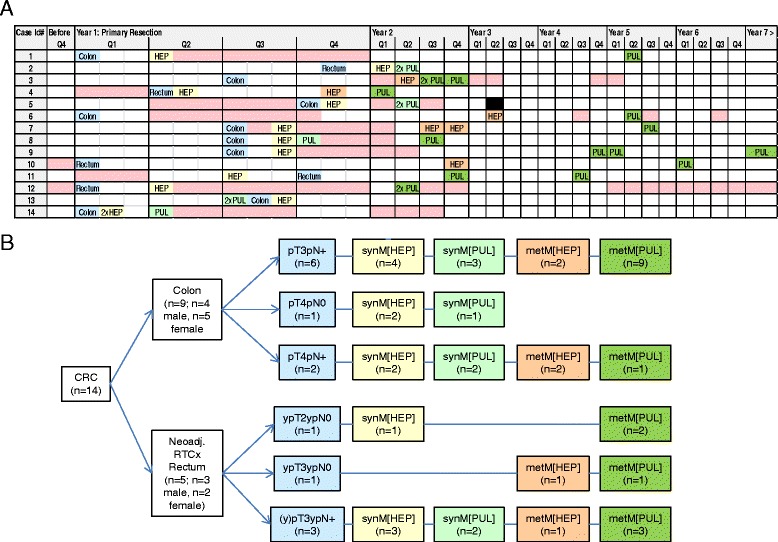
Fig. 1
Fig. 1
Clinico-pathological data of the colorectal carcinoma patient cohort. a The table graph displays the time course and occurrence of resected primary tumours and synchronous or metachronous liver or lung metastases included in the study from 14 patients. b The diagram presents the 70 tissue specimens analyzed from the 14 CRC cases according to primary tumour site, classification and metastases. Blue = primary tumours, yellow = synchronous liver metastases, light green = synchronous lung metastases, orange = metachronous liver metastases, dark green = metachronous lung metastases, pink boxes = treatment regimens, black = death of patient. Refer to main text and Table 1 for further clinico-pathological data. Q1-Q4 = “quarterly year”; neoadj. RTCx = neoadjuvant radio-/chemotherapy
Fig. 2
Fig. 2
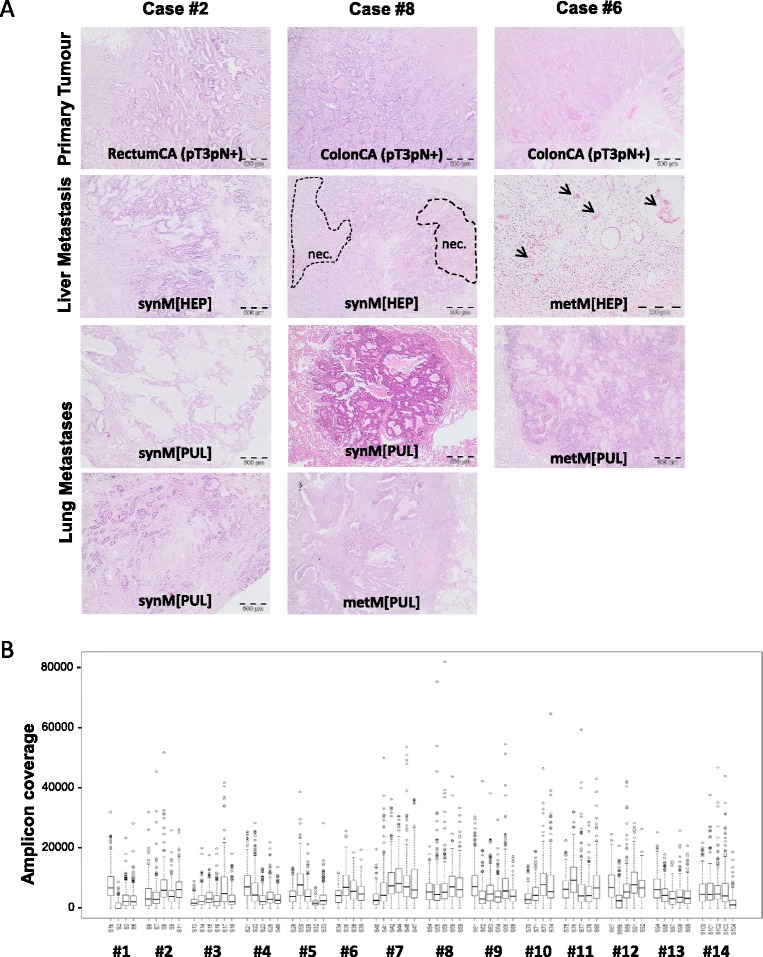
Morphology and tNGS amplicon coverage of investigated primary tumours and distant metastases of the CRC cases. a The panels depict H&E sections of case-matched primary tumours, and synchronous and/or metachronous liver or lung metastasis of three representative cases. Note areas of necrosis (“nec”; e.g. case #8, synM(HEP)) and widely distributed clusters of few tumor cells (e.g. case #6, metM(HEP)), necessary for interpretation of gene mutations with lower allele frequencies. All panels same magnification 2.5x except case #6 metM(HEP) being 10x. b Summary of the amplicon coverage for all 70 investigated DNA samples of the CRC cohort. Refer to the main text, Table 1 and Additional file 1: Table S2 for further details
Fig. 3
Fig. 3
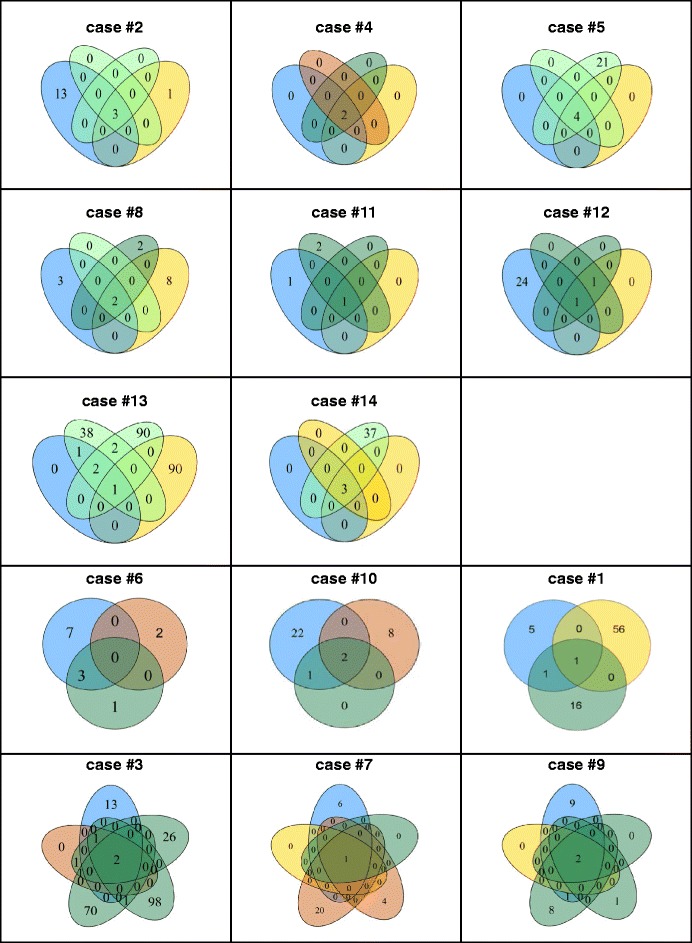
Case-matched shared mutations in primary tumours and distant metastases of CRC cases. The panels depict Venn diagrams of variants detected per case in primary tumour (blue), synchronous (yellow) and metachronous (orange) liver metastasis as well as synchronous (light green) and metachronous (dark green) lung metastases. Numbers represent the number of sequence variants being shared (overlaps) or separate for a specific CRC tissue specimen. Note that CRC cases #4, #5 and #14 exhibited mutations in the primary tumour, which were then also all detected in distant metastases and are hence only depicted in the overlaps. Note three patterns of CRC cases: type I = cases #2, 4, 5, 8, 11, 12, 13, 14; type II = # 6, 10, 1 and type III = #3, 7, 9. These three types did not correlate with the specific clinico-pathological or molecular features. Refer to main text for details
Fig. 4
Fig. 4
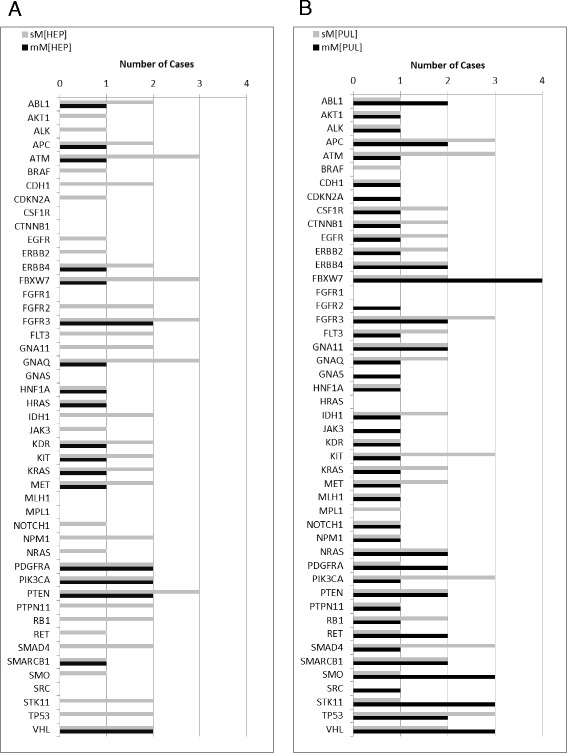
De novo mutations detected in synchronous and metachronous liver and lung metastases. a The graph presents the number of CRC cases with de novo mutations detected for all investigated 48 genes in synchronous (light grey; sM[HEP]) and metachronous (dark grey; mM[HEP]) liver metastases. b The graph presents the number of CRC cases with de novo mutations detected for all investigated 48 genes in synchronous (light grey; sM[PUL]) and metachronous (dark grey; mM[PUL]) lung metastases
Fig. 5
Fig. 5
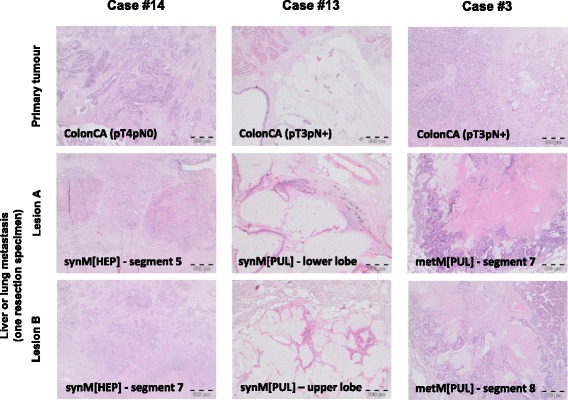
Morphology of case-matched separate CRC metastatic liver or lung lesions resected at one time point with similar or distinct mutation profiles. The panels show H&E stainings of primary tumours and their associated resected liver or lung metastases, from which each two topographically distant located separate lesions (labelled lesion A and lesion B) were individually analyzed by tNGS. Case # 14 showed the same mutation profile in the primary tumour and its associated two metastatic liver lesions (within segments 5 and 7). Cases #13 (upper, lower lobes of lung) and cases #3 (segments 7 and 8) each showed only few shared mutations and numerous additional mutations associated with either of the individual lung metastatic lesions, despite similar morphology. Refer to main text for details

References

    1. Douillard JY, Siena S, Cassidy J, et al. Final results from PRIME: randomized phase III study of panitumumab with FOLFOX4 for first-line treatment of metastatic colorectal cancer. Ann Oncol. 2014;25:1346–1355. doi: 10.1093/annonc/mdu141. - DOI - PubMed
    1. Wong NA, Gonzalez D, Salto-Tellez M, et al. RAS testing of colorectal carcinoma—a guidance document from the Association of Clinical Pathologists Molecular Pathology and Diagnostics Group. J Clin Pathol. 2014;67:751–757. doi: 10.1136/jclinpath-2014-202467. - DOI - PubMed
    1. Schwartzberg LS, Rivera F, Karthaus M, et al. PEAK: a randomized, multicenter phase II study of panitumumab plus modified fluorouracil, leucovorin, and oxaliplatin (mFOLFOX6) or bevacizumab plus mFOLFOX6 in patients with previously untreated, unresectable, wild-type KRAS exon 2 metastatic colorectal cancer. J Clin Oncol. 2014;32:2240–2247. doi: 10.1200/JCO.2013.53.2473. - DOI - PubMed
    1. Ashraf N, Kothari N, Kim R. Predictive biomarkers for anti-epidermal growth factor receptor therapy: beyond KRAS testing. J Natl Compr Canc Netw. 2014;12:1433–1442. - PubMed
    1. Modest DP, Stintzing S, von Weikersthal LF, et al. Impact of Subsequent Therapies on Outcome of the FIRE-3/AIO KRK0306 Trial: First-Line Therapy With FOLFIRI Plus Cetuximab or Bevacizumab in Patients With KRAS Wild-Type Tumors in Metastatic Colorectal Cancer. J Clin Oncol. 2015;33:3718–3726. doi: 10.1200/JCO.2015.61.2887. - DOI - PubMed

Publication types

Substances