


The impact of in situ breast cancer and family history on risk of subsequent breast cancer events and mortality - a population-based study from Sweden
- PMID: 27756431
- PMCID: PMC5069805
- DOI: 10.1186/s13058-016-0764-7
The impact of in situ breast cancer and family history on risk of subsequent breast cancer events and mortality - a population-based study from Sweden
Abstract
Background: The clinical behavior of in situ breast cancer is incompletely understood and several factors have been associated with invasive recurrence. The purpose of this study was to evaluate long-term risk of subsequent breast cancer and mortality among women diagnosed with in situ breast cancer, in relation to family history METHODS: Using the population-based Swedish Multi-Generation and Cancer Registers we identified 8111 women diagnosed with in situ breast cancer between 1980 and 2004. We used standardized incidence ratios (SIRs) to measure the relative risk of subsequent invasive or contralateral in situ breast cancer and standardized mortality ratios (SMRs) for relative risks of death.
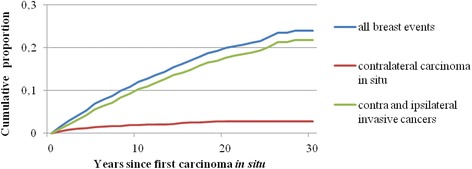
Results: Among women diagnosed with in situ breast cancer, the cumulative 10-year and 20-year risk for subsequent contralateral or ipsilateral invasive cancer was approximately 10 % and 18 %, respectively. The risk of subsequent invasive breast cancer was increased more than 4-fold (SIR 4.6 (95 % CI 4.2 - 4.9)) among women with in situ breast cancer as compared to women in the general population and the risk of contralateral in situ breast cancer was increased almost 16-fold (SIR 16.0 (95 % CI 13.2-19.1)). Having a family history of breast cancer increased the risk of contralateral invasive breast cancer by almost 50 % (incidence rate ratio 1.5 (95 % CI 1.0-2.0)). Women under forty years old at diagnosis, without family history, had a 7-fold increased risk, and those with a family history had a 14-fold increased risk for subsequent invasive breast cancer with SIRs of 7.2 (95 % CI 4.8-10.5) and 14.3 (95 % CI 7.4-25.0), respectively. The overall risk of death in women with in situ breast cancer was significantly increased by 30 % compared to the general population but was highly dependent on the occurrence of a second invasive cancer event (SMR 1.3 (95 % CI 1.2-1.4)).
Conclusions: Among women with in situ breast cancer, a positive family history increases the risk of contralateral invasive breast cancer by almost 50 %. The risk of subsequent invasive breast cancer and mortality is substantially higher in younger women, which should be taken into account when planning their treatment and follow up.
Keywords: Contralateral breast cancer; In situ breast cancer; Mortality; Second event.
Figures
Similar articles
-
Population-Based Analysis of Breast Cancer Incidence and Survival Outcomes in Women Diagnosed with Lobular Carcinoma In Situ.Ann Surg Oncol. 2017 Sep;24(9):2509-2517. doi: 10.1245/s10434-017-5867-6. Epub 2017 Apr 28. Ann Surg Oncol. 2017. PMID: 28455673
-
Risk for contralateral breast cancers in a population covered by mammography: effects of family history, age at diagnosis and histology.Breast Cancer Res Treat. 2007 Oct;105(2):229-36. doi: 10.1007/s10549-006-9445-z. Epub 2006 Nov 18. Breast Cancer Res Treat. 2007. PMID: 17115107
-
Time-dependent risk of depression, anxiety, and stress-related disorders in patients with invasive and in situ breast cancer.Int J Cancer. 2017 Feb 15;140(4):841-852. doi: 10.1002/ijc.30514. Epub 2016 Nov 25. Int J Cancer. 2017. PMID: 27859142
-
The risk of a contralateral breast cancer among women diagnosed with ductal and lobular breast carcinoma in situ: data from the Connecticut Tumor Registry.Breast. 2003 Dec;12(6):451-6. doi: 10.1016/s0960-9776(03)00152-8. Breast. 2003. PMID: 14659121 Review.
-
Risks of second non-breast primaries following breast cancer in women: a systematic review and meta-analysis.Breast Cancer Res. 2023 Feb 10;25(1):18. doi: 10.1186/s13058-023-01610-x. Breast Cancer Res. 2023. PMID: 36765408 Free PMC article.
Cited by
-
Inter- and intra-provincial variation in screen-detected breast cancer across five Canadian provinces: a CanIMPACT study.Can J Public Health. 2020 Oct;111(5):794-803. doi: 10.17269/s41997-019-00282-5. Epub 2020 Feb 4. Can J Public Health. 2020. PMID: 32020541 Free PMC article.
-
Mortality of women with ductal carcinoma in situ of the breast: a population-based study from the Girona province, Spain (1994-2013).Clin Transl Oncol. 2019 Jul;21(7):891-899. doi: 10.1007/s12094-018-1994-1. Epub 2018 Dec 10. Clin Transl Oncol. 2019. PMID: 30536209
-
Methodological choices affect cancer incidence rates: a cohort study.Popul Health Metr. 2017 Jan 19;15(1):2. doi: 10.1186/s12963-017-0120-x. Popul Health Metr. 2017. PMID: 28103940 Free PMC article.
-
Risk for Invasive Cancers in Women With Breast Cancer In Situ: Results From a Population Not Covered by Organized Mammographic Screening.Front Oncol. 2021 Mar 18;11:606747. doi: 10.3389/fonc.2021.606747. eCollection 2021. Front Oncol. 2021. PMID: 33816240 Free PMC article.
-
Family History and Risk of Second Primary Breast Cancer after In Situ Breast Carcinoma.Cancer Epidemiol Biomarkers Prev. 2018 Mar;27(3):315-320. doi: 10.1158/1055-9965.EPI-17-0837. Epub 2018 Jan 16. Cancer Epidemiol Biomarkers Prev. 2018. PMID: 29339357 Free PMC article.
References
Publication types
MeSH terms
LinkOut - more resources
Full Text Sources
Other Literature Sources
Medical
