. 2013 Mar;6(1):20-25.
doi: 10.1177/1753495X12472643. Epub 2013 Mar 1.

Maternal Body Mass Index during Pregnancy and Offspring Neurocognitive Development

Affiliations

Maternal Body Mass Index during Pregnancy and Offspring Neurocognitive Development

Wendy Y Craig et al. Obstet Med. 2013 Mar.

Abstract

Background: This hypothesis generating study explores second trimester maternal body mass index (BMI) during pregnancy and offspring neurocognitive development.

Methods: Mothers and offspring served as controls in two earlier studies: 101 children at age two years and 118 children at age eight years.

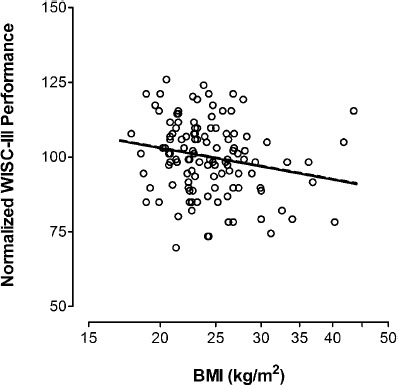
Results: Frequency of maternal BMI ≥30 kg/m2 increased from 10% in 1987-1990 to 30% in 2004-2006 (P < 0.001); the socioeconomic gradient became more pronounced. At age two, one or more BSID-III (Bayley Scales of Infant Development, 3rd Edition) scores <85 were more frequent with higher maternal BMI (P = 0.029); regression analysis suggested an inverse relationship between language scores and BMI (P = 0.054). Among eight-year-olds, one or more WISC-III (Wechsler Intelligence Scale for Children, 3rd edition) scores <85 increased with maternal BMI (P = 0.017); regression analysis showed an inverse relationship between performance subscale IQ score and BMI (P = 0.023).

Conclusion: Second trimester maternal obesity may be an independent risk factor for some aspects of children's neurocognitive development. Further study is indicated.

Keywords: BMI; offspring neurocognitive development; pregnancy.


Figures
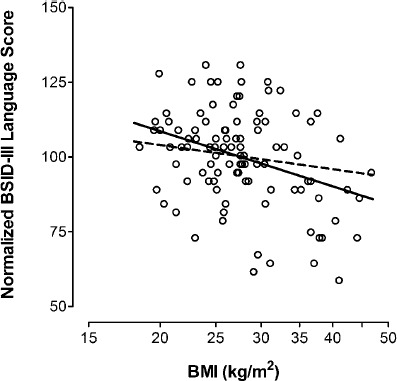
Figure 1
Figure 1
Normalized Bayley Scales of Infant Development, 3rd edition (BSID-III) language composite scores at age 2.4 (0.4) years among 101 children in Dataset A (vertical axis), plotted against their mothers’ body mass index (BMI) during the second trimester (horizontal axis). The BSID-III language scores were normalized to 100, by dividing each result by the overall mean of 105.5. The solid line shows the unadjusted relationship (r = -0.30, slope = -61.265, P = 0.0003), while the dashed line shows the relationship after adjusting for Hollingshead score (hhs), child's sex, number of prior births (npb), mother's age and smoking (r = -0.16, slope = -26.644, P = 0.054). The adjustment equation for the expected BSID-III language scores is shown below. Expected score = 109.606-26.644 × log(bmi) + 5.781 × hhs -10.124 × sex-3.724 × npb + 0.603 × age + 9.27 × smoke
Figure 2
Figure 2
Normalized Wechsler Intelligence Scale for Children, 3rd edition (WISC-III) performance subscale IQ scores at age 8.1 (0.6) years among 118 children in Dataset B (vertical axis), plotted against their mothers’ body mass index (BMI) during the second trimester (horizontal axis). The BSID-III language scores were normalized to 100, by dividing each result by the overall mean of 104.8. The solid line shows the unadjusted relationship (r = -0.20, slope = -34.733, P = 0.028), while the dashed line shows the relationship after adjusting for Hollingshead score (hhs), child's sex, number of prior births (npb), mother's age and smoking (r = -0.20, slope = -35.534, P = 0.023). The adjustment equation for the expected WISC-III performance subscale IQ scores is shown below. Expected Score = 131.633 -35.534 × log(bmi) + 3.843 × hhs + 2.544 × sex -1.149 × npb + 0.147 × age + 1.391 × smoke

References

    1. Craig WY, Allan WC, Kloza EM, et al. Mid-gestational maternal free thyroxine concentration and offspring neurocognitive development at age two years. J Clin Endocrinol Metab 2012; 97: E22–8 - PMC - PubMed
    1. Neggers YH, Goldenberg RL, Ramey SL, Cliver SP. Maternal prepregnancy body mass index and psychomotor development in children. Acta Obstet Gynecol Scand 2003; 82: 235–40 - PubMed
    1. Heikura U, Taanila A, Hartikainen AL, et al. Variations in prenatal sociodemographic factors associated with intellectual disability: a study of the 20-year interval between two birth cohorts in northern Finland. Am J Epidemiol 2008; 167: 169–77 - PubMed
    1. Krakowiak P, Walker CK, Bremer AA, et al. Maternal metabolic conditions and risk for autism and other neurodevelopmental disorders. Pediatrics 2012; 129: e1121–8 - PMC - PubMed
    1. Haddow JE, Palomaki GE, Allan WC, et al. Maternal thyroid deficiency during pregnancy and subsequent neuropsychological development of the child. N Engl J Med 1999; 341: 549–55 - PubMed

LinkOut - more resources