


Microcirculatory Response In Vivo on Local Intraarterial Infusion of Autogenic Adipose-derived Stem Cells or Stromal Vascular Fraction
- PMID: 27757364
- PMCID: PMC5055030
- DOI: 10.1097/GOX.0000000000001067
Microcirculatory Response In Vivo on Local Intraarterial Infusion of Autogenic Adipose-derived Stem Cells or Stromal Vascular Fraction
Abstract
Both adipose-derived stem cells (ASCs) and stromal vascular fraction (SVF) have been demonstrated to have regenerative properties with therapeutic potential for numerous diseases through local or topical applications. However, it is unclear whether ASC or SVF can be delivered systemically through an intra-arterial infusion. The purpose of this study was to examine the microcirculatory response in vivo on local intraarterial infusion of autogenic ASCs or SVF in a vascular pedicle isolated rat cremaster microcirculation model.
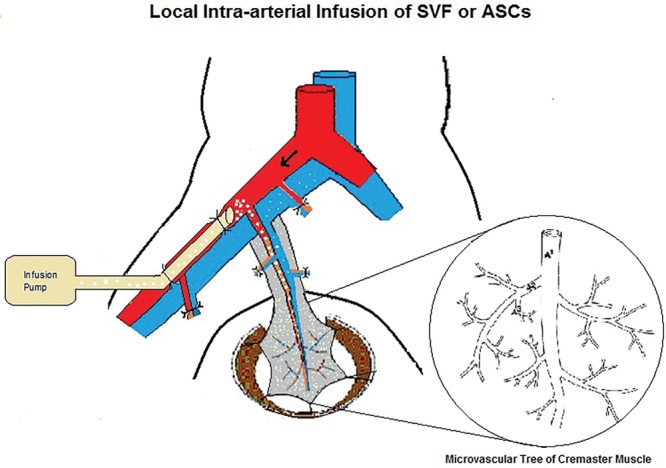
Materials and methods: Fat tissue was surgically harvested from the flanks of male Sprague-Dawley rats (n = 12) and processed for SVF isolation. Some SVF samples were cultured for 24 hours for ASC purification. The autogenic SVF (1 × 10⁵) cells (n = 6) or purified ASC (1 × 10⁵) cells (n = 6) cells were infused into the microcirculation of cremaster muscle at a speed of 0.05 mL/min through the cannulation of femoral artery. As this is a vascular pedicle isolated preparation, the infused SVF or ASC cells went nowhere but the cremaster muscle. The video image of the microcirculation was monitored in real time during infusion.
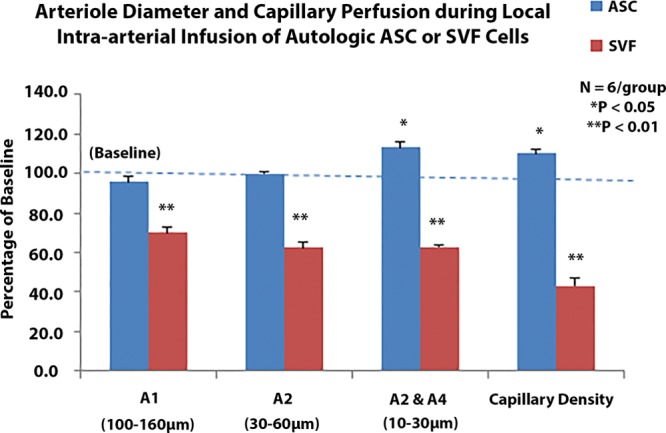
Results: Arteriole diameter was measured as A1 (100-160 µm), A2 (40-80 µm), and A3/A4 (10-30 µm). Capillary perfusion was quantified in 18 capillary fields of each muscle. There was a significant increase in the diameter of terminal arterioles (P = 0.049) and the capillary density (P = 0.02) after ASC intraarterial infusion. However, a significant cell aggregation, embolisms, and arterial obstruction were observed in the microcirculation in every case during SVF infusion.
Conclusions: Intraarterial infusion is an appropriate route for the delivery of autogenic ASCs, but not of SVF. SVF-induced microembolisms were the reason for narrowing or blocking the lumen of terminal arterioles, resulting in no flow in the corresponding capillaries.
Conflict of interest statement
The author has no financial interest to declare in relation to the content of this article. The Article Processing Charge was paid for by the author.
Figures


References
-
- Uzbas F, May ID, Parisi AM, et al. Molecular physiognomies and applications of adipose-derived stem cells. Stem Cell Rev. 2015;11:298–308. - PubMed
-
- Nguyen A, Guo J, Banyard DA, et al. Stromal vascular fraction: a regenerative reality? Part 1: current concepts and review of the literature. J Plast Reconstr Aesth Surg. 2015;69:170–179. - PubMed
-
- Guo J, Nguyen A, Banyard DA, et al. Stromal vascular fraction: a regenerative reality? Part 2: mechanisms of regenerative action. J Plast Reconstr Aesth Surg. 2015;69:180–188. - PubMed
-
- Michalek J, Moster R, Lukac L, et al. Autologous adipose tissue-derived stromal vascular fraction cells application in patients with osteoarthritis. Cell Transplant. 2015 [Epub ahead of print] - PubMed
LinkOut - more resources
Full Text Sources
Other Literature Sources
Research Materials
Miscellaneous