


Clinical significance of sunitinib-associated macrocytosis in metastatic renal cell carcinoma
- PMID: 27758076
- PMCID: PMC5224865
- DOI: 10.1002/cam4.919
Clinical significance of sunitinib-associated macrocytosis in metastatic renal cell carcinoma
Abstract
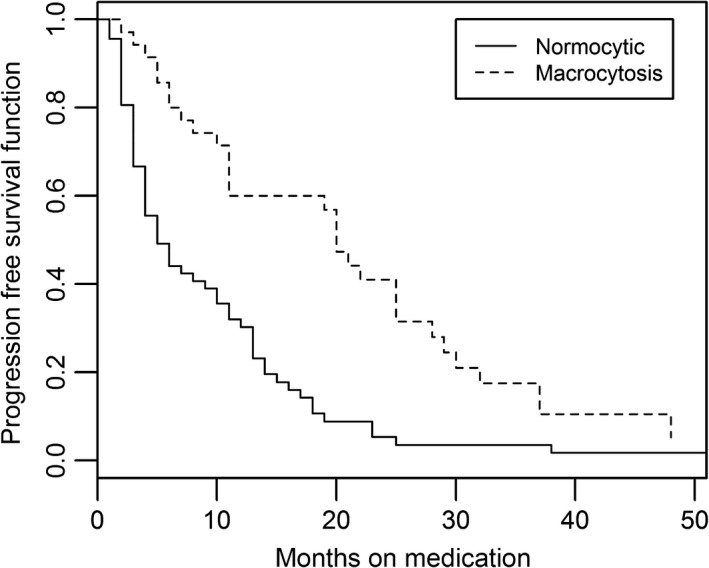
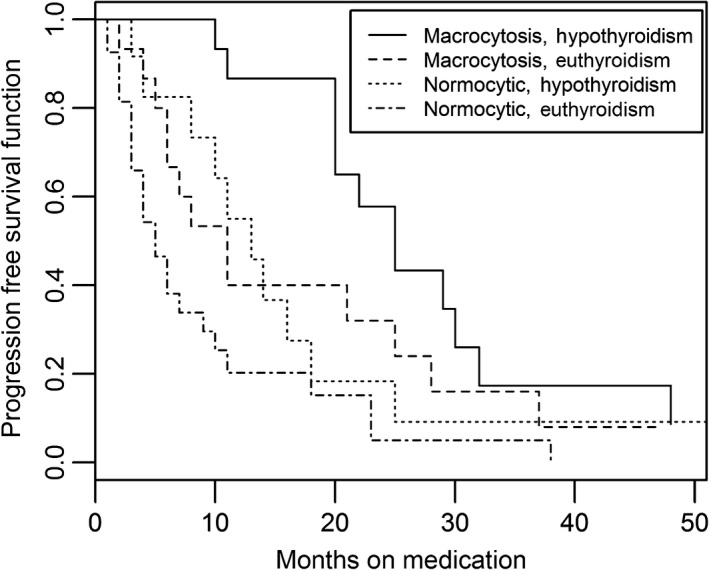
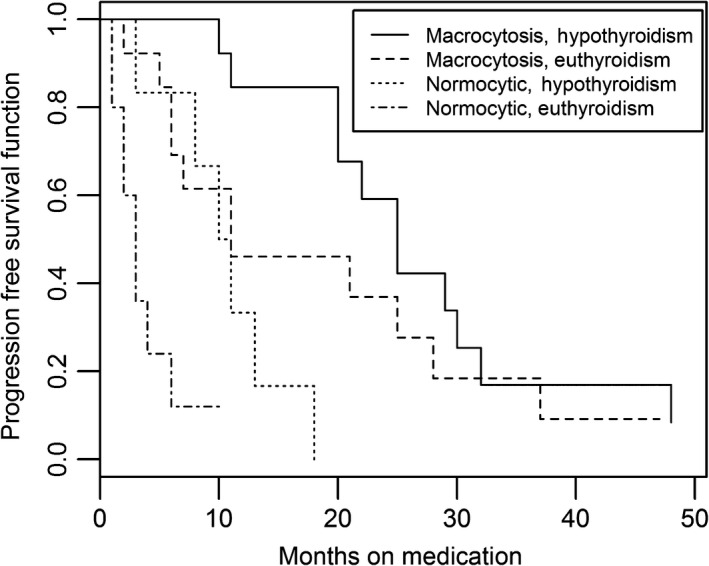
Increases in the mean corpuscular volume (MCV) have been observed in patients with metastatic renal cell carcinoma (mRCC) on tyrosine kinase inhibitor (TKI) treatment; however, its association with progression-free-survival (PFS) is unknown. We aimed to characterize TKI-associated macrocytosis in mRCC and its relationship with PFS. Retrospective review of data on macrocytosis and thyroid dysfunction on mRCC patients treated with sunitinib and/or sorafenib. These results are evaluated in the context of our previous report on the association of hypothyroidism in this setting. We assessed PFS as clinically defined by the treating physician. Seventy-four patients, 29 of whom received both drugs, were included. A treatment period was defined as time from initiation to discontinuation of either sunitinib or sorafenib; 103 treatment periods [sorafenib (47), sunitinib (56)] were analyzed. Macrocytosis was found in 55 and 8% of sunitinib- and sorafenib-treated patients, respectively, P < 0.001. The median time to developing macrocytosis was 3 months (m, range 1-7). Median PFS in sunitinib-treated patients was 11 m (95% CI: 6-19). Median PFS was higher among those with macrocytosis compared to normocytosis (21 m [95% CI: 11-25] vs. 4 m [95% CI: 3-8] P = 0.0001). Macrocytosis and hypothyroidism were two significant predictors of PFS. The greatest difference in PFS among all patients was observed in patients with both macrocytosis and hypothyroidism (25 m), compared to the normocytic and euthyroid patients (5 m) (P < 0.0001). Sunitinib-related macrocytosis was associated with prolonged PFS, and concurrent development of hypothyroidism and macrocytosis further prolonged PFS. Increased MCV may have a role as a predictive biomarker for sunitinib. Prospective studies accounting for other known prognostic factors are needed to confirm this finding.
Keywords: Clinical biomarker; macrocytosis; mean corpuscular volume; progression-free survival; renal cell carcinoma; sorafenib; sunitinib; tyrosine kinase inhibitors.
© 2016 The Authors. Cancer Medicine published by John Wiley & Sons Ltd.
Figures
References
-
- Mancuso, A. , and Sternberg C. N.. 2005. New treatments for metastatic kidney cancer. Can. J. Urol. 12(Suppl 1):66–70; discussion 105. - PubMed
-
- Janzen, N. K. , Kim H. L., Figlin R. A., and Belldegrun A. S.. 2003. Surveillance after radical or partial nephrectomy for localized renal cell carcinoma and management of recurrent disease. Urol. Clin. North Am. 30:843–852. - PubMed
-
- Escudier, B. , Eisen T., Stadler W. M., Szczylik C., Oudard S., Siebels M., et al. 2007. Sorafenib in advanced clear‐cell renal‐cell carcinoma. N. Engl. J. Med. 356:125–134. - PubMed
-
- Motzer, R. J. , Hutson T. E., Tomczak P., Michaelson M. D., Bukowski R. M., Rixe O., et al. 2007. Sunitinib versus interferon alfa in metastatic renal‐cell carcinoma. N. Engl. J. Med. 356:115–124. - PubMed
MeSH terms
Substances
Grants and funding
LinkOut - more resources
Full Text Sources
Other Literature Sources
Medical
