


Peptide Receptor Radionuclide Therapy Outcomes in a North American Cohort With Metastatic Well-Differentiated Neuroendocrine Tumors
- PMID: 27759712
- PMCID: PMC5595066
- DOI: 10.1097/MPA.0000000000000734
Peptide Receptor Radionuclide Therapy Outcomes in a North American Cohort With Metastatic Well-Differentiated Neuroendocrine Tumors
Abstract
Objectives: The objective of this study was to describe the outcomes of patients in the University of Iowa Neuroendocrine Tumor (NET) Database treated with peptide receptor radionuclide therapy (PRRT).
Methods: One hundred thirty-five patients from the University of Iowa NET Database who received PRRT were analyzed, their characteristics were described, and survival was calculated.
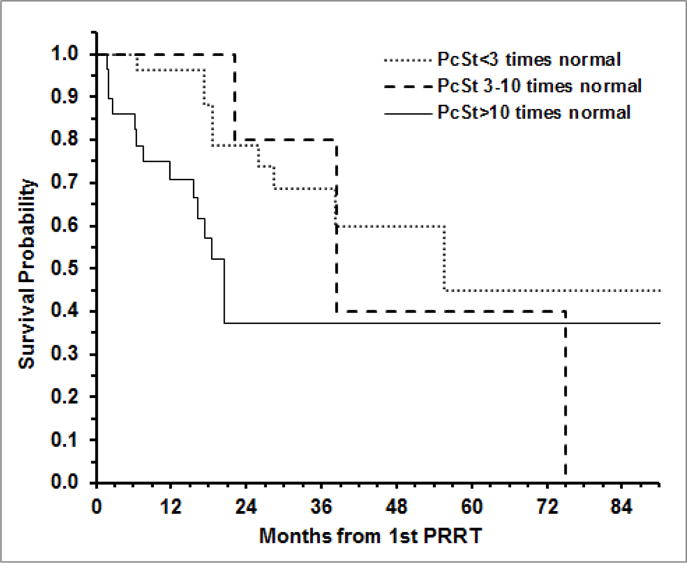
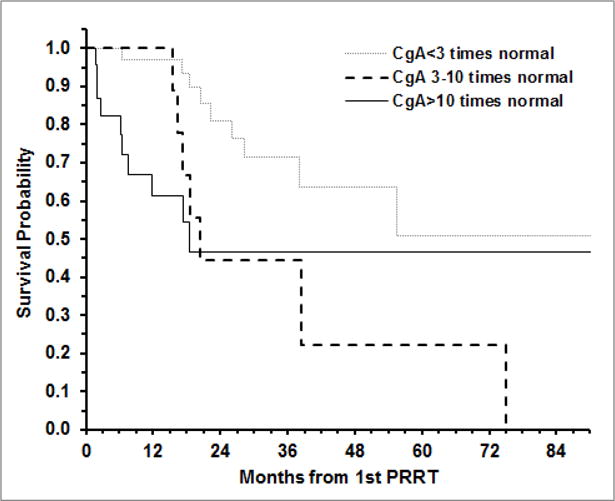
Results: The median age at diagnosis was 51 years, and 64% were men. The primary tumor was located in the small bowel (SBNET) in 37.8%, in the pancreas (PNET) in 26.0%, in the lung in 13.3%, in unknown primary in 9.6%, and in other sites in 13.3%. A radiographic response of any magnitude was observed in 65.8%, 11.1% had a mixed response, and 15.4% showed progression. The overall survival (OS) from the first PRRT was 40 months, and the median time to progression was 23.9 months. Higher pretreatment chromogranin A and pancreastatin levels predicted inferior OS.
Conclusions: Peptide receptor radionuclide therapy resulted in a relatively long OS and time to progression in heavily pretreated North American patients with advanced NETs. Elevated pretreatment chromogranin A and pancreastatin predicted shorter OS after therapy. Peptide receptor radionuclide therapy is a valuable treatment option in patients with advanced NETs, especially SBNETS.
Conflict of interest statement
Figures
References
-
- Oberg K. Neuroendocrine tumors of the digestive tract: impact of new classifications and new agents on therapeutic approaches. Curr Opin Oncol. 2012;24:433–440. - PubMed
-
- Hallet J, Law CH, Cukier M, et al. Exploring the rising incidence of neuroendocrine tumors: a population-based analysis of epidemiology, metastatic presentation, and outcomes. Cancer. 2015;121:589–597. - PubMed
-
- Knigge U, Hansen CP. Surgery for GEP-NETs. Best Pract Res Clin Gastroenterol. 2012;26:819–831. - PubMed
-
- Pathak S, Dash I, Taylor MR, et al. The surgical management of neuroendocrine tumour hepatic metastases. Eur J Surg Oncol. 2013;39:224–228. - PubMed
Publication types
MeSH terms
Substances
Grants and funding
LinkOut - more resources
Full Text Sources
Other Literature Sources
Research Materials
