Meta-Analysis
. 2016 Oct 19;11(1):142.
doi: 10.1186/s13012-016-0505-4.

Understanding dentists' management of deep carious lesions in permanent teeth: a systematic review and meta-analysis

Affiliations
Meta-Analysis

Understanding dentists' management of deep carious lesions in permanent teeth: a systematic review and meta-analysis

Falk Schwendicke et al. Implement Sci. .

Abstract

Background: Increasing evidence supports selective/incomplete (SE) or stepwise (SW) instead of non-selective/complete tissue removal for deep carious lesions in vital teeth, mainly as pulpal risks are significantly reduced. Our aims were to analyze the proportion of dentists who utilize SE/SW for deep lesions in permanent teeth and to identify barriers and facilitators of utilizing SE/SW.

Methods: We included studies that were original, and reported on the proportion of dentists utilizing SE/SW (quantitative studies), or reported on barriers or facilitators of such utilization (qualitative studies). Electronic databases (PubMed, CENTRAL, Embase, PsycINFO) were searched and screening and data extraction performed by two reviewers. Random-effects meta-analysis and meta-regression were used for quantitative synthesis of the proportion of dentists utilizing SE/SW. Thematic analysis was performed to assess barriers and facilitators on SE/SW utilization. Identified themes were translated into the constructs of the theoretical domains framework.

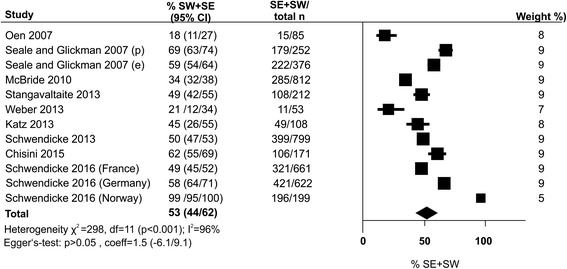
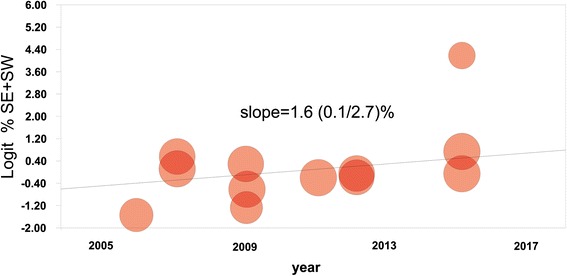
Results: From 1728 articles, nine studies were included, all using quantitative methods. Four thousand one hundred ninety-nine dentists had been surveyed. The mean (95% CI) proportion of dentists using SE/SW for deep lesions was 53 % (44/62 %). More recent studies reported significantly higher proportions (p < 0.05). Reported estimates and thematic analysis found dentists' age and an understanding of the disease caries and the scientific rationale behind different removal strategies to affect dentists' behavior. Guidelines, peers, and the social and professional identity were further associated with the motivation of utilizing SE/SW. Environmental incentives, sanctions, or restrictions, mainly of financial but also regulatory character, impacted on decision-making, as did the specific indication (the patient, the tooth) and the beliefs on how well different treatments perform.

Conclusions: Around half of all dentists rejected evidence-based carious tissue removal strategies. A range of factors can be addressed for improving implementation. Future studies should use mixed qualitative-quantitative methods to yield a deeper understanding of dentists' decision-making.

Trial registration: PROSPERO CRD42016038047.

Keywords: Attitudes; Decision-making; Dental; Evidence-based practice; Qualitative studies; Surveys.


Figures
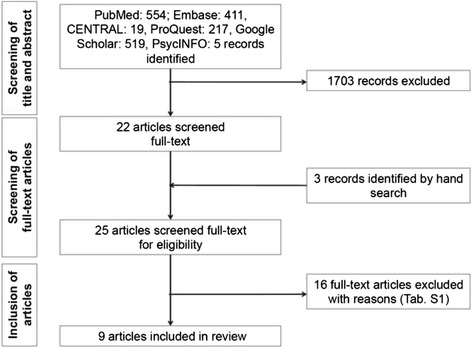
Fig. 1
Fig. 1
Flow of the search
Fig. 2
Fig. 2
The proportion of dentists who performed selective (SE) or stepwise (SW) carious tissue removal (% SW + SW). Wherever possible, subgroups of dentists (according to specialization like pedodontics [p] or endodontics [e], or in different countries) were separately entered into meta-analysis. The pooled proportion and 95 % confidence intervals (bold) from random-effects meta-analysis is shown as diamond. Heterogeneity was assessed using χ 2-test and I 2-statistics. Publication bias or small-study effects were evaluated using Egger’s regression intercept test as well as funnel plot analysis. n total sample size
Fig. 3
Fig. 3
Association between the year of study publication and the share of dentists performing selective (SE) or stepwise (SW) carious tissue removal. Every circle is the weighted estimate of each study. The regression line indicates a significantly increased share in recent years (p = 0.048), with a mean (95% CI) slope of 1.6 (0.1/2.7 %), i.e., the share increased with 1.6 % per year in mean
Fig. 4
Fig. 4
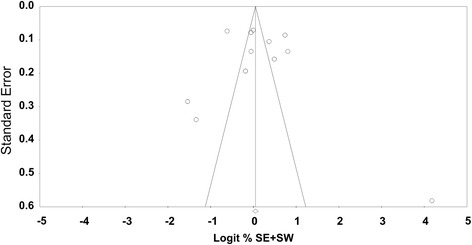
Funnel plot. Standard errors are plotted against the logarithm of the share of dentists performing selective (SE) or stepwise (SW) carious tissue removal. No significant asymmetry was identified
Fig. 5
Fig. 5
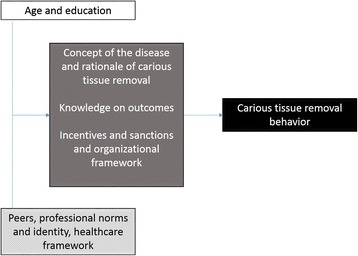
Identified factors shaping dentists’ carious tissue removal behavior according to the domains of the Behavior Change Wheel [20]. Capability (white box) is shaped by dentists’ education, which in turn differs between younger and older dentists. Opportunity (light grey box) is influenced by peers and associated professional norms and identities as well as healthcare organization. Both capability and opportunity shape dentists’ motivation (dark grey box), which is affected by the understanding of the disease caries and the rationale of carious tissue removal, knowledge on the outcomes (of different removal strategies, but also endodontic therapies), and healthcare incentives or sanctions. All factors eventually guide the carious tissue removal behavior (black box)

References

    1. Marcenes W, Kassebaum NJ, Bernabé E, Flaxman A, Naghavi M, Lopez A, Murray CJL. Global burden of oral conditions in 1990–2010: a systematic analysis. J Dent Res. 2013;92:592–597. doi: 10.1177/0022034513490168. - DOI - PMC - PubMed
    1. Listl S, Galloway J, Mossey PA, Marcenes W. Global economic impact of dental diseases. J Dent Res. 2015. - PubMed
    1. Schwendicke F, Frencken JE, Bjorndal L, Maltz M, Manton DJ, Ricketts D, Van Landuyt K, Banerjee A, Campus G, Domejean S, et al. Managing carious lesions: consensus recommendations on carious tissue removal. Adv Dent Res. 2016;28:58–67. doi: 10.1177/0022034516639271. - DOI - PubMed
    1. Schwendicke F, Dorfer CE, Paris S. Incomplete caries removal: a systematic review and meta-analysis. J Dent Res. 2013;92:306–314. doi: 10.1177/0022034513477425. - DOI - PubMed
    1. Ricketts D, Lamont T, Innes NP, Kidd E, Clarkson JE. Operative caries management in adults and children. Cochrane Database Syst Rev. 2013;28 - PubMed