


Review
doi: 10.1186/s13059-016-1081-2.
Closing the loop: 3C versus DNA FISH
Affiliations
- PMID: 27760553
- PMCID: PMC5072311
- DOI: 10.1186/s13059-016-1081-2
Item in Clipboard
Review
Closing the loop: 3C versus DNA FISH
Genome Biol.
.
Abstract
Chromosome conformation capture (3C)-based techniques have revolutionized the field of nuclear organization, partly replacing DNA FISH as the method of choice for studying three-dimensional chromosome architecture. Although DNA FISH is commonly used for confirming 3C-based findings, the two techniques are conceptually and technically different and comparing their results is not trivial. Here, we discuss both 3C-based techniques and DNA FISH approaches to highlight their similarities and differences. We then describe the technical biases that affect each approach, and review the available reports that address their compatibility. Finally, we propose an experimental scheme for comparison of 3C and DNA FISH results.
Figures
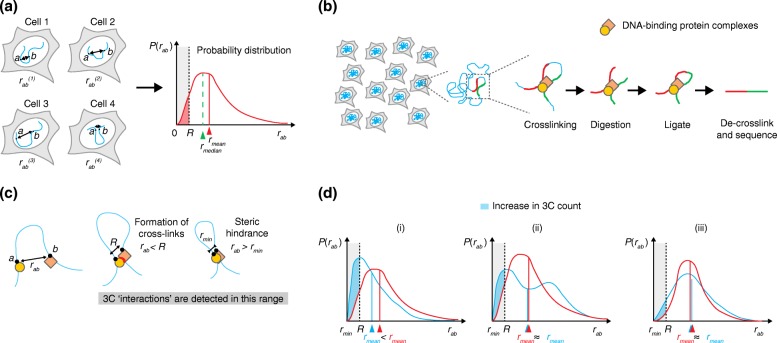
Comparison of 3C and DNA FISH experiments. a Cell-to-cell variation in the three-dimensional (3D) distance r
ab between two genomic loci a and b gives rise to the distribution of distances P(r
ab). Knowledge of P(r
ab) allows calculation of the mean and median 3D distances between a and b r
mean and r
median. It also allows calculation of the fraction of cells for which the distance r
ab is smaller than a certain threshold R.
b General scheme for 3C-based techniques. Cells are fixed and crosslinked chromatin is digested with a restriction endonuclease. Restriction fragments that were sufficiently close in the 3D space to be crosslinked by protein bridges (DNA-binding protein complexes) are then re-ligated to promote the formation of hybrid DNA molecules arising from 3D proximity events. De-crosslinked DNA is then sequenced to identify the ligated restriction fragments. The 3C signal for any locus pair (a and b) is proportional to the number of ligated restriction fragments that map to the two loci.
c From a theoretical perspective, the 3C signal is generated by genomic loci whose 3D distance r
ab is smaller than the (locus-specific) crosslinking range (R) over which the two genomic loci can be crosslinked by formaldehyde, and bigger than a minimum distance r
min that arises from steric hindrance between the two parts of the fiber. d Hypothetical scenarios giving rise to an increase in 3C signal (blue shaded area) when comparing two distributions of 3D distances (blue versus red curves). (i) Increasing 3C signal results from an overall shift of distances towards smaller values, corresponding to decreased mean (or median) distance. (ii) 3C signal increases as a consequence of a shift from a mono- to a bimodal distribution of distances, for example, in the case of the appearance of two sub-populations in different conformational states (e.g., compact versus elongated). In this case r
mean (and r
median, not shown) do not change. (iii) Increased 3C signal is a consequence of increased cell-to-cell variability in 3D distances, without appreciable changes in r
mean (or r
median, not shown)
References
Publication types
MeSH terms
Substances
LinkOut - more resources
Full Text Sources
Other Literature Sources
