Review
. 2016 Dec 1;311(6):F1318-F1328.
doi: 10.1152/ajprenal.00485.2016. Epub 2016 Oct 19.

Molecular mechanisms regulating aquaporin-2 in kidney collecting duct

Affiliations
Review

Molecular mechanisms regulating aquaporin-2 in kidney collecting duct

Hyun Jun Jung et al. Am J Physiol Renal Physiol. .

Abstract

The kidney collecting duct is an important renal tubular segment for regulation of body water homeostasis and urine concentration. Water reabsorption in the collecting duct principal cells is controlled by vasopressin, a peptide hormone that induces the osmotic water transport across the collecting duct epithelia through regulation of water channel proteins aquaporin-2 (AQP2) and aquaporin-3 (AQP3). In particular, vasopressin induces both intracellular translocation of AQP2-bearing vesicles to the apical plasma membrane and transcription of the Aqp2 gene to increase AQP2 protein abundance. The signaling pathways, including AQP2 phosphorylation, RhoA phosphorylation, intracellular calcium mobilization, and actin depolymerization, play a key role in the translocation of AQP2. This review summarizes recent data demonstrating the regulation of AQP2 as the underlying molecular mechanism for the homeostasis of water balance in the body.

Keywords: aquaporin-2; arginine vasopressin; body water balance; intracellular trafficking.


Figures

Fig. 1.
Fig. 1.
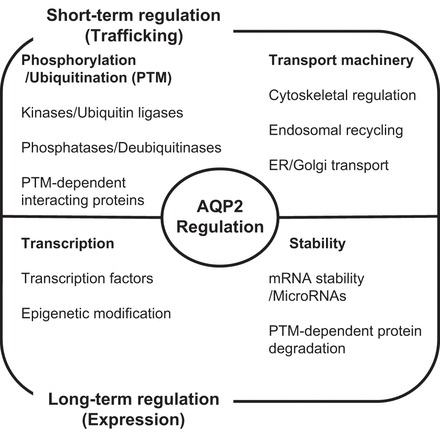
Summary of intracellular molecular mechanisms for aquaporin 2 (AQP2) regulation in renal collecting duct cells. Water permeability of collecting duct cells is regulated via AQP2 under various physiological and pathophysiological conditions through 2 mechanisms. Short-term regulation: trafficking between intracellular vesicles and plasma membrane is associated with posttranslational modification of AQP2 and vesicle-transporting systems dependent on cell signaling; long-term regulation: change of protein abundance is regulated by transcription and mRNA/protein stability. PTM, posttranslational modification.

References

    1. Aitken A. 14-3-3 proteins: a historic overview. Semin Cancer Biol 16: 162–172, 2006. doi:10.1016/j.semcancer.2006.03.005. - DOI - PubMed
    1. Aoki T, Suzuki T, Hagiwara H, Kuwahara M, Sasaki S, Takata K, Matsuzaki T. Close association of aquaporin-2 internalization with caveolin-1. Acta Histochem Cytochem 45: 139–146, 2012. doi:10.1267/ahc.12003. - DOI - PMC - PubMed
    1. Bankir L, Bichet DG, Bouby N. Vasopressin V2 receptors, ENaC, and sodium reabsorption: a risk factor for hypertension? Am J Physiol Renal Physiol 299: F917–F928, 2010. doi:10.1152/ajprenal.00413.2010. - DOI - PubMed
    1. Barile M, Pisitkun T, Yu MJ, Chou CL, Verbalis MJ, Shen RF, Knepper MA. Large scale protein identification in intracellular aquaporin-2 vesicles from renal inner medullary collecting duct. Mol Cell Proteomics 4: 1095–1106, 2005. doi:10.1074/mcp.M500049-MCP200. - DOI - PMC - PubMed
    1. Bhuin T, Roy JK. Rab proteins: the key regulators of intracellular vesicle transport. Exp Cell Res 328: 1–19, 2014. doi:10.1016/j.yexcr.2014.07.027. - DOI - PubMed

Publication types