


Chronic Kidney Disease Is Positively and Diabetes Mellitus Is Negatively Associated with Abdominal Aortic Aneurysm
- PMID: 27764090
- PMCID: PMC5072712
- DOI: 10.1371/journal.pone.0164015
Chronic Kidney Disease Is Positively and Diabetes Mellitus Is Negatively Associated with Abdominal Aortic Aneurysm
Abstract
Background and aims: Chronic kidney disease (CKD) and diabetes mellitus (DM) are considered as risk factors for cardiovascular diseases. The purpose of this study was to clarify the relationship of CKD and DM with the presence of abdominal aortic aneurysm (AAA).
Methods: We enrolled 261 patients with AAA (AAA+) and age-and-sex matched 261 patients without AAA (AAA-) at two hospitals between 2008 and 2014, and examined the association between the risk factors and the presence of AAA. Furthermore, in order to investigate the prevalence of AAA in each group, we enrolled 1126 patients with CKD and 400 patients with DM.
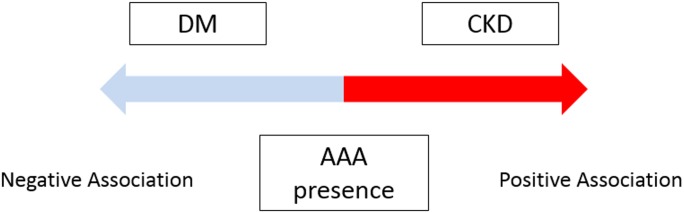
Results: The presence of CKD in patients with AAA+ was significantly higher than that in patients with AAA- (AAA+; 65%, AAA-; 52%, P = 0.004). The presence of DM in patients with AAA+ was significantly lower than that in patients with AAA- (AAA+; 17%, AAA-; 35%, P < 0.001). A multivariate logistic regression analysis demonstrated that hypertension, ischemic heart disease and CKD were independent determinants, whereas, DM was a negatively independent determinant, for the presence of AAA. The prevalence of AAA in patients with CKD 65 years old and above was 5.1%, whereas, that in patients with DM 65 years old and above was only 0.6%.
Conclusion: CKD is a positively associated with the presence of AAA. In contrast, DM is a negatively associated with the presence of AAA in Japanese population.
Conflict of interest statement
The authors have declared that no competing interests exist. Haruhito A. Uchida and Masashi Yoshida belong to the Department of Chronic Kidney Disease and Cardiovascular Disease which is endowed by Chugai pharmaceutical, MSD, Boehringer Ingelheim and Kawanishi Holdings. Jun Wada receives speaker honoraria from Astellas, Boehringer Ingelheim, Novartis, Novo Nordisk, and Tanabe Mitsubishi, and receives grant support from Astellas, Bayer, Chugai, Daiichi Sankyo, Kissei, Kyowa Hakko Kirin, MSD, Otsuka, Teijin, Torii, Pfizer, Takeda, Taisho Toyama and Tanabe Mitsubishi. This does not alter our adherence to PLOS ONE policies on sharing data and materials.
Figures
References
-
- Hirsch AT, Haskal ZJ, Hertzer NR, Bakal CW, Creager MA, Halperin JL, et al. ACC/AHA Guidelines for the Management of Patients with Peripheral Arterial Disease (lower extremity, renal, mesenteric, and abdominal aortic): a collaborative report from the American Associations for Vascular Surgery/Society for Vascular Surgery, Society for Cardiovascular Angiography and Interventions, Society for Vascular Medicine and Biology, Society of Interventional Radiology, and the ACC/AHA Task Force on Practice Guidelines (writing committee to develop guidelines for the management of patients with peripheral arterial disease)—summary of recommendations. J Vasc Interv Radiol. 2006;17(9):1383–97; quiz 98. Epub 2006/09/23. 10.1097/01.rvi.0000240426.53079.46 . - DOI - PubMed
-
- Lederle FA, Johnson GR, Wilson SE, Chute EP, Hye RJ, Makaroun MS, et al. The aneurysm detection and management study screening program: validation cohort and final results. Aneurysm Detection and Management Veterans Affairs Cooperative Study Investigators. Arch Intern Med. 2000;160(10):1425–30. Epub 2000/05/29. . - PubMed
-
- Singh K, Bonaa KH, Jacobsen BK, Bjork L, Solberg S. Prevalence of and risk factors for abdominal aortic aneurysms in a population-based study: The Tromso Study. Am J Epidemiol. 2001;154(3):236–44. Epub 2001/08/02. . - PubMed
MeSH terms
LinkOut - more resources
Full Text Sources
Other Literature Sources
Medical
