. 2016 Oct 21:7:13193.
doi: 10.1038/ncomms13193.

Photothermal therapy with immune-adjuvant nanoparticles together with checkpoint blockade for effective cancer immunotherapy

Affiliations

Photothermal therapy with immune-adjuvant nanoparticles together with checkpoint blockade for effective cancer immunotherapy

Qian Chen et al. Nat Commun. .

Abstract

A therapeutic strategy that can eliminate primary tumours, inhibit metastases, and prevent tumour relapses is developed herein by combining adjuvant nanoparticle-based photothermal therapy with checkpoint-blockade immunotherapy. Indocyanine green (ICG), a photothermal agent, and imiquimod (R837), a Toll-like-receptor-7 agonist, are co-encapsulated by poly(lactic-co-glycolic) acid (PLGA). The formed PLGA-ICG-R837 nanoparticles composed purely by three clinically approved components can be used for near-infrared laser-triggered photothermal ablation of primary tumours, generating tumour-associated antigens, which in the presence of R837-containing nanoparticles as the adjuvant can show vaccine-like functions. In combination with the checkpoint-blockade using anti-cytotoxic T-lymphocyte antigen-4 (CTLA4), the generated immunological responses will be able to attack remaining tumour cells in mice, useful in metastasis inhibition, and may potentially be applicable for various types of tumour models. Furthermore, such strategy offers a strong immunological memory effect, which can provide protection against tumour rechallenging post elimination of their initial tumours.


Figures
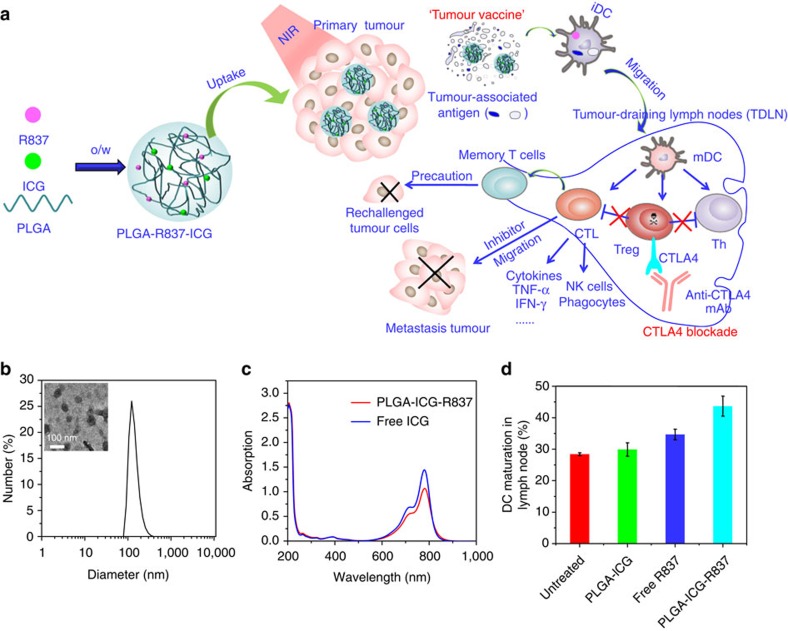
Figure 1
Figure 1. Formulation of nanoparticles and their immune-stimulation abilities.
(a) The mechanism of anti-tumour immune responses induced by PLGA-ICG-R837-based PTT in combination with checkpoint-blockade. (b) Hydrodynamic diameters of PLGA-ICG-R837 nanoparticles measured by DLS. Inset: (a) TEM image of PLGA-ICG-R837. (c) UV–vis–NIR spectra of PLGA-ICG-R837 and free ICG, indicating the successful loading of ICG into PLGA. (d) In vivo DC maturation (CD80+CD86+) with lymph nodes of BALB/c mice s.c. injected with PLGA-ICG, free R837, or PLGA-ICG-R837 (three mice per group). Data are presented as the mean±s.e.m. Error bars are based on triplicated experiments. DLS, dynamic light scattering; TEM, transmission electron microscopy.
Figure 2
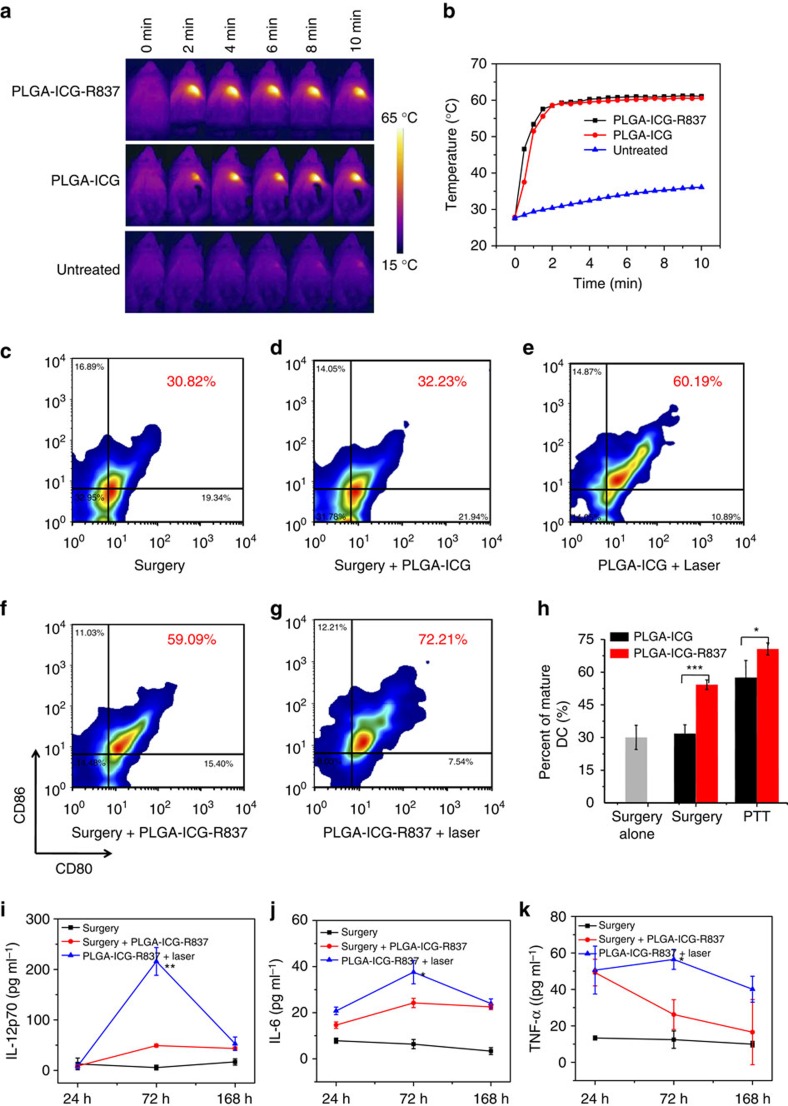
Figure 2. Immune responses after PLGA-ICG-R837-based PTT.
(a) IR thermal images of 4T1-tumour-bearing mice injected with PLGA-ICG-R837, PLGA-ICG or PBS under the 808 nm laser (0.5 W cm−2) irradiation. (b) The tumour temperature changes based on IR thermal imaging date in a. (ch) DC maturation induced by PLGA-ICG-R837-based PTT on mice-bearing 4T1 tumours (gated on CD11c+ DC cells). Cells in the tumour-draining lymph nodes were collected 72 h after various treatments for assessment by flow cytometry after staining with CD11c, CD80 and CD86. (ik) Cytokine levels in sera from mice isolated at 24, 72 and 168 h post different treatments (surgery, surgery and s.c. injection of PLGA-ICG-R837, i.t. injection of PLGA-ICG-R837 and PTT). Three mice were measured in each group in (ak). Data are presented as the mean±s.e.m. P values were calculated by Tukey's post-hoc test (***P<0.001, **P<0.01 or *P<0.05). For (ik), P values were determined between the second group (Surgery+PLGA-ICG-R837) and the third group (PLGA-ICG-R837+laser).
Figure 3
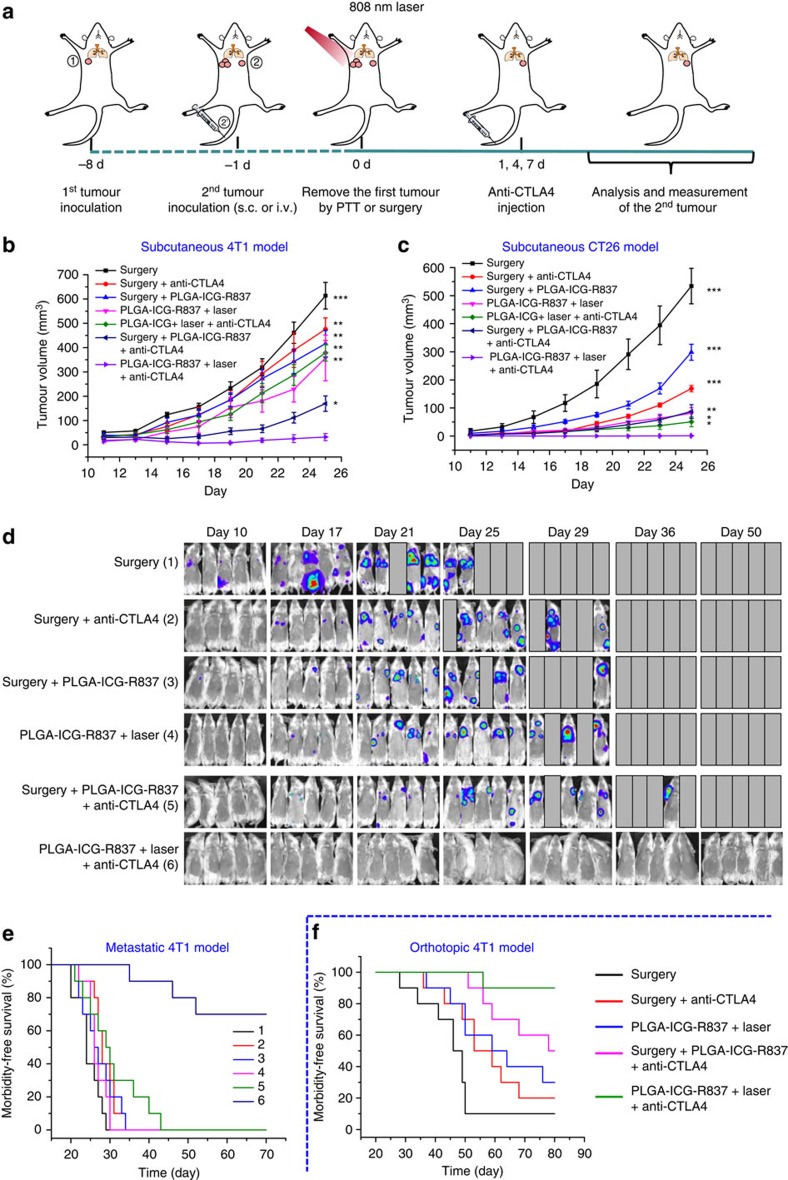
Figure 3. Anti-tumour effect of PLGA-ICG-R837-based PTT plus anti-CTLA-4 therapy.
(a) Schematic illustration of PLGA-ICG-R837-based PTT and anti-CTLA-4 combination therapy to inhibit tumour growth at distant sites. (b,c) Tumour growth curves of different groups of mice (six mice per group) with s.c. inoculation of secondary 4T1 (b) or CT26 (c) tumours after various treatments to eliminate their primary tumours. (d) In vivo bioluminescence images to track the spreading and growth of i.v. injected fLuc-4T1 cancer cells in different groups of mice after the cancer cells after various treatments to eliminate their primary tumours. (e) Morbidity-free survival of different groups of mice with metastatic 4T1 tumours in d after various treatments indicated to eliminate their primary tumours (10 mice per group). (f) Morbidity-free survival of different groups of mice-bearing orthotopic 4T1 tumours with spontaneous metastases after various treatments indicated to eliminate their primary breast tumours (10 mice per group). PLGA-ICG-R837-based photothermal ablation of the first primary tumours in combination with anti-CTLA4 treatment would be able to induce strong anti-tumour immunological effects to inhibit the growth of tumour cells spread into other organs. P values in b and c were calculated by Tukey's post-hoc test (***P<0.001, **P<0.01 or *P<0.05) by comparing other groups with the last group (PLGA-ICG-R837+laser+anti-CLTA-4). Data are presented as the mean±s.e.m.
Figure 4
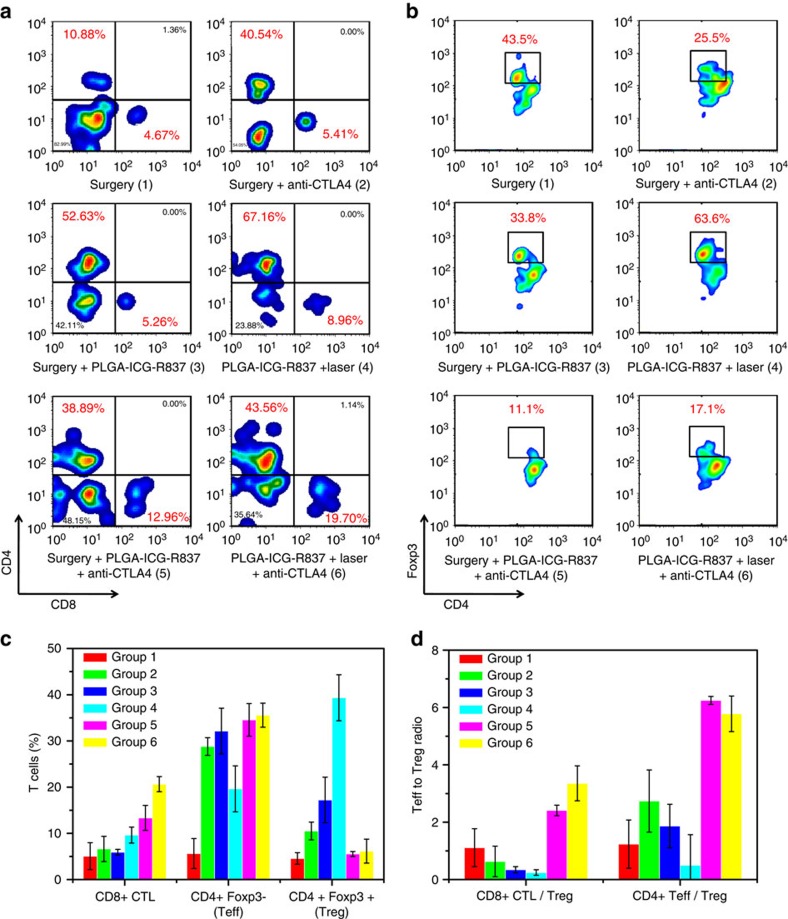
Figure 4. The mechanism study.
(a) Representative flow cytometry plots showing different groups of T cells in secondary tumours. Tumour cell suspensions were analysed by flow cytometry for T-cell infiltration (gated on CD3+ T cells). (b) Representative flow cytometry plots showing percentages (gated on CD4+cells) of CD4+FoxP3+T cells in secondary tumours after various treatments indicated. (c) Proportions of tumour-infiltrating CD8+ killer T cells, CD4+ FoxP3- effector T cells and CD4+ FoxP3+ regulatory T cells according to data in a and b. (d) CD8+ CTL: Treg ratios and CD4+ effector T cells: Treg ratios in the secondary tumours upon various treatments to remove the first tumours. Both ratios were significantly enhanced after combination treatment with PLGA-ICG-R837-based PTT and anti-CTLA4 therapy. Three mice were measured in each group in ad. Data are presented as the mean±s.e.m. Error bars are based on triplicated experiments.
Figure 5
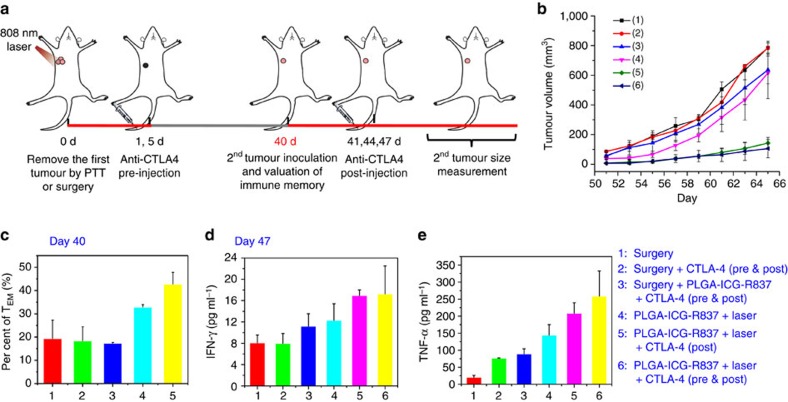
Figure 5. Long-term immune-memory effects.
(a) Schematic illustration of PLGA-ICG-R837-based PTT and anti-CTLA-4 combination therapy to inhibit cancer relapse. (b) tumour growth curves of rechallenged tumours inoculated 40 days post eliminated of their first tumours (eight mice per group). (c) Proportions of effector memory T cells (TEM) in the spleen analysed by flow cytometry (gated on CD3+ CD8+T cells) at day 40 right before rechallenging mice with secondary tumours (groups 4 and 5 would be identical at this point). (d,e) Cytokine levels in sera from mice isolated 7 days after mice were rechallenged with secondary tumours (after the second round of anti-CTLA4 treatment). Three mice were measured in each group in ce. Data are presented as the mean±s.e.m.
Figure 6
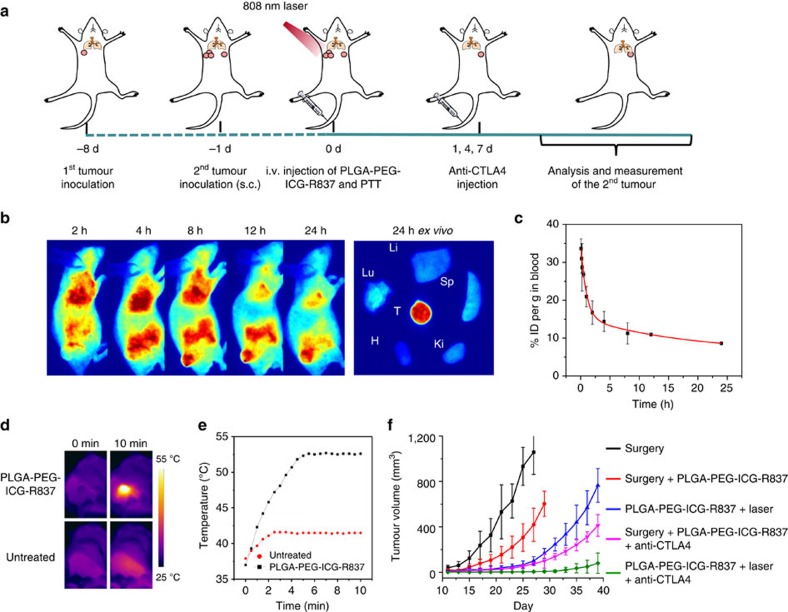
Figure 6. PTT-triggered immunotherapy via systemic injection of nanoparticles.
(a) Schematic illustration showing the design of animal experiments. (b) In vivo fluorescence images of CT26-tumour-bearing mice taken at different time points post i.v. injection of PLGA-PEG-ICG-R837. The right column shows an ex vivo fluorescence image of major organs and tumour dissected from the mouse 24 h post injection. Tu, Li, Sp, Ki, H and Lu stand for tumour, liver, spleen, kidney, heart and lung, respectively. (c) Blood circulation curve of PLGA-PEG-ICG-R837 in mice by measuring the fluorescence of ICG in blood at different time points post i.v. injection (three mice per group). (d) IR thermal images of CT26-tumour-bearing mice injected with PLGA-PEG-ICG-R837 or PBS under the 808 nm laser (0.8 W cm−2) irradiation. (e) The tumour temperature changes based on IR thermal imaging date in d. (f) The growth curves of secondary tumours in different groups of CT26-tumour-bearing mice after various treatments to eliminate their primary tumours (six mice per group). Data are presented as the mean±s.e.m.

References

    1. Hamdy S., Haddadi A., Hung R. W. & Lavasanifar A. Targeting dendritic cells with nano-particulate PLGA cancer vaccine formulations. Adv. Drug Deliv. Rev. 63, 943–955 (2011). - PubMed
    1. Sheng W.-Y. & Huang L. Cancer immunotherapy and nanomedicine. Pharm. Res. 28, 200–214 (2011). - PubMed
    1. Matsuo Y., Takeyama H. & Guha S. Cytokine network: new targeted therapy for pancreatic cancer. Curr. Pharm. Des. 18, 2416–2419 (2012). - PubMed
    1. Zhang G. R., Li W., Holle L., Chen N. Y. & Chen W. Y. A novel design of targeted endocrine and cytokine therapy for breast cancer. Clin. Cancer Res. 8, 1196–1205 (2002). - PubMed
    1. Gubin M. M. et al. Checkpoint blockade cancer immunotherapy targets tumour-specific mutant antigens. Nature 515, 577–581 (2014). - PMC - PubMed

Publication types

MeSH terms