


Isolation and plasmid characterization of carbapenemase (IMP-4) producing Salmonella enterica Typhimurium from cats
- PMID: 27767038
- PMCID: PMC5073282
- DOI: 10.1038/srep35527
Isolation and plasmid characterization of carbapenemase (IMP-4) producing Salmonella enterica Typhimurium from cats
Abstract
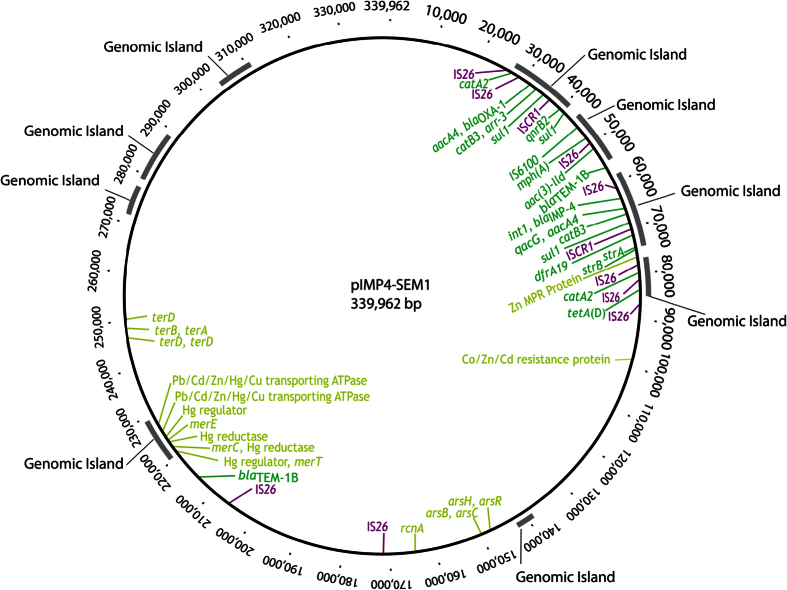
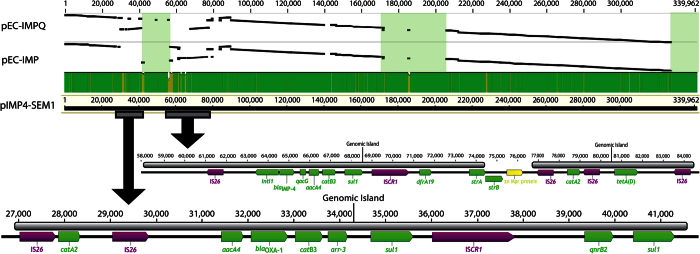
Carbapenem-resistant Enterobacteriaceae (CRE) are a pressing public health issue due to limited therapeutic options to treat such infections. CREs have been predominantly isolated from humans and environmental samples and they are rarely reported among companion animals. In this study we report on the isolation and plasmid characterization of carbapenemase (IMP-4) producing Salmonella enterica Typhimurium from a companion animal. Carbapenemase-producing S. enterica Typhimurium carrying blaIMP-4 was identified from a systemically unwell (index) cat and three additional cats at an animal shelter. All isolates were identical and belonged to ST19. Genome sequencing revealed the acquisition of a multidrug-resistant IncHI2 plasmid (pIMP4-SEM1) that encoded resistance to nine antimicrobial classes including carbapenems and carried the blaIMP-4-qacG-aacA4-catB3 cassette array. The plasmid also encoded resistance to arsenic (MIC-150 mM). Comparative analysis revealed that the plasmid pIMP4-SEM1 showed greatest similarity to two blaIMP-8 carrying IncHI2 plasmids from Enterobacter spp. isolated from humans in China. This is the first report of CRE carrying a blaIMP-4 gene causing a clinical infection in a companion animal, with presumed nosocomial spread. This study illustrates the broader community risk entailed in escalating CRE transmission within a zoonotic species such as Salmonella, and in a cycle that encompasses humans, animals and the environment.
Conflict of interest statement
SA and DJT have received research grants and contracts from Zoetis, Novartis and Neoculi. All other authors have none to declare.
Figures
References
-
- Gupta N., Limbago B. M., Patel J. B. & Kallen A. J. Carbapenem-resistant Enterobacteriaceae: Epidemiology and prevention. Clin Infect Dis 53, 60–67 (2011). - PubMed
-
- Woodford N., Wareham D. W., Guerra B. & Teale C. Carbapenemase-producing Enterobacteriaceae and non-Enterobacteriaceae from animals and the environment: an emerging public health risk of our own making? J Antimicrob Chemother 69, 287–291 (2014). - PubMed
-
- Leung G. H., Gray T. J., Cheong E. Y., Haertsch P. & Gottlieb T. Persistence of related blaIMP-4 metallo-β-lactamase producing Enterobacteriaceae from clinical and environmental specimens within a burns unit in Australia - a six-year retrospective study. Antimicrob Resist Infect Control 2, 1–8 (2013). - PMC - PubMed
Publication types
MeSH terms
Substances
LinkOut - more resources
Full Text Sources
Other Literature Sources
Molecular Biology Databases
Miscellaneous
