. 2016 Oct 21:6:35871.
doi: 10.1038/srep35871.

Oxidative stress dependent microRNA-34a activation via PI3Kα reduces the expression of sirtuin-1 and sirtuin-6 in epithelial cells

Affiliations

Oxidative stress dependent microRNA-34a activation via PI3Kα reduces the expression of sirtuin-1 and sirtuin-6 in epithelial cells

J R Baker et al. Sci Rep. .

Abstract

Sirtuin-1 (SIRT1) and SIRT6, NAD+-dependent Class III protein deacetylases, are putative anti-aging enzymes, down-regulated in patients with chronic obstructive pulmonary disease (COPD), which is characterized by the accelerated ageing of the lung and associated with increased oxidative stress. Here, we show that oxidative stress (hydrogen peroxide) selectively elevates microRNA-34a (miR-34a) but not the related miR-34b/c, with concomitant reduction of SIRT1/-6 in bronchial epithelial cells (BEAS2B), which was also observed in peripheral lung samples from patients with COPD. Over-expression of a miR-34a mimic caused a significant reduction in both mRNA and protein of SIRT1/-6, whereas inhibition of miR-34a (antagomir) increased these sirtuins. Induction of miR-34a expression with H2O2 was phosphoinositide-3-kinase (PI3K) dependent as it was associated with PI3Kα activation as well as phosphatase and tensin homolog (PTEN) reduction. Importantly, miR-34a antagomirs increased SIRT1/-6 mRNA levels, whilst decreasing markers of cellular senescence in airway epithelial cells from COPD patients, suggesting that this process is reversible. Other sirtuin isoforms were not affected by miR-34a. Our data indicate that miR-34a is induced by oxidative stress via PI3K signaling, and orchestrates ageing responses under oxidative stress, therefore highlighting miR-34a as a new therapeutic target and biomarker in COPD and other oxidative stress-driven aging diseases.


Figures
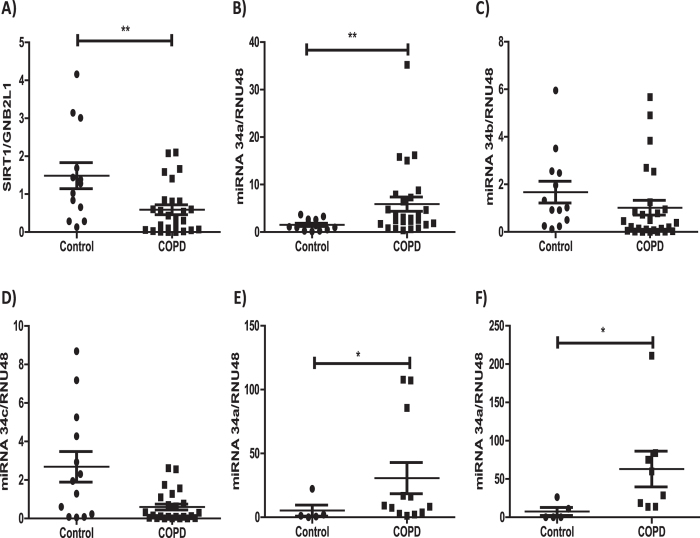
Figure 1
Figure 1. Decreased SIRT1 and increased miR-34a in COPD patients.
Lung tissue from resections were obtained from 4 healthy volunteers and 9 non-COPD smoker volunteers (Controls), 15 mild COPD (Gold 1 plus Gold 2) and 11 severe COPD (Gold 3 plus Gold 4) (COPD) and RNA was extracted. (A) SIRT1 mRNA expression was examined in these lung samples and detected by QRT-PCR using a TaqMan assay normalized to GNB2L1 expression. (B) miR-34a levels, normalized to RNU48, were examine in lung samples from Control and COPD. (C,D) miR-34b and miR-34c levels, normalized to RNU48, were examined in lung samples from Control and COPD subjects. (E) miR-34a levels were examine in sputum cells samples from Control (N = 5) (1 non-smoker and 4 smokers) and COPD (N = 12) subjects. (F) miR-34a levels, normalized to RNU48, were examine in primary epithelial cells from Control (N = 5) (all non-smokers) and COPD (N = 7) subjects. Data are means ± SEM and analyzed by a Mann-Whitney U test * P < 0.05, **P < 0.01.
Figure 2
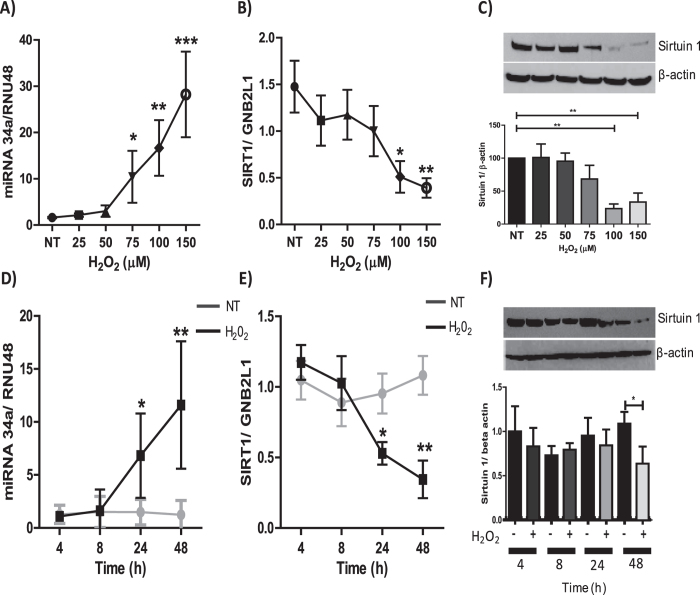
Figure 2. Correlation between oxidative stress-mediated reduction in SIRT1 and increased miR-34a expression.
BEAS2B cells were stimulated for 48 hours with H2O2 at concentrations of 25, 50, 75, 100 and 150 μM, and protein or RNA extracted. (A) RNA was extracted to examine miR-34a (n = 6) (B) and SIRT1 (n = 6). (C) Protein was extracted and SIRT1 protein expression was determined by SDS-PAGE/Western blotting normalized to β-actin (n = 5). BEAS2B cells were stimulated for 4, 8, 24 and 48 hours with 100 μM H2O2 and protein and RNA extracted, (D) changes in miR-34a expression was examined (n = 5), as well as changes in (E, F) SIRT1 gene and protein expression (n = 5). The band density of each blot is represented as a histogram and and is the average of all experiments performed. Data are means ± SEM, analyzed by Kruskal–Wallis test with post hoc Dunns and One-way Anova with post hoc Bonferroni *P < 0.05, **P < 0.01, ***P < 0.001.
Figure 3
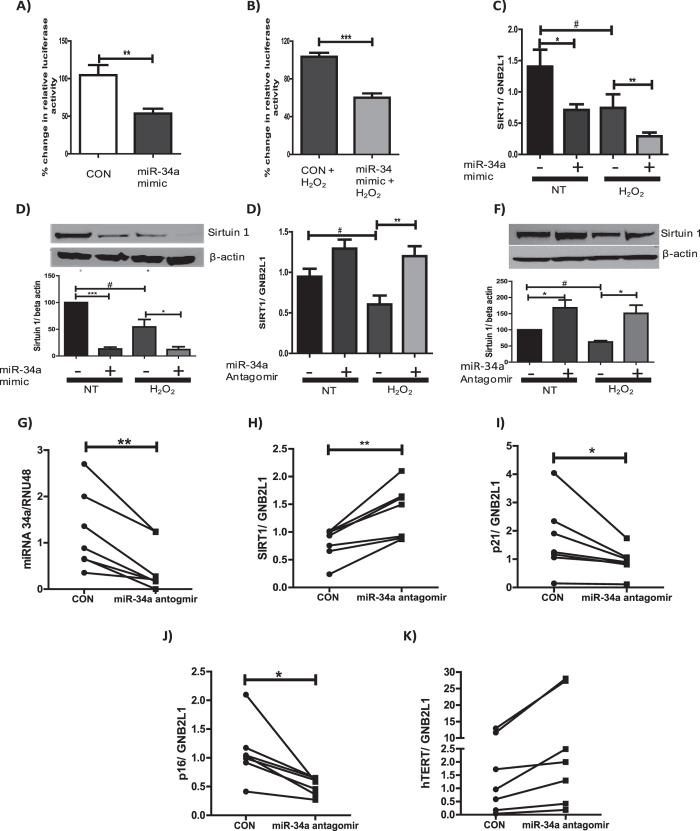
Figure 3. MiR-34a directly binds to SIRT1 mRNA 3′UTR and inhibits protein and mRNA expression.
Luciferase assays were performed in BEAS2B cells. Co-transfection of a luciferase reporter with the 3′UTR of SIRT1 downstream of a luciferase gene (0.25 μg) and either a miR-34a mimic (15 nM) or control for 24 hours. (A) Cells were either left un-stimulated or (B) were stimulated for 48 hours with 100 μM H2O2 (n = 4). (C,D) A miR-34a mimic or control were over-expressed for 24 hours and left un-treated or treated with 100 μM H2O2 for 48 hours and RNA or protein was extracted, SIRT1 gene and protein expression was assessed (n = 5). BEAS2B cells were transfected with either a miR-34a antagomir (30 nM) or control and then left untreated or treated for 48 hours with 100 μM H2O2. RNA or protein was extracted and levels of SIRT1 (E) mRNA (n = 6) or (F) protein (n = 4) were assessed. Primary epithelial cells isolated from 7 COPD patients undergoing lung resection surgery were treated with miR-34a antagomirs (30 nM) for 24 hours. RNA was then extracted and (G) miR-34a, (H) SIRT1, (I) p21, (J) p16 or (K) hTERT mRNA levels were detected. The band density of each blot is represented as a histogram and is the average of all experiments performed. Data are means ± SEM analyzed by Mann-Whitney, Paired student t-test, Kruskal–Wallis test with post hoc Dunns and One-way Anova with post hoc Bonferroni *#P < 0.05, **P < 0.01, ***P < 0.001.
Figure 4
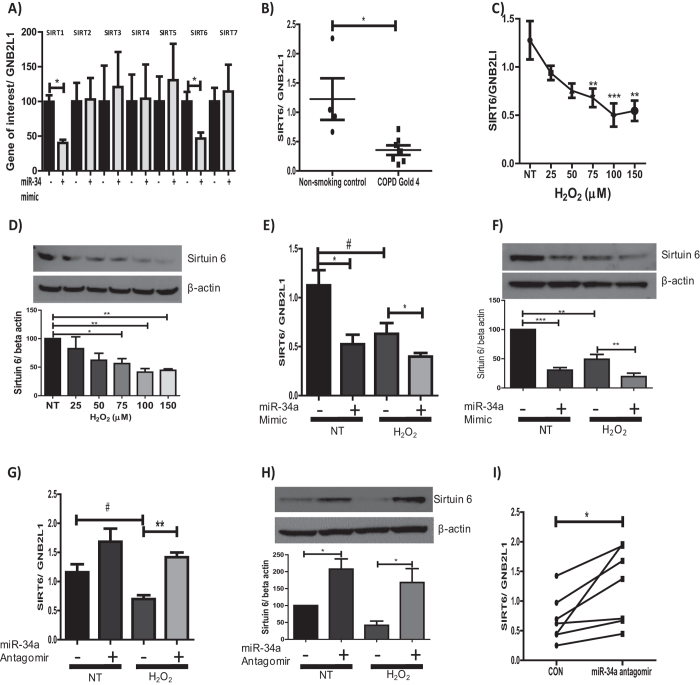
Figure 4. MiR-34a reduces the protein and mRNA expression of SIRT6.
(A) A miR-34a mimic or control was over-expressed for 24 hours and the expression of SIRT1, 2, 3, 4, 5, 6 and 7 assessed (n = 4–7). (B) Lung tissue from resections were obtained from 4 healthy volunteers and 7 COPD Gold stage 4 and RNA extracted, SIRT6 mRNA levels then examined. (C) BEAS2B cells stimulated for 48 hours with H2O2 at concentrations of 25, 50, 75, 100 and 150 μM and protein or RNA extracted and changes in SIRT6 gene expression examined (n = 5). (D) SIRT6 protein expression was also assessed (n = 5). (E,F) A miR-34a mimic (15 nM) or control was over-expressed for 24 hours and left un-treated or treated with 100 μM H2O2 for 48 hours. RNA or protein was extracted, SIRT6 gene and protein expression assessed (n = 5). A miR-34a antagomir (30 nM) or control was over-expressed for 24 hours and left untreated or treated for 48 hours with 100 μM H2O2. RNA or protein was extracted and levels of SIRT6 (G) mRNA (n = 6) or (H) protein were assessed (n = 3–5). (I) Primary bronchial epithelial cells taken from 7 patients with COPD were transfected with either a miR-34a antagomir (30 nM) or control for 24 hours. RNA was extracted and SIRT6 mRNA were detected (n = 7). The band density of each blot is represented as a histogram and is the average of all experiments performed. Data are means ± SEM analyzed by Mann-Whitney, Paired student t-test, Kruskal–Wallis test with post hoc Dunns and One-way Anova with post hoc Bonferroni *P < 0.05, **P < 0.01, ***P < 0.001.
Figure 5
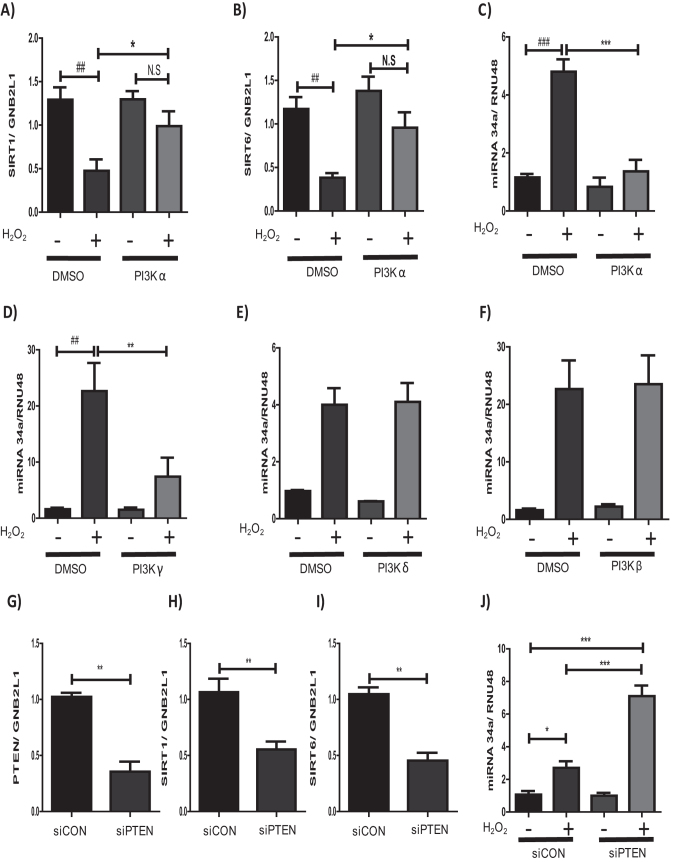
Figure 5. Pathways through which oxidative stress may regulate miR-34a expression.
BEAS2B cells were treated with either PIK75 (at 10 μM) or vehicle (DMSO) for 1 hour prior to stimulation with or without 100 μM H2O2 for 48 hours, RNA extracted and (A) SIRT1 or (B) SIRT6 expression examined (n = 6). BEAS2B cells were treated with either (C) PIK75, (D) AS-605240, (E) IC-87114 and (F) GSK2636771 (10 μM) or vehicle (DMSO) for 1 hour prior to stimulation with or without 100 μM H2O2 for 48 hours, RNA extracted and miR-34a levels assessed (n = 3–5). BEAS-2B cells were transfected with small interfering RNA (siRNA) against either PTEN for 24 h or a random oligonucleotide control and then either left un-stimulated or stimulated with 100 μM H2O2 for 48 hours (n = 4). RNA was extracted and either (G) PTEN, (H) SIRT1, (I) SIRT6 or (J) miR-34a levels assessed. Data are means ± SEM analyzed by Mann-Whitney and Kruskal–Wallis test with post hoc Dunns #P < 0.05, *P < 0.05, ***P < 0.001.
Figure 6
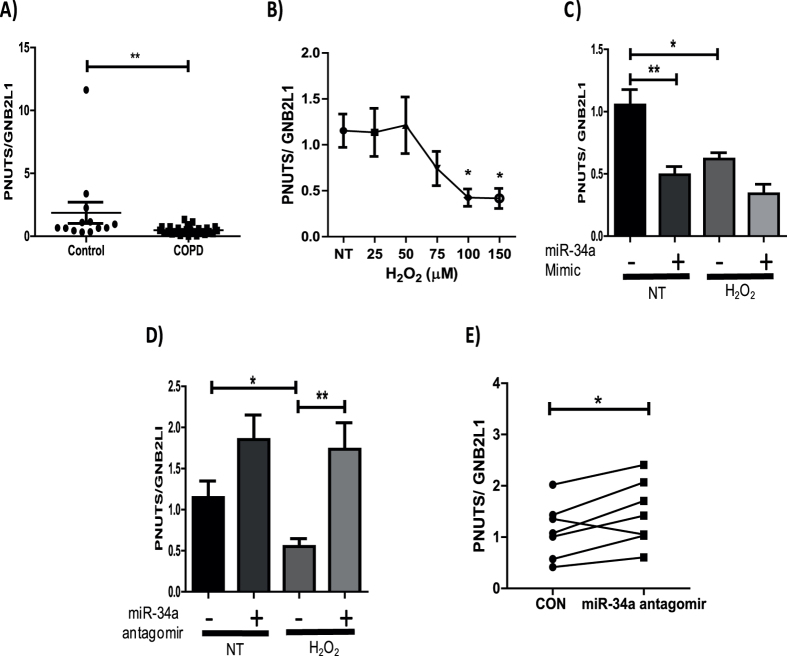
Figure 6. MiR-34a regulates the expression of the age associated protein, PNUTS.
(A) RNA was extracted from lung resection tissue and PNUTS mRNA levels examined. (B) BEAS2B cells were stimulated for 48 hours with H2O2 at concentrations of 25, 50, 75, 100 and 150 μM and RNA extracted. PNUTS gene expression was assessed (n = 4). (C) A miR-34a mimic or control were over-expressed in BEAS2B cells for 24 hours and left un-treated or treated with 100 μM H2O2 for 48 hours. RNA or protein was extracted and PNUTS gene expression assessed. (D) BEAS2B cells were transfected with either a miR-34a antagomir (30 nM) or control and either left untreated or treated for 48 hours with 100 μM H2O2. RNA was extracted and PNUTS mRNA expression assessed (n = 8). (E) Primary bronchial epithelial cells taken from 7 patients with COPD were transfected with either a miR-34a antagomir (30 nM) or RNA control for 24 hours. RNA was then extracted and PNUTS mRNA levels were detected (n = 7) Data are means ± SEM analyzed by Mann-Whitney, Paired student t-test, Kruskal–Wallis test with post hoc Dunns and One-way Anova with post hoc Bonferroni *P < 0.05, **P < 0.01.

References

    1. Kirkham P. A. et al. Oxidative stress-induced antibodies to carbonyl-modified protein correlate with severity of chronic obstructive pulmonary disease. American journal of respiratory and critical care medicine 184, 796–802, doi: 10.1164/rccm.201010-1605OC (2011). - DOI - PMC - PubMed
    1. Kirkham P. A. & Barnes P. J. Oxidative stress in COPD. Chest 144, 266–273, doi: 10.1378/chest.12-2664 (2013). - DOI - PubMed
    1. Reuter S., Gupta S. C., Chaturvedi M. M. & Aggarwal B. B. Oxidative stress, inflammation, and cancer: how are they linked? Free radical biology & medicine 49, 1603–1616, doi: 10.1016/j.freeradbiomed.2010.09.006 (2010). - DOI - PMC - PubMed
    1. Hybertson B. M., Gao B., Bose S. K. & McCord J. M. Oxidative stress in health and disease: the therapeutic potential of Nrf2 activation. Molecular aspects of medicine 32, 234–246, doi: 10.1016/j.mam.2011.10.006 (2011). - DOI - PubMed
    1. Rodier F. & Campisi J. Four faces of cellular senescence. The Journal of cell biology 192, 547–556, doi: 10.1083/jcb.201009094 (2011). - DOI - PMC - PubMed

Publication types

MeSH terms