


Maternal and Birth Characteristics and Childhood Embryonal Solid Tumors: A Population-Based Report from Brazil
- PMID: 27768709
- PMCID: PMC5074509
- DOI: 10.1371/journal.pone.0164398
Maternal and Birth Characteristics and Childhood Embryonal Solid Tumors: A Population-Based Report from Brazil
Abstract
Background: Several maternal and birth characteristics have been reported to be associated with an increased risk of many childhood cancers. Our goal was to evaluate the risk of childhood embryonal solid tumors in relation to pre- and perinatal characteristics.
Methods: A case-cohort study was performed using two population-based datasets, which were linked through R software. Tumors were classified as central nervous system (CNS) or non-CNS-embryonal (retinoblastoma, neuroblastoma, renal tumors, germ cell tumors, hepatoblastoma and soft tissue sarcoma). Children aged <6 years were selected. Adjustments were made for potential confounders. Odds ratios (OR) with 95% confidence intervals (CI) were computed by unconditional logistic regression analysis using SPSS.
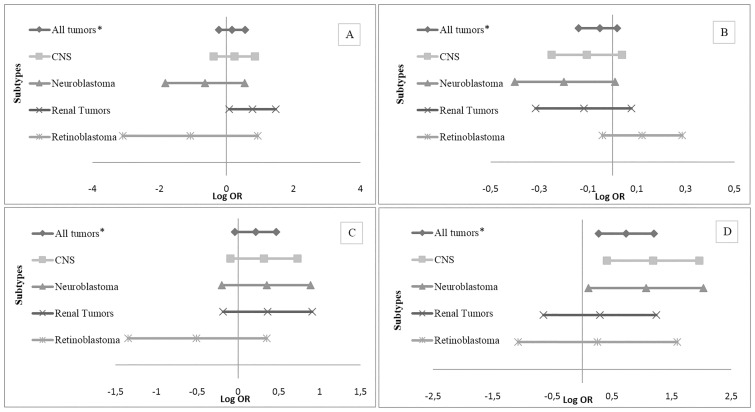
Results: Males, high maternal education level, and birth anomalies were independent risk factors. Among children diagnosed older than 24 months of age, cesarean section (CS) was a significant risk factor. Five-minute Apgar ≤8 was an independent risk factor for renal tumors. A decreasing risk with increasing birth order was observed for all tumor types except for retinoblastoma. Among children with neuroblastoma, the risk decreased with increasing birth order (OR = 0.82 (95% CI 0.67-1.01)). Children delivered by CS had a marginally significantly increased OR for all tumors except retinoblastoma. High maternal education level showed a significant increase in the odds for all tumors together, CNS tumors, and neuroblastoma.
Conclusion: This evidence suggests that male gender, high maternal education level, and birth anomalies are risk factors for childhood tumors irrespective of the age at diagnosis. Cesarean section, birth order, and 5-minute Apgar score were risk factors for some tumor subtypes.
Conflict of interest statement
The authors have declared that no competing interests exist.
Figures
References
-
- Dehner LP. The evolution of the diagnosis and understanding of primitive and embryonic neoplasms in children: living through an epoch. Mod Pathol. 1998. July;11(7):669–85. - PubMed
MeSH terms
LinkOut - more resources
Full Text Sources
Other Literature Sources
