. 2016 Dec 1:169:33-40.
doi: 10.1016/j.drugalcdep.2016.10.005. Epub 2016 Oct 11.

Expanding clinical laboratory tobacco product evaluation methods to loose-leaf tobacco vaporizers

Affiliations

Expanding clinical laboratory tobacco product evaluation methods to loose-leaf tobacco vaporizers

Alexa A Lopez et al. Drug Alcohol Depend. .

Abstract

Background: Novel tobacco products entering the US market include electronic cigarettes (ECIGs) and products advertised to "heat, not burn" tobacco. There is a growing literature regarding the acute effects of ECIGs. Less is known about "heat, not burn" products. This study's purpose was to expand existing clinical laboratory methods to examine, in cigarette smokers, the acute effects of a "heat, not burn" "loose-leaf tobacco vaporizer" (LLTV).

Methods: Plasma nicotine and breath carbon monoxide (CO) concentration and tobacco abstinence symptom severity were measured before and after two 10-puff (30-s interpuff interval) product use bouts separated by 60min. LLTV effects were compared to participants' own brand (OB) cigarettes and an ECIG (3.3V; 1.5ohm; 18mg/ml nicotine).

Results: Relative to OB, LLTV increased plasma nicotine concentration to a lesser degree, did not increase CO, and did not appear to reduce abstinence symptoms as effectively. Relative to ECIG, LLTV nicotine and CO delivery and abstinence symptom suppression did not differ. Participants reported that both the LLTV and ECIG were significantly less satisfying than OB.

Conclusions: Results demonstrate that LLTVs are capable of delivering nicotine and suppressing tobacco abstinence symptoms partially; acute effects of these products can be evaluated using existing clinical laboratory methods. Results can inform tobacco product regulation and may be predictive of the extent that these products have the potential to benefit or harm overall public health.

Keywords: Carbon monoxide; Electronic cigarette; Heat-not-burn products; Loose-leaf tobacco vaporizer; Plasma nicotine.


Conflict of interest statement

No conflict declared.

Figures
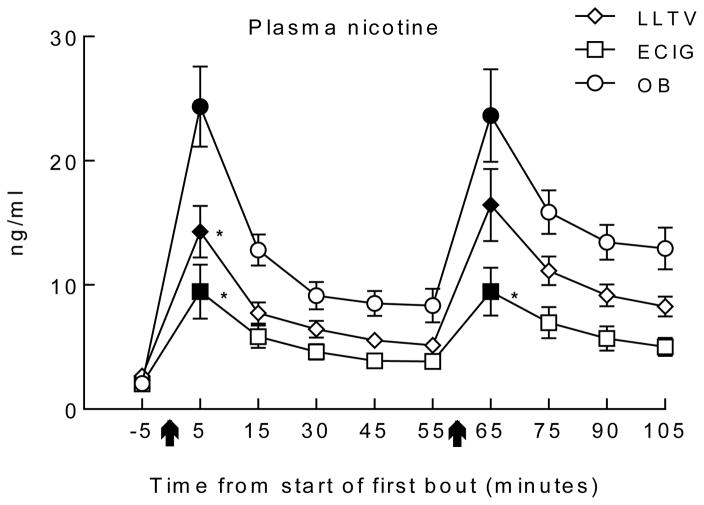
Figure 1
Figure 1
Mean ±SEM plasma nicotine concentrations for 15 participants who completed three conditions; own brand (OB), loose-leaf tobacco vaporizer (LLTV), and an electronic cigarette (ECIG). Arrows indicate the onset of each 10-puff use bout (30 second inter-puff interval). Filled symbols indicate significant difference from baseline (only conducted on time points immediately post-bout. For these non-orthogonal comparisons, all ps <.025). Asterisk indicates a significant difference from OB using paired-samples t tests (only conducted on time points immediately post-bout (for these non-orthogonal comparisons, all ps used < .017).
Figure 2
Figure 2
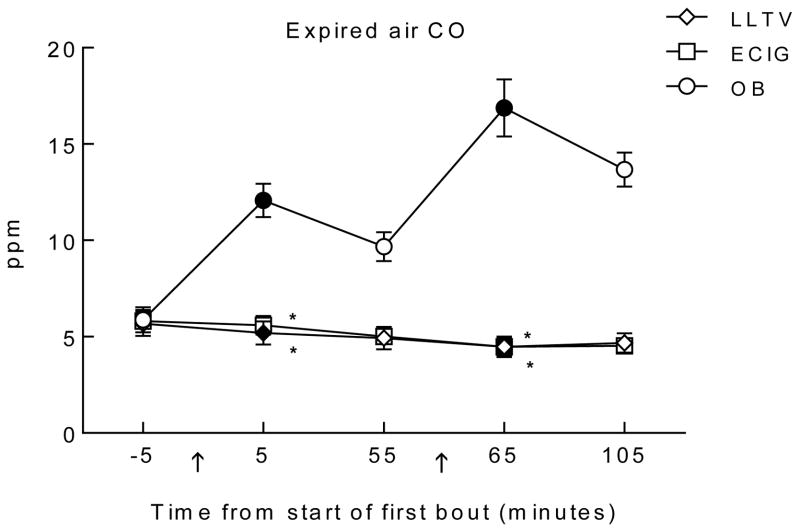
Mean ±SEM expired carbon monoxide (CO) levels for 15 participants who completed three conditions; own brand (OB), loose-leaf tobacco vaporizer (LLTV), and an electronic cigarette (ECIG). In all other respects the figure is identical to Figure 1.
Figure 3
Figure 3
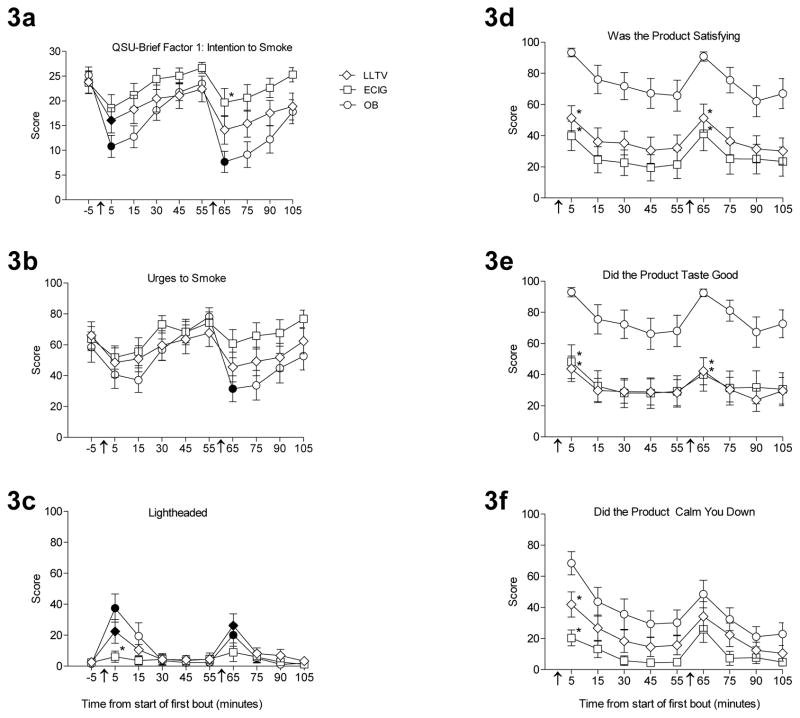
Mean ±SEM ratings for six visual analog scale items from 15 participants before and after product use over three sessions that differed by product; own brand (OB), loose-leaf tobacco vaporizer (LLTV), and an electronic cigarette (ECIG). “Intention to smoke a cigarette” from the QSU-Brief Factor 1 score (Figure 3a); “Urges to Smoke” from the Hughes-Hatsukami withdrawal scale (Figure 3b); “Lightheaded” from the Direct Effects of Nicotine scale (Figure 3c); “Was the product satisfying” (Figure 3d), “Did the product taste good” (Figure 3e), and “Did the product calm you down” (Figure 3f) from the Direct Effects of Product Use scale. No comparisons across time were conducted for figures 3d, 3e, or 3f, as these questions did not have a true baseline time point. In all other respects the figure is identical to Figure 1.

References

    1. Blank MD, Cobb CO, Kilgalen B, Austin J, Weaver MF, Shihadeh A, Eissenberg T. Acute effects of waterpipe tobacco smoking: a double-blind, placebo-control study. Drug Alcohol Depend. 2011;116:102–109. doi: 10.1016/j.drugalcdep.2010.11.026. - DOI - PMC - PubMed
    1. Breland A, Soule E, Lopez A, Ramôa C, El-Hellani A, Eissenberg T. Electronic cigarettes: what are they and what do they do? Ann N Y Acad Sci. 2016 doi: 10.1111/nyas.12977. - DOI - PMC - PubMed
    1. Breland A, Kleykamp B, Eissenberg T. Clinical laboratory evaluation of potential reduced exposure products for smokers. Nicotine Tob Res. 2006;8:727–738. doi: 10.1080/14622200600789585. - DOI - PubMed
    1. Breland A, Buchhalter A, Evans S, Eissenberg T. Evaluating acute effects of potential reduced-exposure products for smokers: clinical laboratory methodology. Nicotine Tob Res. 2002;4:131–140. doi: 10.1080/1462220021000032780. - DOI - PubMed
    1. Buchhalter A, Schrinel L, Eissenberg T. Withdrawal-suppressing effects of a novel smoking system: comparison with own brand, not own brand, and de-nicotinized cigarettes. Nicotine Tob Res. 2001;3:111–118. doi: 10.1080/14622200110042636. - DOI - PubMed

Publication types