


Do sex hormones or hormone therapy modify the relation of n-3 fatty acids with incident depressive symptoms in postmenopausal women? The MESA Study
- PMID: 27768981
- PMCID: PMC5135581
- DOI: 10.1016/j.psyneuen.2016.10.003
Do sex hormones or hormone therapy modify the relation of n-3 fatty acids with incident depressive symptoms in postmenopausal women? The MESA Study
Abstract
Introduction: Considering that estradiol (E2) and n-3 polyunsaturated fatty acids (PUFAs) have roles in neurogenesis and in neurotransmission, we examined whether the association of PUFAs with incident depressive symptoms in postmenopausal women is modified by hormone therapy (HT) use or estrogen status.
Methods: Women (N=1616) free of depressive symptoms at baseline (2000-2002) in the Multi-Ethnic Study of Atherosclerosis were classified by HT usage and quartiles of dietary eicosapentaenoic acid (EPA), docosahexaenoic acid (DHA), and the sum EPA+DHA. Women with serum E2 ≤0.073 nmol/L (sample median), were classified low on E2. Poisson regression was used to model incident depressive symptoms at examination 3 (2004-05), defined by the Center for Epidemiological Studies Depression Scale ≥16 or taking an antidepressant, first as a function of HT use and n-3 PUFA quartiles, and second, as a function of low E2 status and n-3 PUFA quartiles.
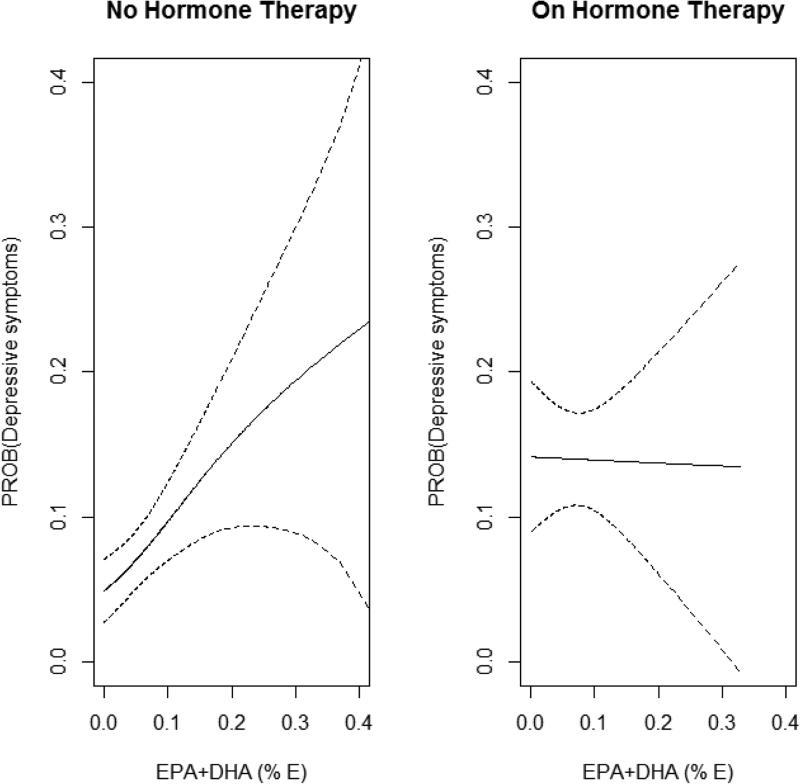
Results: Among HT non- users, positive, graded relationships (p-trends≤0.003) were found between PUFAs and incident depressive symptoms. Compared to the lowest quartile, the adjusted risk ratios (RRs) for the highest were 2.10, 2.39, and 2.04 for EPA, DHA, and EPA+DHA, respectively. For HT users, no associations were seen. When analyses were run for E2 status, the RRs over quartiles of the PUFAs were positive and graded for low E2 women, but were null for High E2 women.
Conclusions: Higher intakes of DHA and EPA were associated with higher risk of depressive symptoms in nonusers of HT, contrary to hypothesis.
Keywords: CES-D; Depressive symptoms; Estrogen; Hormone therapy; Menopause; n-3 Fatty acids.
Copyright © 2016 Elsevier Ltd. All rights reserved.
Figures
References
-
- Alessandri J-M, Extier A, Al-Gubory KH, Langelier B, Baudry C, LePoupon C, Lavialle M, Guesnet P. Ovariectomy and 17β-estradiol alter transcription of lipid metabolism genes and proportions of neo-formed n3 and n-6 long-chain polyunsaturated fatty acids differently in brain and liver. J Nutr Biochem. 2011;22:820–827. - PubMed
-
- Barha CK, Galea LAM. Influence of different estrogens on neuroplasticity and cognition in the hippocampus. Biochim Biophys Acta. 2010;1800:1056–1067. - PubMed
-
- Barha CK, Lieblich SE, Chow C, Galea LAM. Multiparity-induced enhancement of hippocampal neurogenesis and spatial memory depends on ovarian hormone status in middle age. Neurobiol Aging. 2015;36:2391–2405. - PubMed
Publication types
MeSH terms
Substances
Grants and funding
- HHSN268201500003C/HL/NHLBI NIH HHS/United States
- N01 HC095161/HL/NHLBI NIH HHS/United States
- N01 HC095168/HL/NHLBI NIH HHS/United States
- N01 HC095167/HL/NHLBI NIH HHS/United States
- R01 HL074406/HL/NHLBI NIH HHS/United States
- N01 HC095159/HL/NHLBI NIH HHS/United States
- N01 HC095163/HL/NHLBI NIH HHS/United States
- HHSN268201500003I/HL/NHLBI NIH HHS/United States
- UL1 TR000040/TR/NCATS NIH HHS/United States
- N01 HC095166/HL/NHLBI NIH HHS/United States
- N01 HC095162/HL/NHLBI NIH HHS/United States
- R01 HL074338/HL/NHLBI NIH HHS/United States
- N01 HC095160/HL/NHLBI NIH HHS/United States
- UL1 TR001079/TR/NCATS NIH HHS/United States
- N01 HC095169/HL/NHLBI NIH HHS/United States
- N01 HC095165/HL/NHLBI NIH HHS/United States
- N01 HC095164/HL/NHLBI NIH HHS/United States
LinkOut - more resources
Full Text Sources
Other Literature Sources
Medical
Research Materials
