. 2016 Dec;204(4):1433-1445.
doi: 10.1534/genetics.116.194134. Epub 2016 Oct 21.

Chromatin Association of Gcn4 Is Limited by Post-translational Modifications Triggered by its DNA-Binding in Saccharomyces cerevisiae

Affiliations

Chromatin Association of Gcn4 Is Limited by Post-translational Modifications Triggered by its DNA-Binding in Saccharomyces cerevisiae

Akhi Akhter et al. Genetics. 2016 Dec.

Abstract

The Saccharomyces cerevisiae transcription factor Gcn4 is expressed during amino acid starvation, and its abundance is controlled by ubiquitin-mediated proteolysis. Cdk8, a kinase component of the RNA polymerase II Mediator complex, phosphorylates Gcn4, which triggers its ubiquitination/proteolysis, and is thought to link Gcn4 degradation with transcription of target genes. In addition to phosphorylation and ubiquitination, we previously showed that Gcn4 becomes sumoylated in a DNA-binding dependent manner, while a nonsumoylatable form of Gcn4 showed increased chromatin occupancy, but only if Cdk8 was present. To further investigate how the association of Gcn4 with chromatin is regulated, here we examine determinants for Gcn4 sumoylation, and how its post-translational modifications are coordinated. Remarkably, artificially targeting Gcn4 that lacks its DNA binding domain to a heterologous DNA site restores sumoylation at its natural modification sites, indicating that DNA binding is sufficient for the modification to occur in vivo Indeed, we find that neither transcription of target genes nor phosphorylation are required for Gcn4 sumoylation, but blocking its sumoylation alters its phosphorylation and ubiquitination patterns, placing Gcn4 sumoylation upstream of these Cdk8-mediated modifications. Strongly supporting a role for sumoylation in limiting its association with chromatin, a hyper-sumoylated form of Gcn4 shows dramatically reduced DNA occupancy and expression of target genes. Importantly, we find that Cdk8 is at least partly responsible for clearing hyper-sumoylated Gcn4 from DNA, further implicating sumoylation as a stimulus for Cdk8-mediated phosphorylation and degradation. These results support a novel function for SUMO in marking the DNA-bound form of a transcription factor, which triggers downstream processes that limit its association with chromatin, thus preventing uncontrolled expression of target genes.

Keywords: Cdk8; Gcn4; gene activation; sumoylation; transcription.


Figures

Figure 1
Figure 1
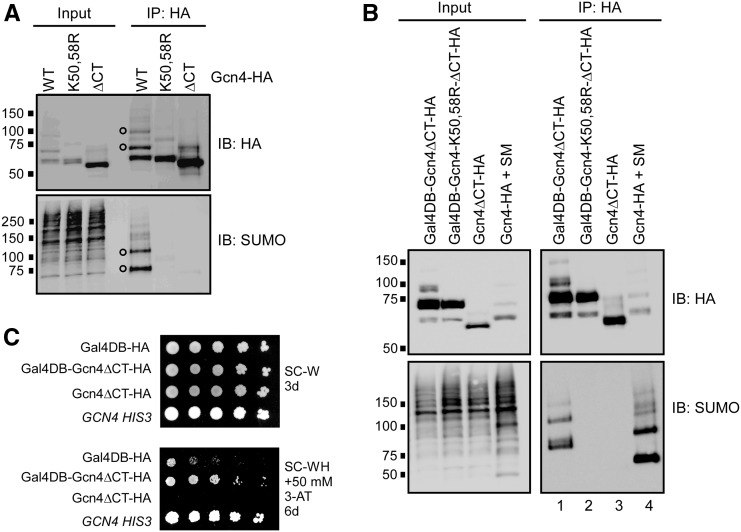
DNA binding is sufficient for Gcn4 sumoylation on Lys 50 and 58. (A) HA and SUMO immunoblot analysis of HA IPs from strains expressing plasmid-derived WT, SUMO-deficient (K50,58R), or DNA-binding-deficient (ΔCT) forms of Gcn4, all of which contain a 6× HA C-terminal epitope tag. Open circles indicate position of the two major sumoylated forms of Gcn4, detectable in both HA and SUMO blots, as previously reported (Rosonina et al. 2012). Expression of Gcn4 was induced by addition of SM for 20 min to synthetic complete growth medium lacking Val and Ile to generate amino acid starvation conditions, and lysates were prepared with NEM to impair SUMO proteases and deubiquitinating enzymes. Inputs represent ∼2.5–5% of immunoprecipitated material analyzed in the immunoblot. Strains analyzed are ERYM663, ERYM664F, and ERYM709. (B) IP-immunoblot analysis, as in (A), from strains expressing indicated HA-tagged proteins. All proteins, except Gcn4-HA, were generated from plasmids containing the constitutive ADH1 promoter, in the HF7c strain grown under standard conditions (see Materials and Methods). Gcn4-HA was expressed from the GCN4 chromosomal locus in the BY4741 strain to which SM was added, and was included in this analysis for comparison. Strains analyzed are YER026, YER028, YER029, and ERYM663. (C) Yeast spot assay comparing growth of HF7c yeast expressing indicated proteins, as in (B), on minimal medium selective for yeast containing expression plasmids (SC-W; lacking Trp), or the same lacking His (SC-WH) plus 50 mM 3-AT. HF7c contains a HIS3 reporter gene controlled by the GAL4 UAS, to which the Gal4 DB binds. A control HIS+ strain (with WT GCN4) is included for comparison. Plates were photographed after incubation for the number of days indicated. Strains analyzed are YER027, YER026, YER029, and YAA020A.
Figure 2
Figure 2
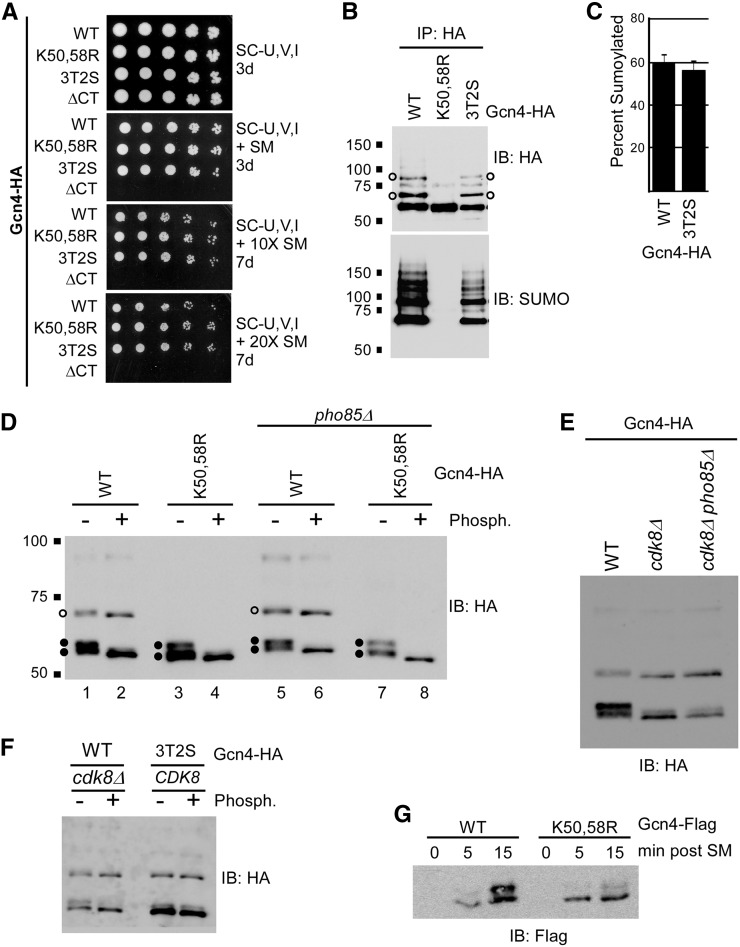
Gcn4 sumoylation does not depend on its prior phosphorylation. (A) Yeast spot assay comparing growth of strains expressing indicated forms of Gcn4, including a form that cannot be phosphorylated by Pho85 or Cdk8 (3T2S; Chi et al. 2001). Minimal medium was used lacking Ura, Val, and Ile, and supplemented with either no SM (top), 0.5 μg/ml SM, or 10× or 20× this concentration, as indicated. Plates were photographed after indicated number of days of growth. Strains analyzed are ERYM663, ERYM664F, YAA003, and ERYM709. (B) HA and SUMO immunoblot analyses of HA IPs from strains expressing indicated HA-tagged forms of Gcn4, as in Figure 1A. Open circles indicate the positions of the two major sumoylated forms of Gcn4. Strains analyzed are ERYM663, ERYM664F, and YAA003. (C) Level of Gcn4 sumoylation in Gcn4-WT and -3T2S strains. Densitometry was performed on HA IP-immunoblots (as in Figure S1C) by measuring the intensity of the two major sumoylated forms of Gcn4, and representing it as a percent fraction of the total Gcn4 signal on the immunoblot. Strains analyzed are ERYM663 and YAA003. (D) HA immunoblot analysis of the Gcn4-HA isoforms in the indicated strains was performed, as in Figure 1A, after mock treatment (−) or addition of Lambda protein phosphatase (+). Open circles indicate the position of the major sumoylated form of Gcn4 (the additional sumoylated form detected in IPs is only barely visible near the top of the blot). Closed circles indicate the positions of the differentially phosphorylated unsumoylated forms of Gcn4. Strains analyzed are ERYM663, ERYM664F, ERYM665, and ERYM666. (E) Gcn4-HA immunoblot analysis in cdk8Δ and cdk8Δ pho85Δ strains. Strains analyzed are ERYM663, ERYM667, and ERYM671. (F) HA immunoblot analysis of Gcn4-WT in a cdk8Δ strain and Gcn4-3T2S in a CDK8 strain from lysates treated (+), or mock treated (−), with Lambda phosphatase. Strains analyzed are ERYM663, ERYM667, and YAA003. (G) Flag immunoblot analysis of strains expressing plasmid-derived Flag-tagged Gcn4-WT or Gcn4-K50,58R in a time-course after addition of SM to growth medium. Strains analyzed are ERYM665 and ERYM666.
Figure 3
Figure 3
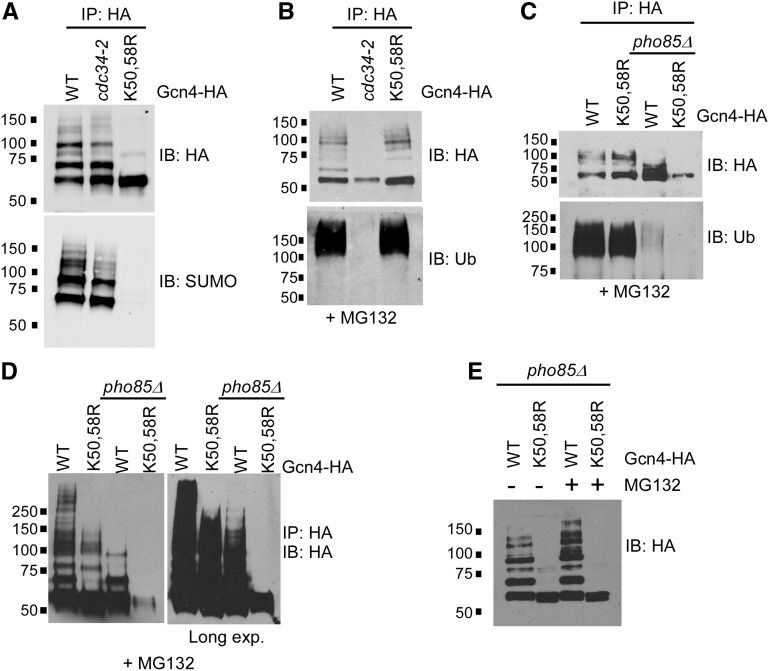
Gcn4 sumoylation promotes further modifications that are stabilized by blocking the 26S proteasome. (A) HA and SUMO immunoblot analysis of HA IPs of Gcn4-WT from CDC34 (WT) or cdc34-2 strains, or from a Gcn4-K50,58R-expressing strain, as in Figure 1A. Strains analyzed are ERYM663, YAA002, and ERYM664F. (B) HA and ubiquitin (Ub) immunoblot analysis of HA IPs from strains expressing WT, cdc34-2, or K50,58R forms of Gcn4. Cultures were treated with MG132 prior to induction with SM as in Figure 1A. Strains analyzed are ERYM663, YAA002, and ERYM664F. (C, D) HA and Ub immunoblot analysis of HA IPs of Gcn4-WT or Gcn4-K50,58R from PHO85 or pho85Δ strains. Cultures were treated with MG132 prior to induction with SM as in Figure 1A. Two exposures of a higher resolution HA immunoblot of immunoprecipitated samples derived from the same strains appears in (D). Strains analyzed are ERYM663, ERYM664F, ERYM665, and ERYM666. (E) HA immunoblot analysis of HA IPs of Gcn4-WT or Gcn4-K50,58R in pho85Δ strains either mock treated, or treated with MG132 prior to induction with SM as in Figure 1A. Because pho85Δ strains grow slowly, cultures analyzed in (C–E) were not necessarily matched for cell density, which can result in variable of Gcn4 expression signals. Strains analyzed are ERYM665 and ERYM666.
Figure 4
Figure 4
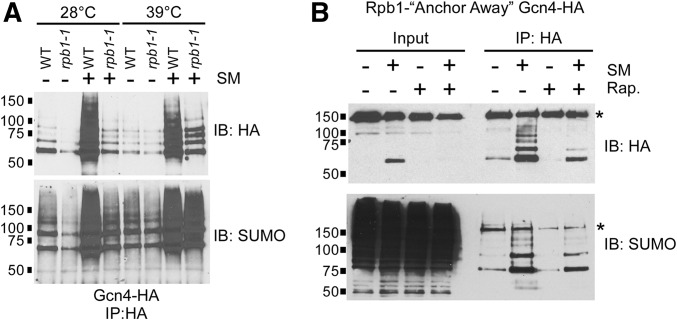
Gcn4 sumoylation does not depend on active transcription or RNAP II recruitment. (A) HA and SUMO immunoblot analysis of HA IPs of Gcn4-WT from WT or rpb1-1 strains. Strains were grown either at 28°, then left at that temperature, or switched to 39° for 15 min, which is the nonpermissive temperature for the rpb1-1 strain (Nonet et al. 1987). Strains were then either mock treated (−) or induced with SM (+) for an additional 15 min at the same temperatures prior to lysis and IP. Strains analyzed are YAA010 and YAA011. (B) HA and SUMO immunoblot analysis of HA IPs of Gcn4-WT expressed in the Rpb1-FRB (Anchor Away) strain (YAA032). Cultures of the strain were either mock treated (−), or treated with 1 μg/ml rapamycin (+ Rap.) for 20 min prior to a further 20 min treatment with either DMSO (mock; −) or SM, to induce expression of Gcn4, prior to lysis and IP. Asterisks indicate unrelated cross-reacting protein detected in immunoblot analyses in this strain.
Figure 5
Figure 5
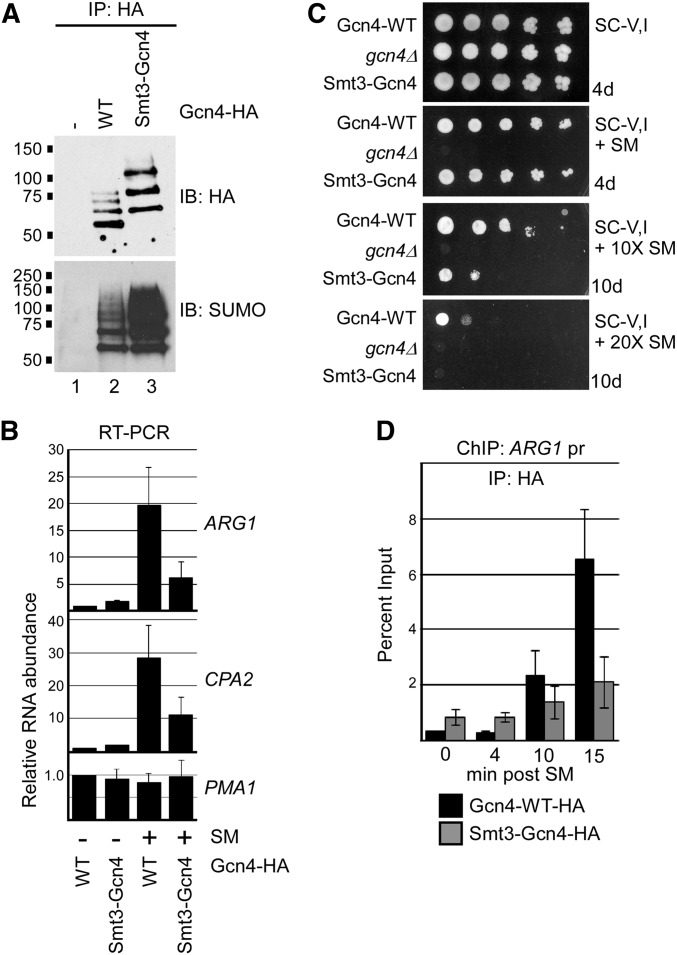
Hyper-sumoylation of Gcn4 reduces its occupancy on target DNA. (A) HA and SUMO immunoblot analysis of HA IPs of Gcn4-WT, or of the fusion Smt3-Gcn4-WT, both of which contain the usual C-terminal 6× HA tag. A strain with no HA tag on Gcn4 (−) was analyzed in parallel as a control. Strains analyzed are ERYM615, ERYM613, and YAA030H. (B) qRT-PCR analysis of RNA isolated from Gcn4-WT or Smt3-Gcn4 strains mock-treated (−) or induced for Gcn4 expression with SM (+). Genes analyzed include Gcn4-targets ARG1 and CPA2, and the constitutively expressed PMA1 gene. The average of three independent experiments is shown, with SD shown as error bars. Strains analyzed are ERYM613 and YAA030H. (C) Yeast spot assay comparing growth of strains expressing Gcn4-WT, no Gcn4 (gcn4Δ), or the fusion Smt3-Gcn4 on minimal medium lacking Val and Ile, and supplemented with either no SM (top), 0.5 μg/ml SM, or 10× or 20× this concentration, as indicated. Plates were photographed after indicated number of days of growth. Strains analyzed are ERYM613, ERYM625, and YAA030H. (D) Comparison of Gcn4 and Smt3-Gcn4 occupancy on target DNA. HA ChIP analysis of the promoter-proximal region of the ARG1 gene was performed in the Gcn4-WT or Smt3-Gcn4 strains at indicated times post induction with SM. The average of three independent experiments is shown with SD shown as error bars. Strains analyzed are ERYM613 and YAA030H.
Figure 6
Figure 6
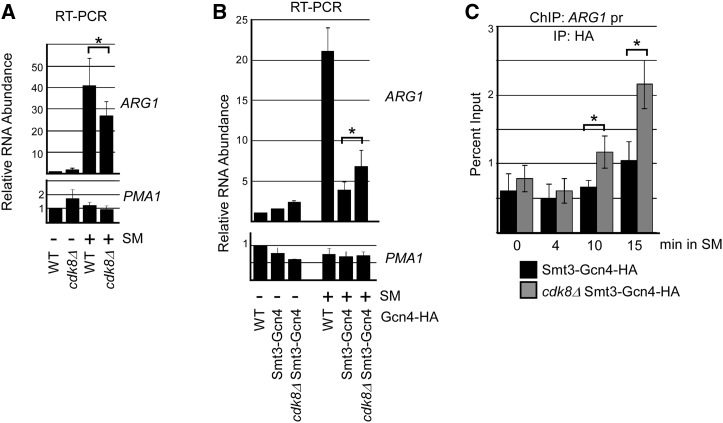
Deletion of CDK8 partially restores occupancy of Smt3-Gcn4 on target DNA. (A) Comparison of ARG1 and PMA1 RNA levels in WT and cdk8Δ strains. qRT-PCR analysis was performed on RNA isolated from WT or cdk8Δ strains in mock-treated (−) or SM-induced cells. The average of three independent experiments is shown with SD shown as error bars. Asterisk indicates statistically different values. Strains analyzed are ERYM613 and YAA034B. (B) Analysis of ARG1 and PMA1 RNA levels by qRT-PCR on RNA isolated from indicated strains that were mock-treated (−) or treated with SM. The average of three independent experiments is shown with SD shown as error bars. Asterisk indicates statistically different values. Strains analyzed are ERYM613, YAA030H, and YAA034B. (C) Comparison of DNA occupancy of Smt3-Gcn4 in CDK8 and cdk8Δ strains on ARG1 promoter-proximal DNA. HA ChIP analysis was performed at time-points indicated after induction with SM. The average of three independent experiments is shown with SD shown as error bars. Asterisks indicate statistically different values. Strains analyzed are YAA030H and YAA034B.
Figure 7
Figure 7
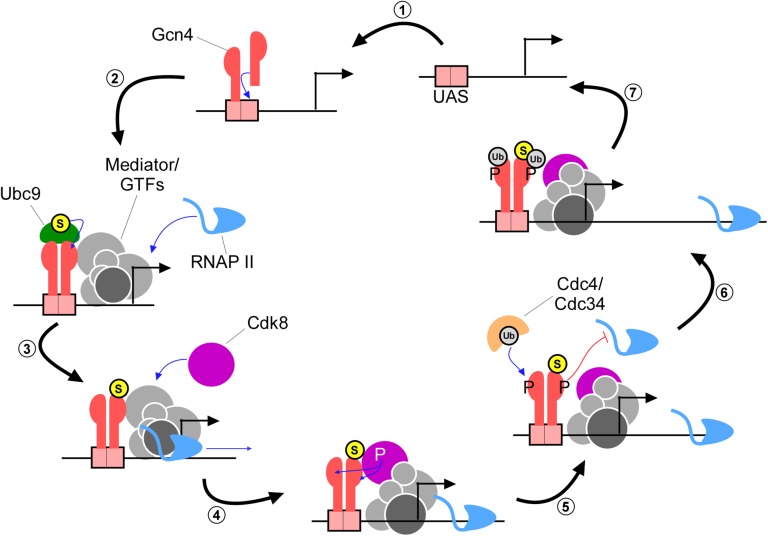
Model depicting how coordinated modifications regulate Gcn4 after it binds DNA. Refer to text for a detailed description. Encircled S represents SUMO modification, encircled Ub is ubiquitin, and P represents phosphorylation. The 26 S proteasome, which targets ubiquitinated Gcn4 for degradation, is not shown, but acts in step 7.

References

    1. Allen B. L., Taatjes D. J., 2015. The Mediator complex: a central integrator of transcription. Nat. Rev. Mol. Cell Biol. 16: 155–166. - PMC - PubMed
    1. Amberg D. C., D. J. Burke, and J. N. Strathern, 2006 Yeast RNA isolation: small-scale. CSH Protoc. 2006: pii: pdb.prot4155. - PubMed
    1. Andrau J.-C., van de Pasch L., Lijnzaad P., Bijma T., Koerkamp M. G., et al. , 2006. Genome-wide location of the coactivator mediator: binding without activation and transient Cdk8 interaction on DNA. Mol. Cell 22: 179–192. - PubMed
    1. Bertolotto C., Lesueur F., Giuliano S., Strub T., de Lichy M., et al. , 2011. A SUMOylation-defective MITF germline mutation predisposes to melanoma and renal carcinoma. Nature 480: 94–98. - PubMed
    1. Brzovic P. S., Heikaus C. C., Kisselev L., Vernon R., Herbig E., et al. , 2011. The acidic transcription activator Gcn4 binds the mediator subunit Gal11/Med15 using a simple protein interface forming a fuzzy complex. Mol. Cell 44: 942–953. - PMC - PubMed

MeSH terms

Substances

LinkOut - more resources