


Pathways through opiate use and offending: A systematic review
- PMID: 27770693
- PMCID: PMC5234472
- DOI: 10.1016/j.drugpo.2016.08.015
Pathways through opiate use and offending: A systematic review
Abstract
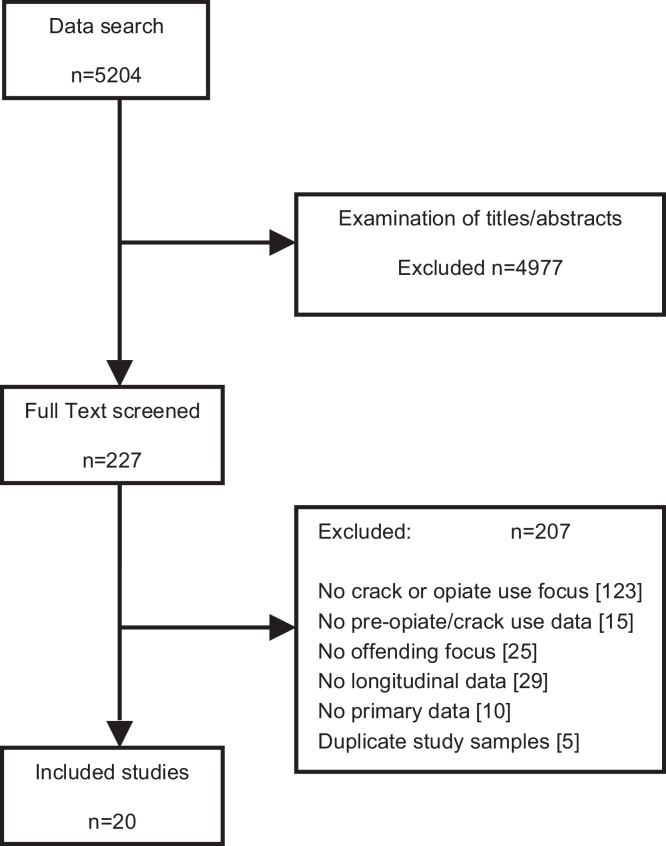
Background: Although evidence points to a strong link between illicit drug use and crime, robust evidence for temporal order in the relationship is scant. We carried out a systematic review to assess the evidence for pathways through opiate/crack cocaine use and offending to determine temporal order.
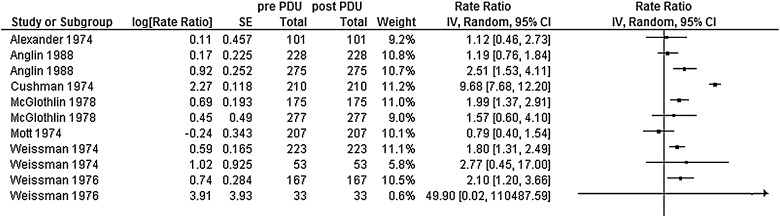
Methods: A systematic review sourced five databases, three online sources, bibliographies and citation mapping. Inclusion criteria were: focus on opiate/crack use, and offending; pre-drug use information; longitudinal design; corroborative official crime records. Rate ratios (RR) of post-drug use initiation to pre-drug use initiation were pooled using random effects meta-analysis.
Results: 20 studies were included; UK (9) and US (11). All were of opiate use. Mean age at (recorded) offending onset (16.7yrs) preceded mean age at opiate-use onset (19.6yrs). Substantial heterogeneity (over 80%: unexplained by meta-regression) meant that RRs were not pooled. The RR for total (recorded) offending ranged from 0.71 to 25.7 (10 studies; 22 subsamples: positive association, 4: equivocal, 1: negative association). Positive associations were observed in 14/15 independent samples; unlikely to be a chance finding (sign test p=0.001). Individual offence types were examined: theft (RR 0.63-8.3, 13 subsamples: positive, 9: equivocal, 1 negative); burglary (RR 0.74-50.0, 9 subsamples: positive, 13: equivocal); violence (RR 0.39-16.0, 6 subsamples: positive, 15: equivocal); and robbery (RR 0.50-5.0, 5 subsamples: positive, 15: equivocal).
Conclusions: Available evidence suggests that onset-opiate use accelerates already-existing offending, particularly for theft. However, evidence is out of date, with studies characterised by heterogeneity and failure to use a matched non-opiate-user comparison group to better-establish whether onset-opiate use is associated with additional crime.
Keywords: Crime; Opiate use; Substance abuse; Systematic review.
Copyright © 2016 The Authors. Published by Elsevier B.V. All rights reserved.
Figures
References
-
- Altman D.G. Chapman & Hall; Florida: 1991. Practical statistics for medical research.
-
- Anglin M.D., Booth M.W., Ryan T.M., Hser Y.-I. Ethnic differences in narcotics addiction. II. Chicano and Anglo addiction career patterns. International Journal of Addiction. 1988;23:1011–1027. - PubMed
-
- Anglin M.D., Hser Y.-I. Addicted women and crime. Criminology. 1987;25:358–359.
-
- Anglin M.D., Ryan T.M., Booth M.W., Hser Y.-I. Ethnic differences in narcotics addiction. I. Characteristics of Chicano and Anglo methadone maintenance clients. International Journal of Addiction. 1988;23:125–149. - PubMed
Publication types
MeSH terms
Grants and funding
LinkOut - more resources
Full Text Sources
Other Literature Sources
Medical
