


Dietary Habits and Risk of Kidney Function Decline in an Urban Population
- PMID: 27771303
- PMCID: PMC5161560
- DOI: 10.1053/j.jrn.2016.08.007
Dietary Habits and Risk of Kidney Function Decline in an Urban Population
Abstract
Objective: Explore the association between following a Dietary Approaches to Stop Hypertension (DASH)-accordant diet and kidney end points among urban adults.
Design: Prospective cohort study.
Setting: Healthy Aging in Neighborhoods of Diversity across the Life Span study.
Subjects: A total of 1,534 urban dwelling participants of the Healthy Aging in Neighborhoods of Diversity across the Life Span study with a baseline estimated glomerular filtration rate (eGFR) ≥60 mL/minute/1.73 m2.
Intervention: DASH diet accordance determined via a score based on nine target nutrients.
Main outcome measure: Rapid kidney function decline (eGFR decline >3 mL/minute/1.73 m2 per year), incident chronic kidney disease (CKD) (follow-up eGFR <60 mL/minute/1.73 m2), and eGFR decline >25%.
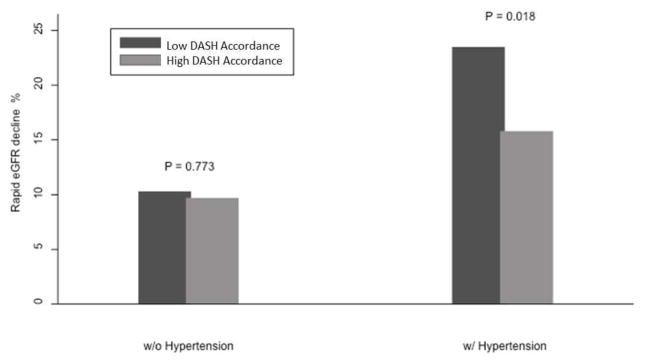
Results: Participants' mean age was 48 years, and 59% were African-American. Median DASH score was 1.5 (range, 0-8). Over a median of 5 years, 13.4% experienced rapid eGFR decline, including 15.2% among participants not following a DASH-accordant diet (score ≤1) and 12.0% with higher accordance (score >1) (P = .08). Outcomes varied by hypertension status. In multinomial logistic regression models, following adjustment for sociodemographic and clinical factors, including total energy intake, low DASH diet accordance was associated with rapid eGFR decline among participants with hypertension (risk ratio, 1.68; 95% confidence interval: 1.17-2.42) but not among those without hypertension (risk ratio, 0.83; 95% confidence interval: 0.56-1.24; P interaction .001). There was no statistically significant association between DASH diet accordance and incident CKD or eGFR decline >25%. Results were similar when DASH diet accordance was analyzed in tertiles.
Conclusions: Among urban adults, low accordance to a DASH-type diet was not associated with incident CKD, but was associated with higher risk of rapid eGFR decline among those with hypertension, yet not among those without hypertension. Further study of dietary patterns as a potential target for improving kidney outcomes among high-risk populations is warranted.
Copyright © 2016 National Kidney Foundation, Inc. All rights reserved.
Conflict of interest statement
The authors have no conflicts of interest relevant to this manuscript.
Figures
References
-
- Kontogianni MD, Panagiotakos DB. Dietary patterns and stroke: a systematic review and remeta-analysis. Maturitas. 2014;79(1):41–47. - PubMed
-
- Maghsoudi Z, Azadbakht L. How dietary patterns could have a role in prevention, progression, or management of diabetes mellitus? Review on the current evidence. Journal of research in medical sciences : the official journal of Isfahan University of Medical Sciences. 2012;17(7):694–709. - PMC - PubMed
Publication types
MeSH terms
Grants and funding
LinkOut - more resources
Full Text Sources
Other Literature Sources
Medical
Research Materials
Miscellaneous
