Dopaminergic Enhancement of Striatal Response to Reward in Major Depression
- PMID: 27771973
- PMCID: PMC5378658
- DOI: 10.1176/appi.ajp.2016.16010111
Dopaminergic Enhancement of Striatal Response to Reward in Major Depression
Abstract
Objective: Major depressive disorder is characterized by reduced reward-related striatal activation and dysfunctional reward learning, putatively reflecting decreased dopaminergic signaling. The goal of this study was to test whether a pharmacological challenge designed to facilitate dopaminergic transmission can enhance striatal responses to reward and improve reward learning in depressed individuals.
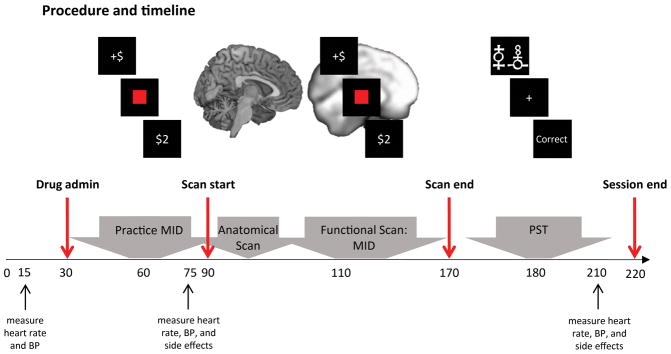
Method: In a double-blind placebo-controlled design, 46 unmedicated depressed participants and 43 healthy control participants were randomly assigned to receive either placebo or a single low dose (50 mg) of the D2/D3 receptor antagonist amisulpride, which is believed to increase dopamine signaling through presynaptic autoreceptor blockade. To investigate the effects of increased dopaminergic transmission on reward-related striatal function and behavior, a monetary incentive delay task (in conjunction with functional MRI) and a probabilistic reward learning task were administered at absorption peaks of amisulpride.
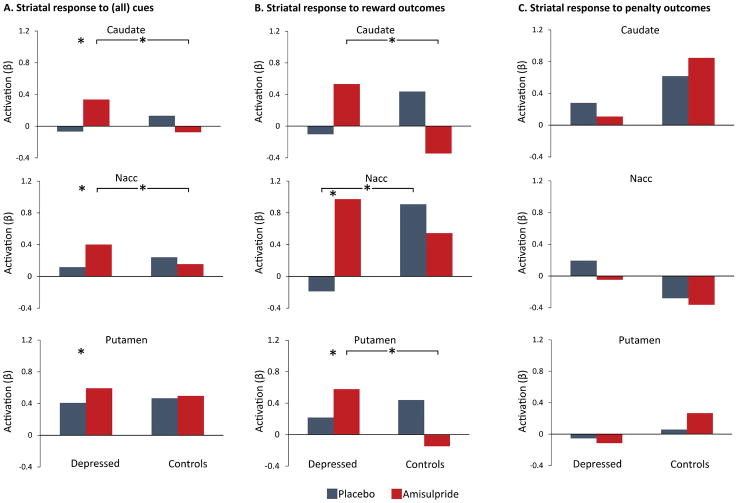
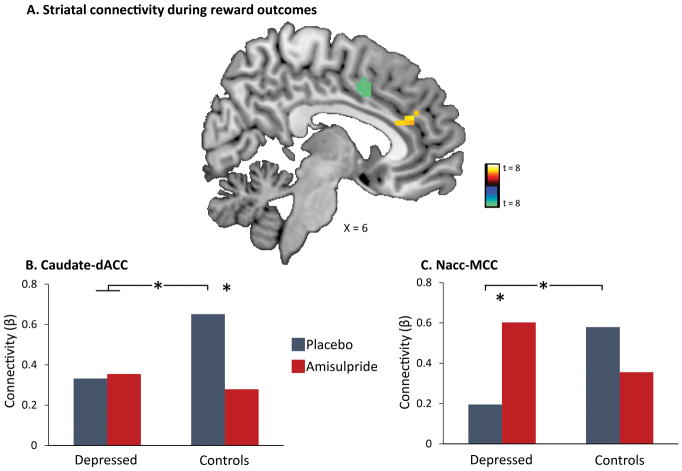
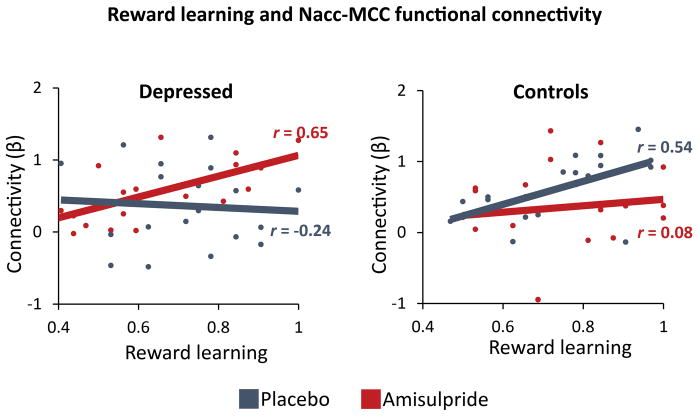
Results: Depressed participants selected previously rewarded stimuli less frequently than did control participants, indicating reduced reward learning, but this effect was not modulated by amisulpride. Relative to depressed participants receiving placebo (and control participants receiving amisulpride), depressed participants receiving amisulpride exhibited increased striatal activation and potentiated corticostriatal functional connectivity between the nucleus accumbens and the midcingulate cortex in response to monetary rewards. Stronger corticostriatal connectivity in response to rewards predicted better reward learning among depressed individuals receiving amisulpride as well as among control participants receiving placebo.
Conclusions: Acute enhancement of dopaminergic transmission potentiated reward-related striatal activation and corticostriatal functional connectivity in depressed individuals but had no behavioral effects. Taken together, the results suggest that targeted pharmacological treatments may normalize neural correlates of reward processing in depression; despite such acute effects on neural function, behavioral modification may require more chronic exposure. This is consistent with previous reports that antidepressant effects of amisulpride in depression emerged after sustained administration.
Keywords: Antidepressants; Biological Markers; Brain Imaging Techniques; Dopamine; Mood Disorders-Unipolar; Reward.
Figures
Comment in
-
Boosting dopamine to lift depression?Sci Transl Med. 2016 Nov 16;8(365):365ec183. doi: 10.1126/scitranslmed.aal0071. Sci Transl Med. 2016. PMID: 27856792 No abstract available.
References
-
- American Psychiatric Association. Diagnostic and statistical manual of mental disorders. 5. Washington, DC: 2013.
-
- Schultz W. Predictive reward signal of dopamine neurons. Journal of Neurophysiology. 1998;80:1–27. - PubMed
-
- Wise RA. Dopamine, learning and motivation. Nature Reviews Neuroscience. 2004;5:483–494. - PubMed
-
- Berridge KC. The debate over dopamine’s role in reward: the case for incentive salience. Psychopharmacology. 2007;191:391–431. - PubMed
Publication types
MeSH terms
Substances
Grants and funding
LinkOut - more resources
Full Text Sources
Other Literature Sources
Medical