Review
. 2017 Mar;31(2):77-92.
doi: 10.1016/j.blre.2016.10.001. Epub 2016 Oct 13.

NF-κB signaling pathway and its potential as a target for therapy in lymphoid neoplasms

Affiliations
Review

NF-κB signaling pathway and its potential as a target for therapy in lymphoid neoplasms

Li Yu et al. Blood Rev. 2017 Mar.

Abstract

The NF-κB pathway, a critical regulator of apoptosis, plays a key role in many normal cellular functions. Genetic alterations and other mechanisms leading to constitutive activation of the NF-κB pathway contribute to cancer development, progression and therapy resistance by activation of downstream anti-apoptotic pathways, unfavorable microenvironment interactions, and gene dysregulation. Not surprisingly, given its importance to normal and cancer cell function, the NF-κB pathway has emerged as a target for therapy. In the review, we present the physiologic role of the NF-κB pathway and recent advances in better understanding of the pathologic roles of the NF-κB pathway in major types of lymphoid neoplasms. We also provide an update of clinical trials that use NF-κB pathway inhibitors. These trials are exploring the clinical efficiency of combining NF-κB pathway inhibitors with various agents that target diverse mechanisms of action with the goal being to optimize novel therapeutic opportunities for targeting oncogenic pathways to eradicate cancer cells.

Keywords: Apoptosis; B-cell lymphoma; EBV; MiRNA; NF-κB pathway; Tumor microenvironment.


Conflict of interest statement

Conflict of interest: KHY receives research support from Roche Molecular System, Gilead Sciences Pharmaceutical, Seattle Genetics, Dai Sanyo Pharmaceutical, Adaptive Biotechnology, Incyte Pharmaceutical, and HTG Molecular Diagnostics.

Figures

Figure 1
Figure 1
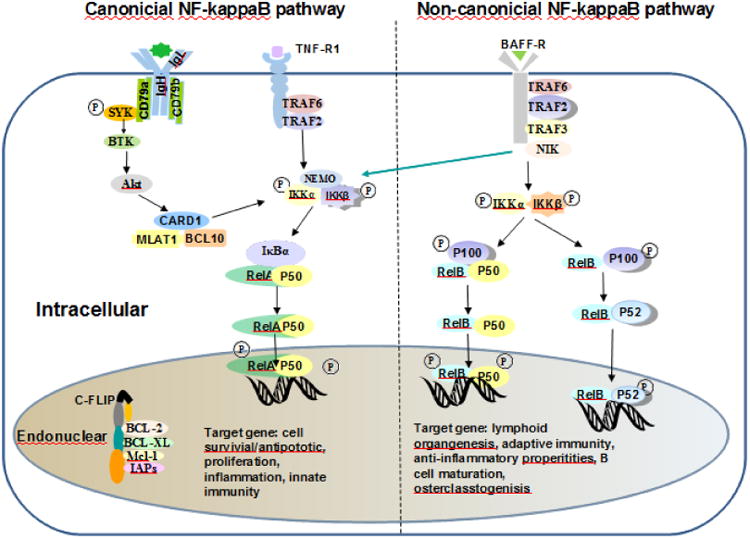
The canonical and non-canonical NF-κB pathways. The canonical and non-canonical NF-κB signaling pathways are shown in the left and right of the figure. The canonical pathway is activated by the C-like receptors 4, TNF receptors' family and the antigen receptors BCR and TCR, while the non-canonical pathway is activated by other receptors, such as BAFF-R, CD40, RANK, CD30, and LTβ-R. Arrows indicate activating steps.
Figure 2
Figure 2
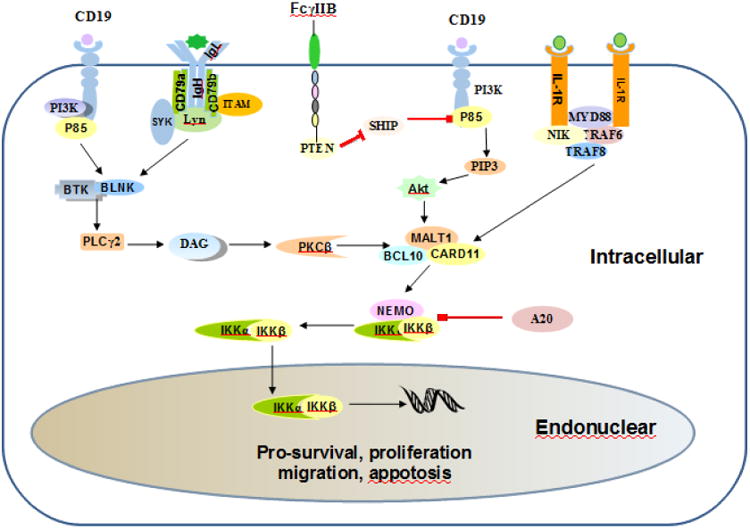
The activation modes of NF-κB in the pathogenesis of B cell lymphoma. There are three main modes: BCR, PI3K/AKT, and MYD88. (1). BCR is activated by antigen binding or cell autologous interaction, resulting in ITAMs phosphorylation in the cytoplasmic domains of CD79A and CD79B. Then SYK amplifies the initial activation signal by autophosphorylation and further ITAMs phosphorylation, which activates BTK and BLNK, leading to subsequent activation of PKCβ and CARD11-BCL10-MALT1 complex. (2). CD19 provides a docking site for the p85, followed by subsequent activation of BTK and BLNK. (3). MyD88 mutations are bound to IRAK kinase forming a helical protein, which activates the complex of CARD11-BCL10-MALT1. (4). A20 is a negative regulator of NF-κB. (5). IKK is phosphorylated to activate NF-κB transcription factors that regulate gene expression of several survival factors. The arrows indicate direction of signaling from plasma membrane toward effectors and bars indicate inhibitory steps.
Figure 3
Figure 3
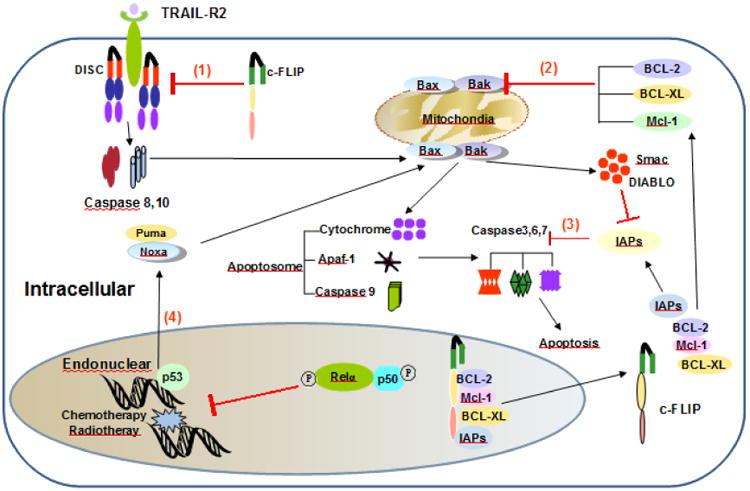
The apoptotic pathways of NF-κB: TRAIL mediating the extrinsic pathway and p53 mediating the intrinsic pathway. Numbers in circles indicate the steps of the apoptotic pathways inhibited by molecules that are induced by NF-κB activation including c-FLIP, Bcl-2 family's molecules, and IAPs. (1), the activation of procaspase 8 and 10 is inhibited by cFLIP. (2), the prosurvival signals, such as Bcl2, Bcl-XL, Mcl-1 inhibit the pro-apoptotic molecules Bak/Bax. (3), the inhibitors of apoptosis (IAPs) family proteins inhibit the effector caspases 3, 6 and 7. (4), NF-κB inhibits directly or indirectly the transcription factor p53. Arrows indicate activating steps, and bars indicate inhibitory steps.
Figure 4
Figure 4
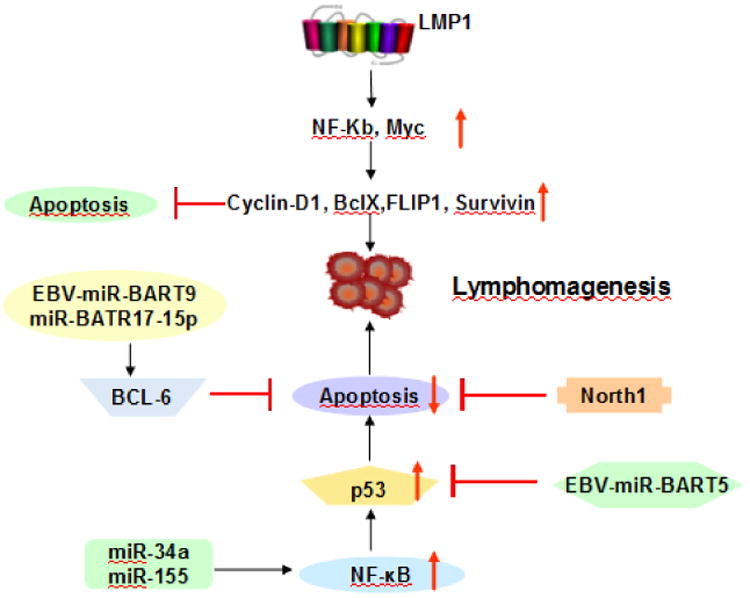
EBV-mediated critical cellular signaling is shown in HL and EBV-positive DLBCL of the elderly. LMP-1 gene polymorphisms associate with enhanced NF-κB activation, which not only increases the expression of cycling D1, BclXL, FLIP1, and Surviving to induce lymphomagenesis, but also inhibits apoptosis mediated by up-regulation of different anti-apoptotic proteins. MicroRNA, such as miR-34a, miR-155, contribute to EBV-positive DLBCL of the elderly lymphomagenesis by up-regulation NF-κB activation, while North1 and BCL-6 down-regulate the NF-κB pathway activation.
Figure 5
Figure 5
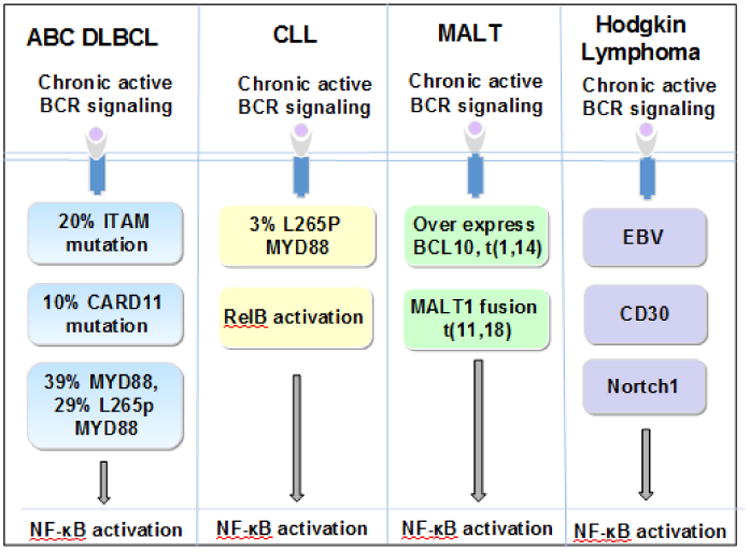
Extrinsic and intrinsic signaling of BCR signaling activates NF-κB in B-cell malignancies. a, In ABC-DLBCL, ITAM, CARD11, and MYD88 independence of BCR. b, In CLL, L265 MYD88 mutation and RelB activation. c, In MALT, overexpression of BCL10 or MALT1 fusion protein. d, In HL, EBV, CD30 and Notch1.
Figure 6
Figure 6
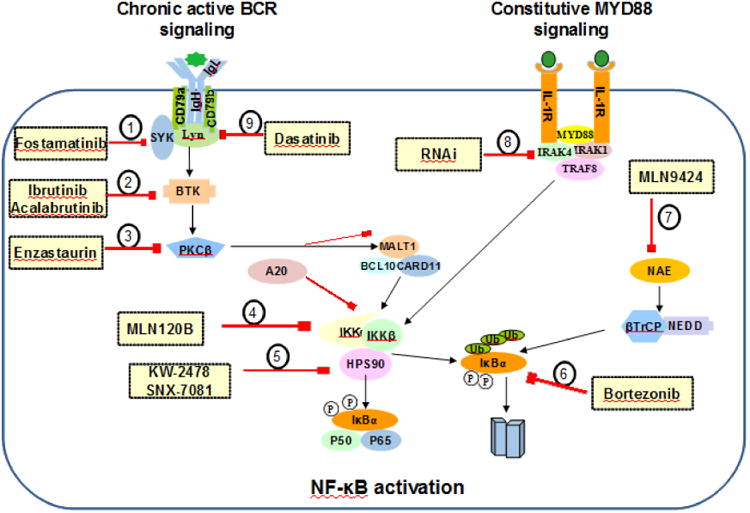
Therapeutic targets in B cell lymphoma of NF-κB activation. The pathogenesis of B cell lymphoma activation involves constitutive activation of BCR, MyD88, and NF-κB pathway promoting cell survival through NF-κB signaling pathways. Small molecule inhibitor is designed to target specific signals in these complex networks to inhibit NF-κB in B cell lymphomas, including: (1), SYK (Fostamatinib/R406). (2), BTK (Ibrutinib; Acalabrutinib). (3), PKCb (Enzastaurin). (4), IKK (MLN120B). (5), HSP90 (KW-2478; SNX-7081). (6), proteasome (Bortezomib). (7), NEDD8-activating enzyme (MLN4924). (8), IRAK4 (RNAi). (9), Src-family kinase (Dasatinib).

References

    1. Burger JA, Ghia P, Rosenwald A, Caligaris-Cappio F. The microenvironment in mature B-cell malignancies: a target for new treatment strategies. Blood. 2009;114:3367–3375. - PMC - PubMed
    1. Davis RE, Ngo VN, Lenz G, Tolar P, Young RM, Romesser PB, et al. Chronic active B-cell-receptor signalling in diffuse large B-cell lymphoma. Nature. 2010;463:88–92. - PMC - PubMed
    1. Scott DW, Gascoyne RD. The tumour microenvironment in B cell lymphomas. Nat Rev Cancer. 2014;14:517–534. - PubMed
    1. Gires O, Zimber-Strobl U, Gonnella R, Ueffing M, Marschall G, Zeidler R, et al. Latent membrane protein 1 of Epstein-Barr virus mimics a constitutively active receptor molecule. EMBO J. 1997;16:6131–6140. - PMC - PubMed
    1. Thorley-Lawson DA, Allday MJ. The curious case of the tumour virus: 50 years of Burkitt's lymphoma. Nat Rev Microbiol. 2008;6:913–924. - PubMed

Publication types

MeSH terms