. 2015 Dec 2;3(5):1500201.
doi: 10.1002/advs.201500201. eCollection 2016 May.

High Performance Perovskite Solar Cells

Affiliations

High Performance Perovskite Solar Cells

Xin Tong et al. Adv Sci (Weinh). .

Abstract

Perovskite solar cells fabricated from organometal halide light harvesters have captured significant attention due to their tremendously low device costs as well as unprecedented rapid progress on power conversion efficiency (PCE). A certified PCE of 20.1% was achieved in late 2014 following the first study of long-term stable all-solid-state perovskite solar cell with a PCE of 9.7% in 2012, showing their promising potential towards future cost-effective and high performance solar cells. Here, notable achievements of primary device configuration involving perovskite layer, hole-transporting materials (HTMs) and electron-transporting materials (ETMs) are reviewed. Numerous strategies for enhancing photovoltaic parameters of perovskite solar cells, including morphology and crystallization control of perovskite layer, HTMs design and ETMs modifications are discussed in detail. In addition, perovskite solar cells outside of HTMs and ETMs are mentioned as well, providing guidelines for further simplification of device processing and hence cost reduction.

Keywords: electron‐transporting materials; hole‐transporting materials; perovskite solar cells; photovoltaic parameters.


Figures
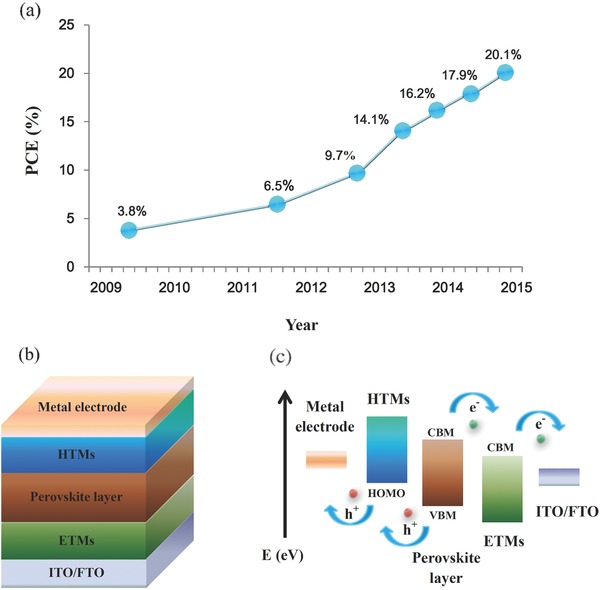
Figure 1
Figure 1
a) Rapid PCE evolution of perovskite solar cells from 2009 to 2015. b) Schematic diagram of general device configuration. c) Work principle of normal perovskite solar cells based on (b).
Figure 2
Figure 2
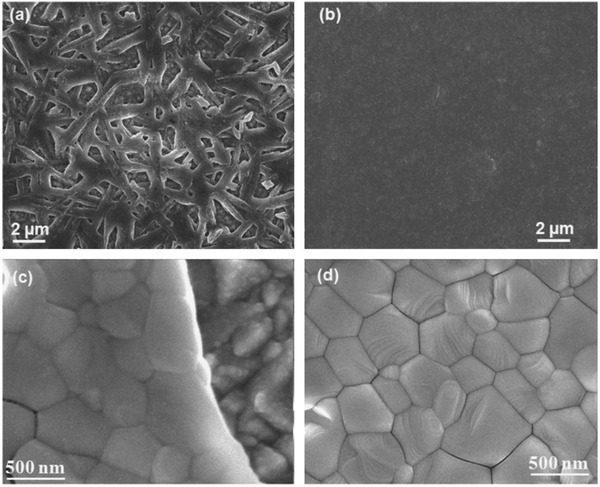
SEM images of perovskite layers prepared by a,c) traditional spin‐coating technique and b,d) gas‐assisted technique . Images (c) and (d) are high magnification images with respect to (a) and (b). Reproduced with permission.26 Copyright 2014, Elsevier.
Figure 3
Figure 3
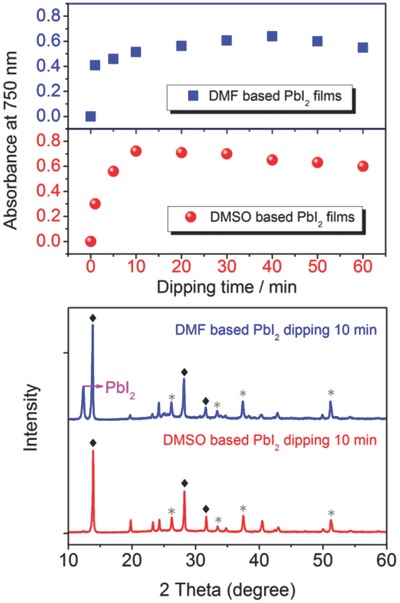
a) Variation of layer absorbance at 750 nm as a function of dipping time corresponding to conventional DMF–PbI2‐based (blue) and as‐prepared DMSO–PbI2 ‐based perovskite layer (red). b) X‐ray diffraction (XRD) pattern of DMF–PbI2‐based and DMSO–PbI2‐based perovskite layer after 10 min dipping. Reproduced with permission.33 Copyright 2014, Royal Society of Chemistry.
Figure 4
Figure 4
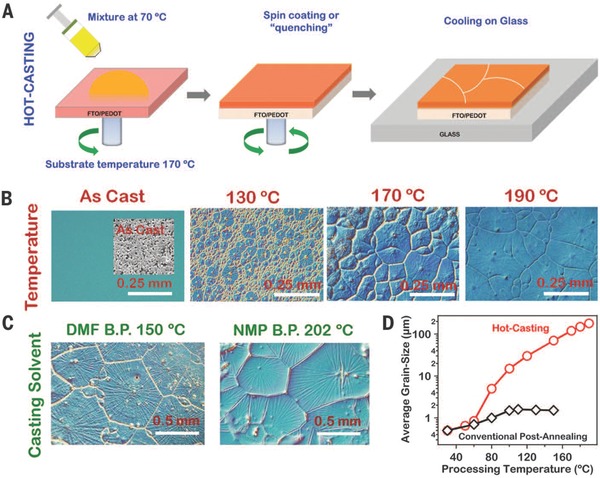
a) Schematic diagram of hot‐casting process. b) Optical images (resolution: 0.25 mm) of as‐casted perovskite layer under different substrate temperature (130 °C, 170 °C and 190 °C). c) Optical images of films with additives of DMF (boiling point: 150 °C) and NMP (boiling point: 202 °C). d) Average grain size as a function of processing temperature by hot‐casting method (red curve) and traditionally annealing method (black curve). Reproduced with permission.34 Copyright 2015, American Association for the Advancement of Science.
Figure 5
Figure 5
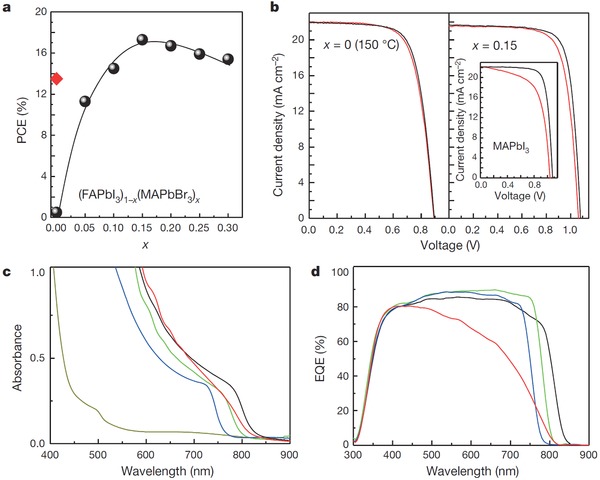
a) The PCE as a function of x (varied from 0 to 0.3) in (FAPbI3)1–x (MAPbBr3)x‐based solar cells (100 °C annealing); the red point is the PCE of initial solar cell only with perovskite FAPbI3 (150 °C annealing). b) J–V curves of (FAPbI3)1–x (MAPbBr3)x‐based devices with x = 0 (150 °C annealing), 0.15 and referential MAPbI3 device. c) UV–vis absorption spectra corresponding to x = 0 (dark yellow curve), 0.05 (red curve), 0.15 (green curve) and 0.25 (blue curve); black curve represents FAPbI3 (150 °C annealing) and d) correlated EQE spectra. Reproduced with permission.37 Copyright 2015, Nature Publishing Group.
Figure 6
Figure 6
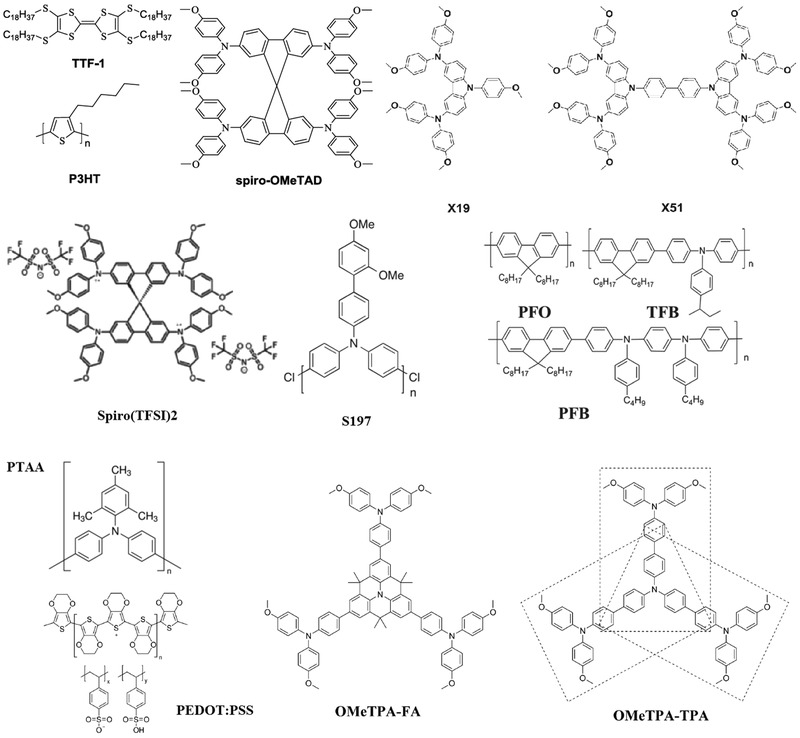
Molecular structures of organic HTMs including spiro‐OMeTAD, PFB, PFO, TFB. Reproduced with permission.40 Spiro(TFSI)2. Reproduced with permission.45 Copyright 2014, American Chemical Society. TTF‐1, P3HT. Reproduced with permission.49 Copyright 2014, Royal Society of Chemistry. S197. Reproduced with permission.51 X19, X51. Reproduced with permission.53 PTAA, PEDOT:PSS, OMeTPA‐FA and OMeTPA‐TPA. Reproduced with permission.55
Figure 7
Figure 7
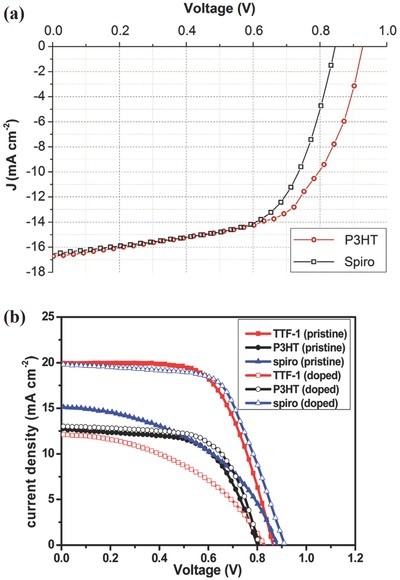
a) J–V curves of spiro‐MeOTAD‐based (black curve) and P3HT‐based devices (red curve) devices. Reproduced with permission.47 Copyright 2014, Elsevier. b) J–V curves of original and Li‐TFSI, TBP doped TTF‐1, P3HT and spiro‐MeOTAD based‐perovskite solar cells. Reproduced with permission.49 Copyright 2014, Royal Society of Chemistry.
Figure 8
Figure 8
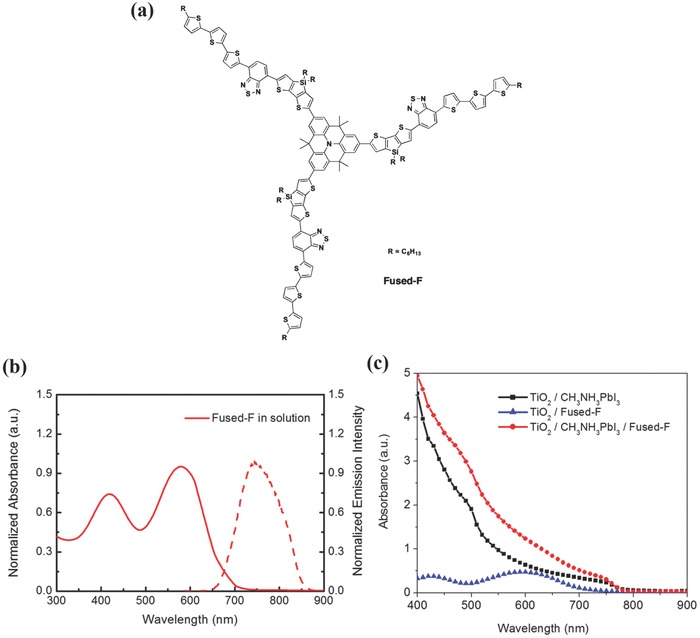
a) Molecular structure of Fused‐F. b) Absorbance (UV–vis spectra) and emission intensity (fluorescence spectra) of Fused‐F (in chloroform solution). c) UV–vis spectra of TiO2/Fused‐F, TiO2/MAPbI3 layers and TiO2/MAPbI3 layers/Fused‐F. Reproduced with permission.50 Copyright 2014, American Chemical Society.
Figure 9
Figure 9
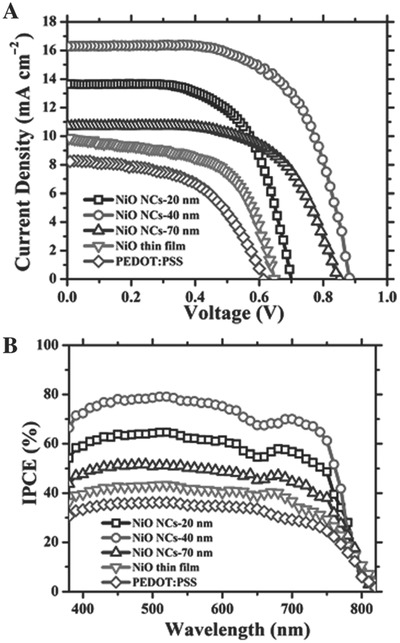
a) J–V curves of perovskite solar cells employing NiO NCs (20 nm, 40 nm and 70 nm), thin film and organic PEDOT: PSS as HTMs. b) Corresponding IPCE spectra of NiO NCs (20 nm, 40 nm and 70 nm), thin film and organic PEDOT: PSS‐based perovskite solar cells. Reproduced with permission.62
Figure 10
Figure 10
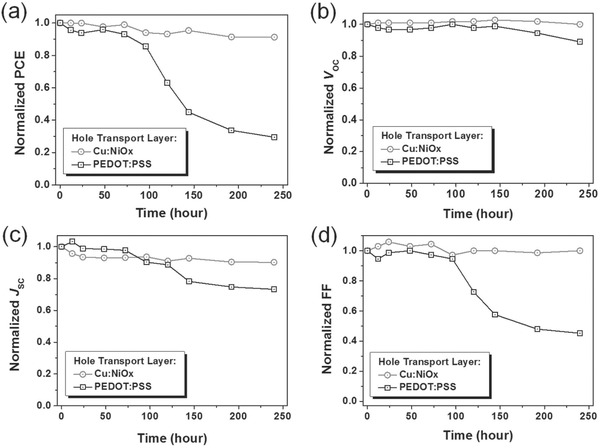
Time‐dependent normalized photovoltaic parameters of PEDOT:PSS and Cu:NiOx –based perovskite solar cells including a) PCE, b) V oc, c) J sc and d) FF. Reproduced with permission.64
Figure 11
Figure 11
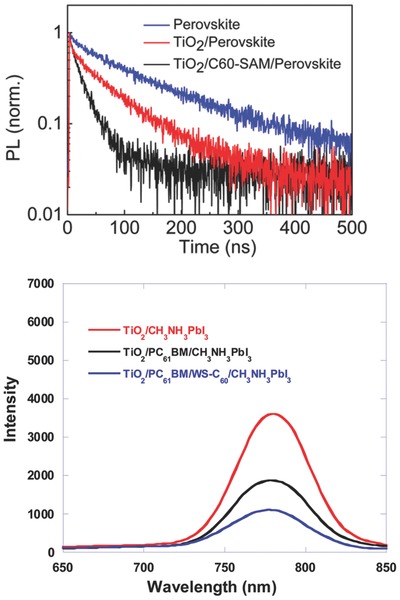
a) Time‐resolved PL decays of perovskite, TiO2/perovskite and TiO2/C60‐SAM/perovskite. Reproduced with permission.90 Copyright 2014, American Chemical Society. b) PL spectra of TiO2, TiO2/ PC61BM and TiO2/WS‐C60 modified PC61BM. Reproduced with permission.92 Copyright 2015, American Chemical Society.

References

    1. a) Cheng M., Xu B., Chen C., Yang X., Zhang F., Tan Q., Hua Y., Kloo L., Sun L., Adv. Energy Mater. 2015, 5, 1401720;
    2. b) Lu C. Y., Tsai C. H., Tsai Y. T., Hsu C. J., Chang C. H., Wu C. C., Adv. Energy Mater. 2015, 5, 1401738;
    3. c) Tan F., Qu S., Jiang Q., Liu J., Wang Z., Li F., Yue G., Li S., Chen C., Zhang W., Wang Z., Adv. Energy Mater. 2014, 4, 1400512.
    1. a) Ni W., Wan X., Li M., Wang Y., Chen Y., Chem. Commun. 2015, 51, 4936; - PubMed
    2. b) Pang C., Chellappan V., Yim J. H., Tan M. J., Goh G. T. W., Lee S., Zhang J., de Mello J., ACS Appl. Mater. Interfaces 2015, 7, 5219; - PubMed
    3. c) Wang X., Wang, Zhiming, High‐Efficiency Solar Cells, Springer, Heidelberg, Germany: 2014;
    4. d) Kim M., Yun H. G., Jang L. W., Jeon D. W., Kang M. G., Yoon J. H., Kim J. M., Park J. H., Lee I. H., Kim J. J., J. Power Sources 2015, 278, 32;
    5. e) Jiang Wu Z. M. W., Quantum Dot Solar Cells, Springer, Heidelberg, Germany: 2014;
    6. f) Song D., Cui P., Zhao X., Li M., Chu L., Wang T., Jiang B., Nanoscale 2015, 7, 5712; - PubMed
    7. g) Wu J., Yu P., Susha A. S., Sablon K. A., Chen H., Zhou Z., Li H., Ji H., Niu X., Govorov A. O., Rogach A. L., Wang Z. M., Nano Energy 2015;
    8. h) Wu J., Liu L., Liu S., Yu P., Zheng Z., Shafa M., Zhou Z., Li H., Ji H., Wang Z. M., Nano Lett. 2014, 14, 6002. - PubMed
    1. Jung H. S., Park N. G., Small 2015, 11, 10.
    1. a) Dong Q., Fang Y., Shao Y., Mulligan P., Qiu J., Cao L., Huang J., Science 2015, 347, 967; - PubMed
    2. b) Stranks S. D., Eperon G. E., Grancini G., Menelaou C., Alcocer M. J. P., Leijtens T., Herz L. M., Petrozza A., Snaith H. J., Science 2013, 342, 341; - PubMed
    3. c) Wehrenfennig C., Eperon G. E., Johnston M. B., Snaith H. J., Herz L. M., Adv. Mater. 2014, 26, 1584; - PMC - PubMed
    4. d) Xing G., Mathews N., Sun S., Lim S. S., Lam Y. M., Graetzel M., Mhaisalkar S., Sum T. C., Science 2013, 342, 344; - PubMed
    5. e) C. S. Ponseca , Jr. , Savenije T. J., Abdellah M., Zheng K., Yartsev A., Pascher T., Harlang T., Chabera P., Pullerits T., Stepanov A., Wolf J. P., Sundstrom V., J. Am. Chem. Soc. 2014, 136, 5189. - PubMed
    1. Kojima A., Teshima K., Shirai Y., Miyasaka T., J. Am. Chem. Soc. 2009, 131, 6050. - PubMed