Review
. 2014 Dec 5:2:197-213.
doi: 10.2147/HP.S47598. eCollection 2014.

Signaling hypoxia by hypoxia-inducible factor protein hydroxylases: a historical overview and future perspectives

Affiliations
Review

Signaling hypoxia by hypoxia-inducible factor protein hydroxylases: a historical overview and future perspectives

Tammie Bishop et al. Hypoxia (Auckl). .

Abstract

By the early 1900s, the close matching of oxygen supply with demand was recognized to be a fundamental requirement for physiological function, and multiple adaptive responses to environment hypoxia had been described. Nevertheless, the widespread operation of mechanisms that directly sense and respond to levels of oxygen in animal cells was not appreciated for most of the twentieth century with investigators generally stressing the regulatory importance of metabolic products. Work over the last 25 years has overturned that paradigm. It has revealed the existence of a set of "oxygen-sensing" 2-oxoglutarate dependent dioxygenases that catalyze the hydroxylation of specific amino acid residues and thereby control the stability and activity of hypoxia-inducible factor. The hypoxia-inducible factor hydroxylase pathway regulates a massive transcriptional cascade that is operative in essentially all animal cells. It transduces a wide range of responses to hypoxia, extending well beyond the classical boundaries of hypoxia physiology. Here we review the discovery and elucidation of these pathways, and consider the opportunities and challenges that have been brought into focus by the findings, including new implications for the integrated physiology of hypoxia and therapeutic approaches to ischemic/hypoxic disease.

Keywords: 2-oxoglutarate oxygenase; HIF; cell signaling; hydroxylase; hypoxia; oxygen-sensing.


Figures
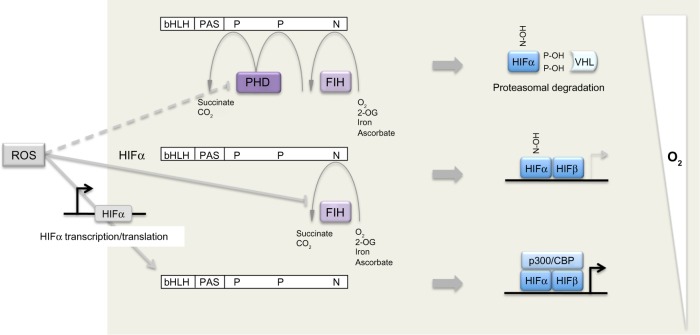
Figure 1
Figure 1
Dual regulation of hypoxia-inducible factor (HIF)-α by oxygen-dependent prolyl and asparaginyl hydroxylation. Notes: In the presence of oxygen, prolyl hydroxylase domain (PHD) enzymes and factor inhibiting HIF (FIH) hydroxylate two proline (P) and one asparaginyl (N) residues, respectively. Hydroxylated proline residues (P-OH) target HIF-α for proteasomal degradation by enabling recognition by the von Hippel-Lindau tumor suppressor protein (pVHL) product, an ubiquitin E3 ligase. Proline hydroxylation is inhibited in the presence of modest hypoxia, allowing HIF-α to escape proteolytic destruction and form a transcription factor in complex with HIF-β. More severe hypoxia results in the inhibition of hydroxylation of the asparaginyl residue (N-OH), allowing for the recruitment of the transcriptional co-activators p300/CREB (cAMP-response-element-binding protein) binding protein to enhance HIF-mediated gene transcription. Reactive oxygen species (ROS) can act at multiple points to modulate the HIF hydroxylase pathway: for example, by inhibiting FIH (and to a lesser extent, PHD enzymes) as well as by enhancing HIF-α transcription and translation. Abbreviations: PAS, PER-AHR/ARNT-SIM; PER, period circadian protein; AHR, aryl-hydrocarbon receptor; ARNT, aryl-hydrocarbon-receptor nuclear translocator; SIM, single-minded protein; bHLH, basic-helix-loop-helix; 2-OG, 2-oxoglutarate.
Figure 2
Figure 2
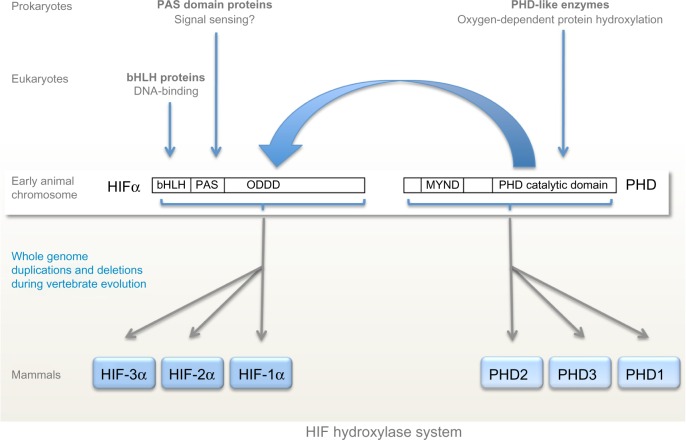
Evolution of the hypoxia-inducible factor (HIF) hydroxylase system. Notes: The major components of the HIF hydroxylase system are widely represented across both animal and non-animal species. PAS domains and PHD-like enzymes are found in both prokaryotes and eukaryotes whilst bHLH domains are found in all eukaryotes. The HIF hydroxylase system appears to have emerged with the evolution of early animals, coinciding with the convergence of bHLH and PAS domains to form bHLH/PAS-containing proteins including HIF-α. Despite that coincidence, it is sequences lying distal to the bHLH/PAS domains (ODDD) that are sensitive to oxygen-dependent post-translational hydroxylation (large blue arrow). In Trichoplax adhaerens, considered to be the “basal” animal, the HIF hydroxylase system consists of a single PHD enzyme and HIF-α, whose genes lie on the same chromosome. Whole genome duplications and deletions during vertebrate evolution result in multiple copies of both HIF-α and PHD in mammals. Abbreviations: PAS, PER-AHR/ARNT-SIM; PER, period circadian protein; AHR, aryl-hydrocarbon receptor; ARNT, aryl-hydrocarbon-receptor nuclear translocator; SIM, single-minded protein; PHD, prolyl hydroxylase domain; bHLH, basic-helix-loop-helix; ODDD, oxygen-dependent degradation domain; MYND, myeloid, Nervy and DEAF-1.
Figure 3
Figure 3
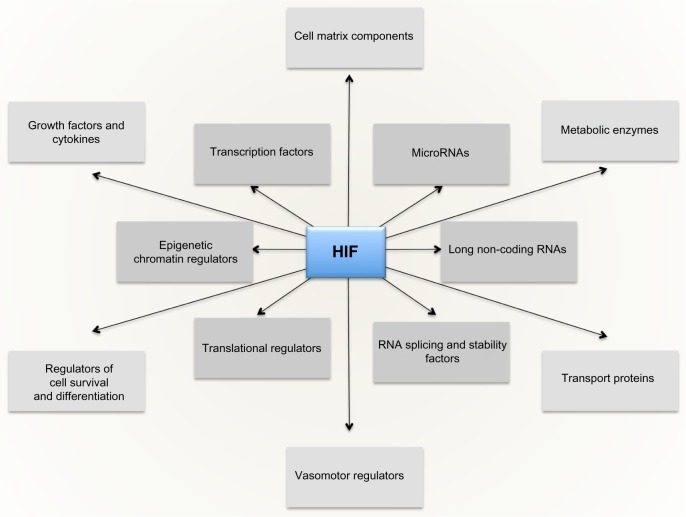
The HIF transcriptional cascade. Notes: Direct transcriptional targets of hypoxia-inducible factor (HIF) include both protein coding genes and regulatory molecules with secondary effects on gene expression. Activation of this cascade entrains multiple cellular and systemic responses to hypoxia. Abbreviation: RNA, ribonucleic acid.
Figure 4
Figure 4
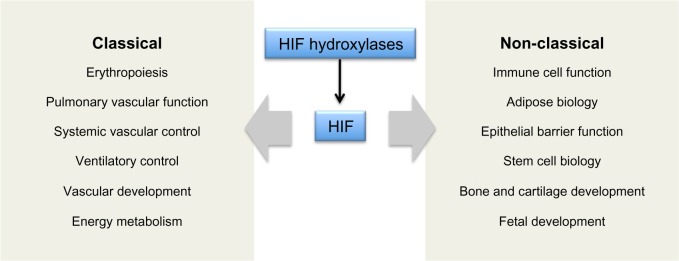
Integrated physiological functions associated with HIF hydroxylase pathways. Notes: In addition to effects on physiological systems classically associated with the maintenance of oxygen homeostasis, studies of the hypoxia-inducible factor (HIF) hydroxylase system have revealed actions on many other processes which are not classically associated with physiological adaptation to hypoxia and potentially widen the role of hypoxia in integrated physiology.
Figure 5
Figure 5
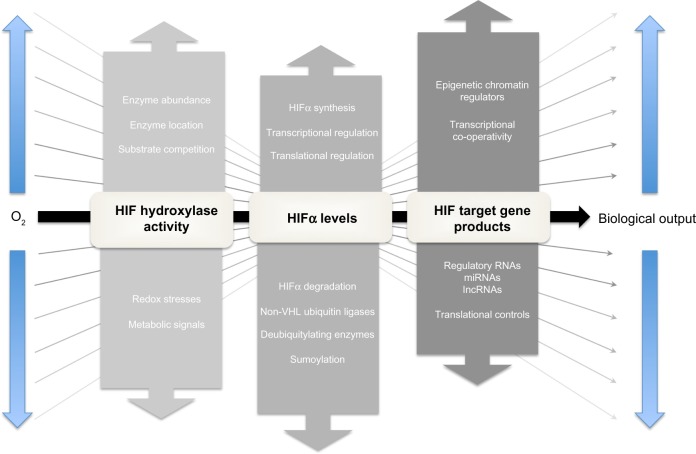
The principle of “range-finding” processes in the HIF hydroxylase system. Notes: The relationship between the oxygen-dependent kinetics of hypoxia-inducible factor (HIF) hydroxylation and overall biological output of HIF activation can be modulated by multiple mechanisms operating at different points in the HIF hydroxylase pathway. These “range-finding” mechanisms provide multiple means by which the biological output of the basic oxygen-sensitive signal provided by the HIF hydroxylases can be modulated to meet signaling requirements in the intact organism. Abbreviations: VHL, von Hippel-Lindau; RNAs, ribonucleic acids; lncRNAs, long non-coding RNAs; miRNAs, microRNAs.

References

    1. Leichtweiss HP, Lübbers DW, Weiss C, Baumgartl H, Reschke W. The oxygen supply of the rat kidney: measurements of intrarenal pO2. Pflugers Archi. 1969;309(4):328–349. - PubMed
    1. Krogh A. The number and distribution of capillaries in muscles with calculations of the oxygen pressure head necessary for supplying the tissue. J Physiol. 1919;52(6):409–415. - PMC - PubMed
    1. Clark E, Clark EL. Microscopic observations on the growth of blood capillaries in the living mammal. American Journal of Anatomy. 1939;64(2):251–301.
    1. Ashton N. Retinal vascularization in health and disease: Proctor Award Lecture of the Association for Research in Ophthalmology. Am J Ophthalmol. 1957;44(4 Pt 2):7–17. - PubMed
    1. Barron AG, Barron ESG. Mechanism of cobalt polycythemia. Effect of ascorbic acid. Proceedings of the Society of Experimental Biology and Medicine. 1936;35:407–409.