


The Estimated Verbal GCS Subscore in Intubated Traumatic Brain Injury Patients: Is it Really Better?
- PMID: 27774844
- PMCID: PMC5397225
- DOI: 10.1089/neu.2016.4657
The Estimated Verbal GCS Subscore in Intubated Traumatic Brain Injury Patients: Is it Really Better?
Abstract
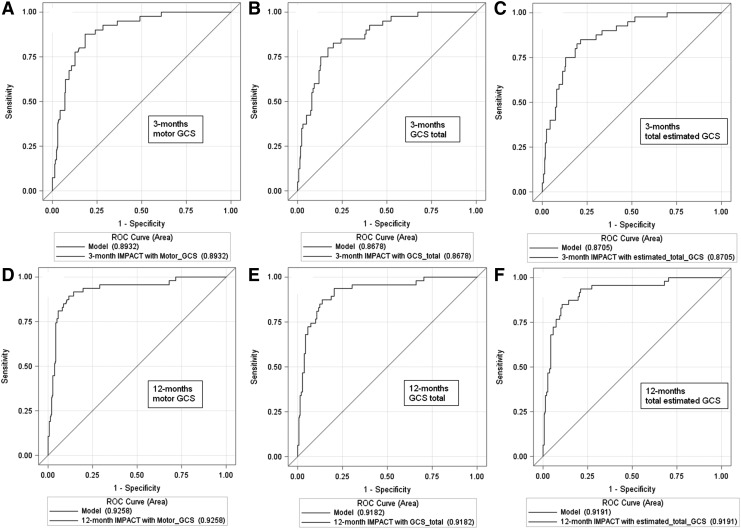
The Glasgow Coma Scale (GCS) has limited utility in intubated patients due to the inability to assign verbal subscores. The verbal subscore can be derived from the eye and motor subscores using a mathematical model, but the advantage of this method and its use in outcome prognostication in traumatic brain injury (TBI) patients remains unknown. We compared the validated "Core+CT"-IMPACT-model performance in 251 intubated TBI patients prospectively enrolled in the longitudinal OPTIMISM study between November 2009 and May 2015 when substituting the original motor GCS (mGCS) with the total estimated GCS (teGCS; with estimated verbal subscore). We hypothesized that model performance would improve with teGCS. Glasgow Outcome Scale (GOS) scores were assessed at 3 and 12 months by trained interviewers. In the complete case analysis, there was no statistically or clinically significant difference in the discrimination (C-statistic) at either time-point using the mGCS versus the teGCS (3 months: 0.893 vs. 0.871;12 months: 0.926 vs. 0.92). At 3 months, IMPACT-model calibration was excellent with mGCS and teGCS (Hosmer-Lemeshow "goodness-of-fit" chi square p value 0.9293 and 0.9934, respectively); it was adequate at 12 months with teGCS (0.5893) but low with mGCS (0.0158), possibly related to diminished power at 12 months. At both time-points, motor GCS contributed more to the variability of outcome (Nagelkerke ΔR2) than teGCS (3 months: 5.8% vs. 0.4%; 12 months: 5% vs. 2.6%). The sensitivity analysis with imputed missing outcomes yielded similar results, with improved calibration for both GCS variants. In our cohort of intubated TBI patients, there was no statistically or clinically meaningful improvement in the IMPACT-model performance by substituting the original mGCS with teGCS.
Keywords: Glasgow Coma Scale; estimated verbal GCS; motor GCS; outcome prognostication; traumatic brain injury.
Conflict of interest statement
No competing financial interests exist.
Figures

References
-
- Teasdale G., and Jennett B. (1974). Assessment of coma and impaired consciousness. A practical scale. Lancet 2, 81–84 - PubMed
-
- Champion H.R., Copes W.S., Sacco W.J., Lawnick M.M., Keast S.L., Bain L.W., Jr., Flanagan M.E., and Frey C.F. (1990). The Major Trauma Outcome Study: establishing national norms for trauma care. J. Trauma 30, 1356–1365 - PubMed
-
- Champion H.R., Sacco W.J., Carnazzo A.J., Copes W., and Fouty W.J. (1981). Trauma score. Crit. Care Med. 9, 672–676 - PubMed
-
- Niskanen M., Kari A., Nikki P., Iisalo E., Kaukinen L., Rauhala V., Saarela E., and Halinen M. (1991). Acute physiology and chronic health evaluation (APACHE II) and Glasgow coma scores as predictors of outcome from intensive care after cardiac arrest. Crit. Care Med. 19, 1465–1473 - PubMed
-
- Steyerberg E.W., Mushkudiani N., Perel P., Butcher I., Lu J., McHugh G.S., Murray G.D., Marmarou A., Roberts I., Habbema J.D., and Maas A.I. (2008). Predicting outcome after traumatic brain injury: development and international validation of prognostic scores based on admission characteristics. PLoS Med. 5, e165. - PMC - PubMed
Publication types
MeSH terms
Grants and funding
LinkOut - more resources
Full Text Sources
Other Literature Sources
Medical
