


Incidence of syphilis seroconversion among HIV-infected persons in Asia: results from the TREAT Asia HIV Observational Database
- PMID: 27774955
- PMCID: PMC5075717
- DOI: 10.7448/IAS.19.1.20965
Incidence of syphilis seroconversion among HIV-infected persons in Asia: results from the TREAT Asia HIV Observational Database
Abstract
Introduction: Outbreaks of syphilis have been described among HIV-infected men who have sex with men (MSM) in Western communities, whereas reports in Asian countries are limited. We aimed to characterize the incidence and temporal trends of syphilis among HIV-infected MSM compared with HIV-infected non-MSM in Asian countries.
Methods: Patients enrolled in the TREAT Asia HIV Observational Database cohort and with a negative non-treponemal test since enrolment were analyzed. Incidence of syphilis seroconversion, defined as a positive non-treponemal test after previously testing negative, was evaluated among patients at sites performing non-treponemal tests at least annually. Factors associated with syphilis seroconversion were investigated at sites doing non-treponemal testing in all new patients and subsequently testing routinely or when patients were suspected of having syphilis.
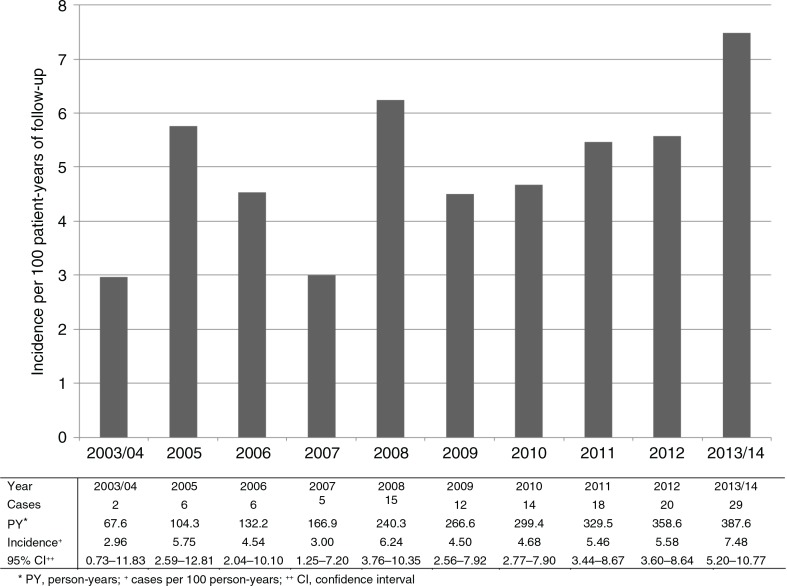
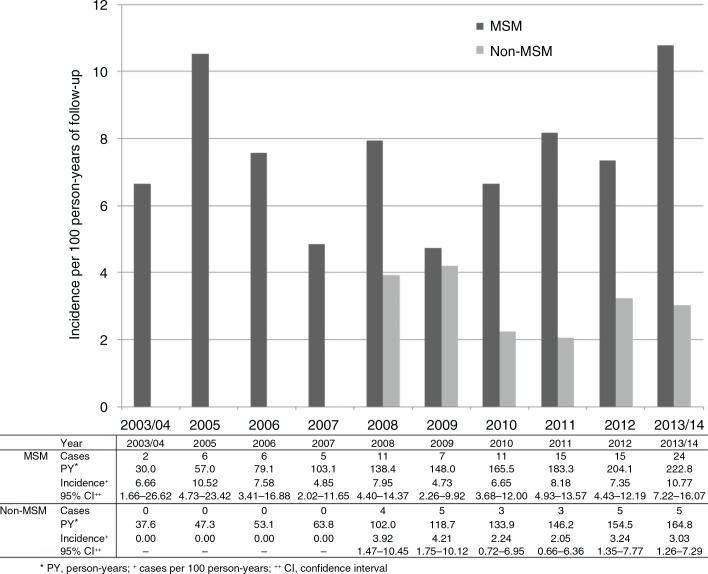
Results: We included 1010 patients from five sites that performed non-treponemal tests in all new patients; those included had negative non-treponemal test results during enrolment and subsequent follow-ups. Among them, 657 patients were from three sites conducting regular non-treponemal testing. The incidence of syphilis seroconversion was 5.38/100 person-years (PY). Incidence was higher in MSM than non-MSM (7.64/100 PY vs. 2.44/100 PY, p<0.001). Among MSM, the incidence rate ratio (IRR) for every additional year from 2009 was 1.19 (p=0.051). MSM status (IRR 3.48, 95% confidence interval (CI) 1.88-6.47), past syphilis diagnosis (IRR 5.15, 95% CI 3.69-7.17) and younger age (IRR 0.84 for every additional 10 years, 95% CI 0.706-0.997) were significantly associated with syphilis seroconversion.
Conclusions: We observed a higher incidence of syphilis seroconversion among HIV-infected MSM and a trend to increasing annual incidence. Regular screening for syphilis and targeted interventions to limit transmission are needed in this population.
Keywords: HIV; MSM; incidence; seroconversion; syphilis.
Conflict of interest statement
The authors have no competing interests to declare.
Figures
References
-
- Centers for Disease Control and Prevention. Sexually transmitted disease surveillance 2014 [Internet] 2015. [cited 2015 Nov 1]. Available from: http://www.cdc.gov/std/stats14.
-
- World Health Organization. Global incidence and prevalence of selected curable sexually transmitted infection 2008 [Internet] 2012. [cited 2015 Nov 1]. Available from: http://www.who.int/reproductivehealth/publications/rtis/stisestimates/en.
-
- UNAIDS. Global report: UNAIDS report on the global AIDS Epidemic 2013 [Internet] 2013. [cited 2015 Nov 1]. Available from: http://www.unaids.org/en/resources/campaigns/globalreport2013/globalreport.
-
- Suguimoto SP, Techasrivichien T, Musumari PM, El-saaidi C, Lukhele BW, Ono-Kihara M, et al. Changing patterns of HIV epidemic in 30 years in East Asia. Curr HIV/AIDS Rep. 2014;11(2):134–45. doi: http://dx.doi.org/10.1007/s11904-014-0201-4. - DOI - PubMed
-
- Stamm WE, Handsfield HH, Rompalo AM, Ashley RL, Roberts PL, Corey L. The association between genital ulcer disease and acquisition of HIV infection in homosexual men. JAMA. 1988;260(10):1429–33. doi: http://dx.doi.org/10.1001/jama.1988.03410100119036. - DOI - PubMed
MeSH terms
Grants and funding
LinkOut - more resources
Full Text Sources
Other Literature Sources
Medical
Miscellaneous
