


Reduced ability to detect surface-related biofilm bacteria after antibiotic exposure under in vitro conditions
- PMID: 27775462
- PMCID: PMC5119450
- DOI: 10.1080/17453674.2016.1246795
Reduced ability to detect surface-related biofilm bacteria after antibiotic exposure under in vitro conditions
Abstract
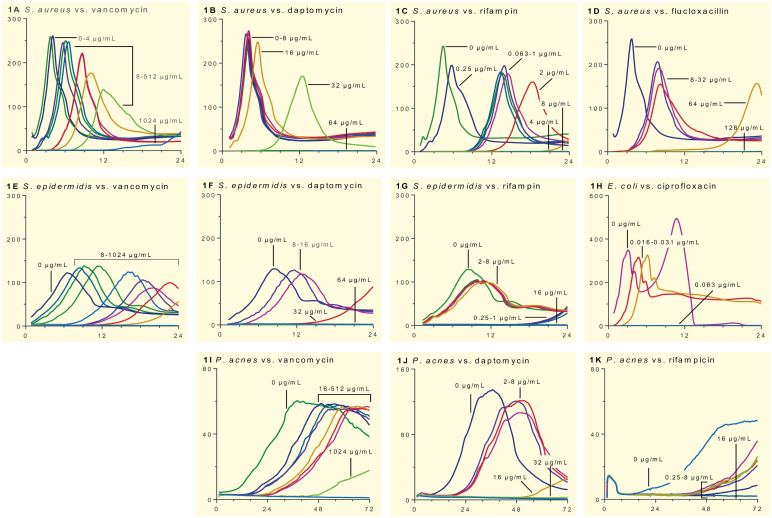
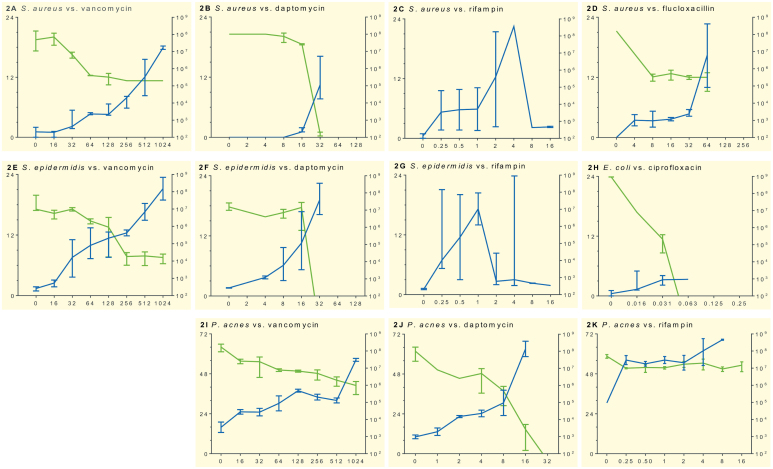
Background and purpose - Antibiotic treatment of patients before specimen collection reduces the ability to detect organisms by culture. We investigated the suppressive effect of antibiotics on the growth of non-adherent, planktonic, and surface-related biofilm bacteria in vitro by using sonication and microcalorimetry methods. Patients and methods - Biofilms of Staphylococcus aureus, S. epidermidis, Escherichia coli, and Propionibacterium acnes were formed on porous glass beads and exposed for 24 h to antibiotic concentrations from 1 to 1,024 times the minimal inhibitory concentration (MIC) of vancomycin, daptomycin, rifampin, flucloxacillin, or ciprofloxacin. The beads were then sonicated to dislodge biofilm, followed by culture and measurement of growth-related heat flow by microcalorimetry of the resulting sonication fluid. Results - Vancomycin did not inhibit the heat flow of staphylococci and P. acnes at concentrations ≤1,024 μg/mL, whereas flucloxacillin at >128 μg/mL inhibited S. aureus. Daptomycin inhibited heat flow of S. aureus, S. epidermidis, and P. acnes at lower concentrations (32-128 times MIC, p < 0.001). Rifampin showed inconsistent results in staphylococci due to random emergence of resistance, which was observed at concentrations ≤1,024 times MIC (i.e. 8 μg/mL). Ciprofloxacin inhibited heat flow of E. coli at ≥4 times MIC (i.e. ≥ 0.06 μg/mL). Interpretation - Whereas time-dependent antibiotics (i.e. vancomycin and flucloxacillin) showed only weak growth suppression, concentration-dependent drugs (i.e. daptomycin and ciprofloxacin) had a strong suppressive effect on bacterial growth and reduced the ability to detect planktonic and biofilm bacteria. Exposure to rifampin rapidly caused emergence of resistance. Our findings indicate that preoperative administration of antibiotics may have heterogeneous effects on the ability to detect biofilm bacteria.
Figures
References
-
- Asin E, Isla A, Canut A, Rodriguez Gascon A.. Comparison of antimicrobial pharmacokinetic/pharmacodynamic breakpoints with EUCAST and CLSI clinical breakpoints for Gram-positive bacteria. Int J Antimicrob Agents 2012; 40 (4): 313–22. - PubMed
-
- Berbari E F, Marculescu C, Sia I, Lahr B D, Hanssen A D, Steckelberg J M, Gullerud R, Osmon D R.. Culture-negative prosthetic joint infection. Clin Infect Dis 2007; 45 (9): 1113–9. - PubMed
-
- Boling E A, Blanchard G C, Russell W J.. Bacterial identification by microcalorimetry. Nature 1973; 241 (5390): 472–3. - PubMed
-
- Borens O, Yusuf E, Steinrucken J, Trampuz A.. Accurate and early diagnosis of orthopedic device-related infection by microbial heat production and sonication. J Orthop Res 2013; 31 (11): 1700–3. - PubMed
MeSH terms
Substances
LinkOut - more resources
Full Text Sources
Other Literature Sources
Medical
Molecular Biology Databases