. 2016 Oct 20;17(10):1752.
doi: 10.3390/ijms17101752.

MicroRNA-Mediated Down-Regulation of Apoptosis Signal-Regulating Kinase 1 (ASK1) Attenuates the Apoptosis of Human Mesenchymal Stem Cells (MSCs) Transplanted into Infarcted Heart

Affiliations

MicroRNA-Mediated Down-Regulation of Apoptosis Signal-Regulating Kinase 1 (ASK1) Attenuates the Apoptosis of Human Mesenchymal Stem Cells (MSCs) Transplanted into Infarcted Heart

Chang Youn Lee et al. Int J Mol Sci. .

Abstract

Stem cell therapy using adult stem cells, such as mesenchymal stem cells (MSCs) has produced some promising results in treating the damaged heart. However, the low survival rate of MSCs after transplantation is still one of the crucial factors that limit the therapeutic effect of stem cells. In the damaged heart, oxidative stress due to reactive oxygen species (ROS) production can cause the death of transplanted MSCs. Apoptosis signal-regulating kinase 1 (ASK1) has been implicated in the development of oxidative stress-related pathologic conditions. Thus, we hypothesized that down-regulation of ASK1 in human MSCs (hMSCs) might attenuate the post-transplantation death of MSCs. To test this hypothesis, we screened microRNAs (miRNAs) based on a miRNA-target prediction database and empirical data and investigated the anti-apoptotic effect of selected miRNAs on human adipose-derived stem cells (hASCs) and on rat myocardial infarction (MI) models. Our data indicated that miRNA-301a most significantly suppressed ASK1 expression in hASCs. Apoptosis-related genes were significantly down-regulated in miRNA-301a-enriched hASCs exposed to hypoxic conditions. Taken together, these data show that miRNA-mediated down-regulation of ASK1 protects MSCs during post-transplantation, leading to an increase in the efficacy of MSC-based cell therapy.

Keywords: adipose-derived stem cell (ASC); apoptosis signal-regulating kinase 1 (ASK1); mesenchymal stem cells (MSCs); microRNA-301a; myocardial infarction (MI); reactive oxygen species (ROS).


Conflict of interest statement

The authors declare no conflict of interest.

Figures
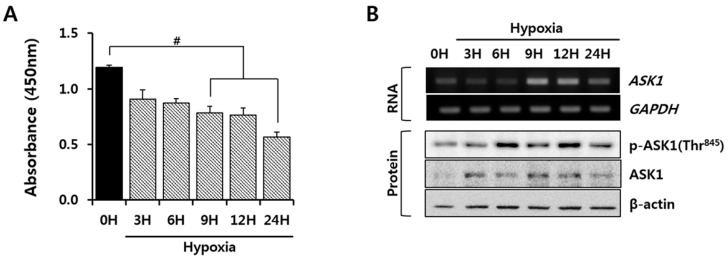
Figure 1
Figure 1
Increased expression of apoptosis signal-regulating kinase 1 (ASK1) in human adipose-derived stem cells (hASCs) exposed to hypoxic conditions. hASCs were exposed to hypoxic conditions (1% ≥ O2, 5% CO2, 37 °C) for up to 24 h. (A) Viability of hypoxic hASCs was measured by cell counting kit-8 reagent (CCK-8) assay (# p < 0.05 vs. 0 h); (B) ASK1 mRNA and protein expression were measured by reverse transcription polymerase chain (RT-PCR) and immunoblot, respectively.
Figure 2
Figure 2
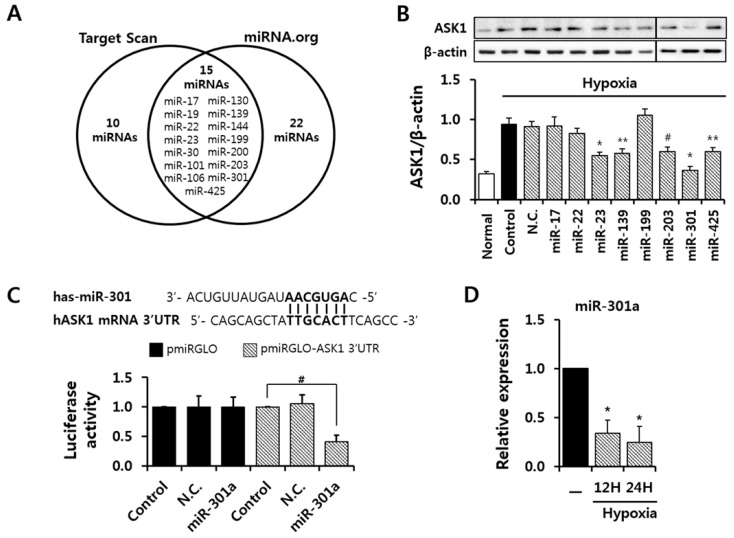
Screening of predicted miRNAs for targeting ASK1. (A) Candidate miRNAs that target ASK1 were selected based on prediction databases (www.TargetScan.org & www.microRNA.org); (B) ASK1 expression in ASCs transfected with the indicated candidate miRNAs was analyzed by immunoblot (# p < 0.05, ** p < 0.01, * p < 0.001 vs. Control, N.C.: negative control); (C) Luciferase assay using the 3’untranslated region (3′ UTR) of ASK1 was performed to confirm the interaction between miRNA-301a and ASK1 (# p < 0.05 vs. Control); (D) Endogenous expression of miRNA-301a was measured by real-time PCR (* p < 0.001 vs. Control).
Figure 3
Figure 3
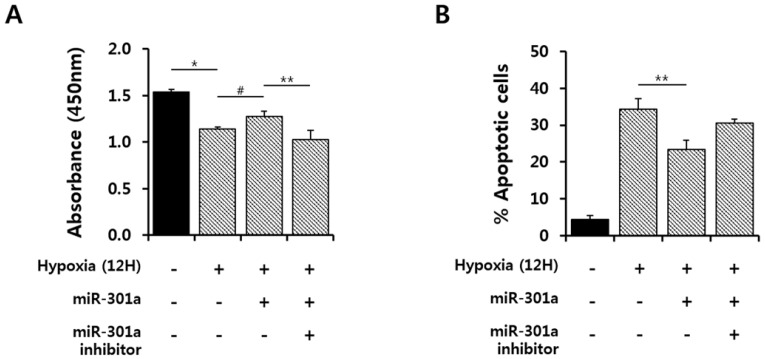
miRNA-301a attenuated cell death under hypoxic conditions. miRNA-301a was transfected into hASCs under hypoxic conditions for 12 h. (A) The cell viability rate was measured by cell counting kit-8 reagent (CCK-8) assay (# p < 0.05 vs. hypoxia, ** p < 0.01 vs. inhibitor, * p < 0.01 vs. Normal); (B) The number of apoptotic cells decreased as detected by annexin V/PI after miR-301 transfection in vitro (annexin V/PI). The values are the average of three measurements, and the S.E. is indicated by error bars (** p < 0.05 vs. hypoxia).
Figure 4
Figure 4
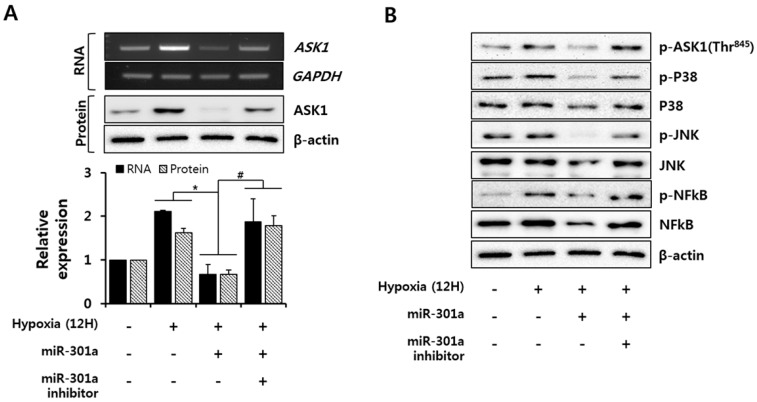
miRNA-301a inhibits the ASK1-related apoptotic pathway. (A) ASK1 mRNA and protein expression were measured by RT-PCR and immunoblot (* p < 0.001 vs. hypoxia, # p < 0.05 vs. inhibitor); (B) Expression and phosphorylation levels of ASK1-downstream molecules (JNK, p38, and NFκB) were detected by immunoblot.
Figure 5
Figure 5
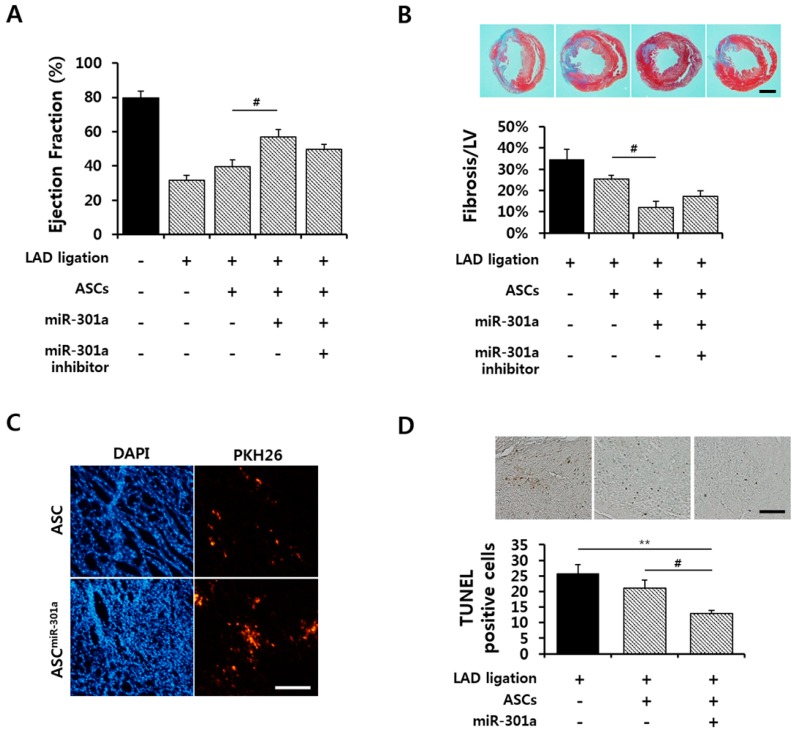
Effects of hASCmiR-301 on cardiac function after myocardial infarction (MI). (A) Cardiac functions were assessed using a Millar micro-tip 2 F pressure transducer at one week after MI (# p < 0.05); (B) Fibrosis was detected by Masson’s trichrome staining from three rats per group. Scale bar = 5 mm (# p < 0.05); (C) One week after the ASCs injection, PKH26-stained ASCs were detected in the ischemic myocardium. Scale bar = 200 μm; (D) Representative histological sections of ischemic myocardium stained with TUNEL assay at one week after MI. Quantitative analysis was performed for TUNEL (terminal deoxynucleotidyltransferase-mediated dUTP nick-end labeling) positive cells. Scale bar = 100 μm (** p < 0.01, # p < 0.05).

References

    1. Baig M.K., Mahon N., McKenna W.J., Caforio A.L., Bonow R.O., Francis G.S., Gheorghiade M. The pathophysiology of advanced heart failure. Heart Lung. 1999;28:87–101. doi: 10.1053/hl.1999.v28.a97762. - DOI - PubMed
    1. Nelson D.M., Ma Z., Fujimoto K.L., Hashizume R., Wagner W.R. Intra-myocardial biomaterial injection therapy in the treatment of heart failure: Materials, outcomes and challenges. Acta Biomater. 2011;7:1–15. doi: 10.1016/j.actbio.2010.06.039. - DOI - PMC - PubMed
    1. Penn M.S., Mangi A.A. Genetic enhancement of stem cell engraftment, survival, and efficacy. Circ. Res. 2008;102:1471–1482. doi: 10.1161/CIRCRESAHA.108.175174. - DOI - PMC - PubMed
    1. Nekanti U., Rao V.B., Bahirvani A.G., Jan M., Totey S., Ta M. Long-term expansion and pluripotent marker array analysis of wharton's jelly-derived mesenchymal stem cells. Stem Cells Dev. 2010;19:117–130. doi: 10.1089/scd.2009.0177. - DOI - PubMed
    1. Pittenger M.F., Mackay A.M., Beck S.C., Jaiswal R.K., Douglas R., Mosca J.D., Moorman M.A., Simonetti D.W., Craig S., Marshak D.R. Multilineage potential of adult human mesenchymal stem cells. Science. 1999;284:143–147. doi: 10.1126/science.284.5411.143. - DOI - PubMed

LinkOut - more resources