Review
. 2016 Oct 21;8(10):97.
doi: 10.3390/cancers8100097.

The Role of TAM Family Receptors in Immune Cell Function: Implications for Cancer Therapy

Affiliations
Review

The Role of TAM Family Receptors in Immune Cell Function: Implications for Cancer Therapy

Magdalena Paolino et al. Cancers (Basel). .

Abstract

The TAM receptor protein tyrosine kinases-Tyro3, Axl, and Mer-are essential regulators of immune homeostasis. Guided by their cognate ligands Growth arrest-specific gene 6 (Gas6) and Protein S (Pros1), these receptors ensure the resolution of inflammation by dampening the activation of innate cells as well as by restoring tissue function through promotion of tissue repair and clearance of apoptotic cells. Their central role as negative immune regulators is highlighted by the fact that deregulation of TAM signaling has been linked to the pathogenesis of autoimmune, inflammatory, and infectious diseases. Importantly, TAM receptors have also been associated with cancer development and progression. In a cancer setting, TAM receptors have a dual regulatory role, controlling the initiation and progression of tumor development and, at the same time, the associated anti-tumor responses of diverse immune cells. Thus, modulation of TAM receptors has emerged as a potential novel strategy for cancer treatment. In this review, we discuss our current understanding of how TAM receptors control immunity, with a particular focus on the regulation of anti-tumor responses and its implications for cancer immunotherapy.

Keywords: Cbl-b; Gas6; NK cells; Protein S; TAM receptors; cancer immunotherapy.


Conflict of interest statement

The authors declare no conflict of interest.

Figures
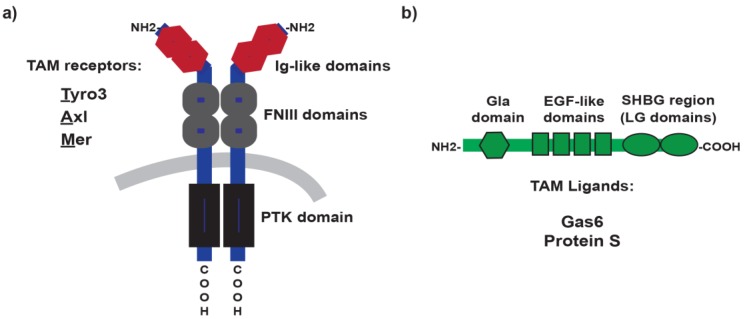
Figure 1
Figure 1
The structural domains of TAM receptors and ligands. Representation of the domain organization of the three TAM receptors: Tyro3, Axl and Mer at the plasma membrane of cells (a). TAM ligands: growth arrest-specific gene 6 (Gas6) and Protein S (Pros 1) are soluble circulating proteins (b). TAM receptors use their immunoglobulin-like (Ig-like) domains to bind the laminin G (LG) domains in the sex hormone binding globulin (SHBG) region of TAM ligands. PTK: Protein tyrosine kinase domain; FNIII: fibronectin type III domains; Gla: gamma-carboxyglutamic acid-rich domain; EGF-like: epidermal growth factor-like domain.
Figure 2
Figure 2
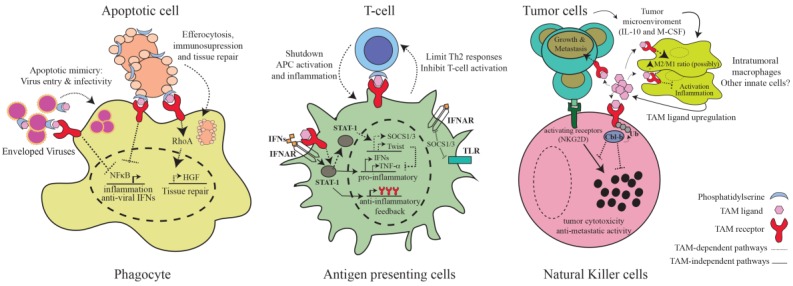
TAM-dependent immunity. Schematic representation of the major cellular functions of TAM receptors in the regulation of immunity. TAM-signaling functions as a pleiotropic inhibitory pathway in charge of resolving inflammation by dampening the activation of innate cells as well as restoring tissue function through promotion of tissue repair and clearance of apoptotic cells. Viruses can mimic apoptotic cell death to usurp TAM-dependent inhibitory pathways for their benefit. In a cancer setting, tumor cells induce TAM signaling to: (i) dampen NK-cell based anti-tumoral responses; (ii) reduce innate cells-mediated inflammation and possibly increase the ratio of M2-to-M1 intratumoral macrophages; and (iii) to directly promote its own growth and metastasis. A possible role for TAM signaling inhibiting Natural Killer T (NKT) cells has been proposed but is not presented here (see main text). A simplified view of the as yet identified underlying molecular mechanisms regulating these bioactivities is presented. Arrows indicate activating interactions. Flat-ended lines indicate inhibitory interactions. Ub: Ubiquitin; HGF: hepatocyte growth factor; IFNs: type-1 interferons; IFNAR: type-1 interferon receptor; NFkB: Nuclear Factor kB; RhoA: Ras homolog gene family member A; STAT-1: Signal transducer and activator of transcription 1; Th2: Lymphocyte T helper 2; APC: Antigen-presenting cell; TLR: Toll-like receptor; SOCS1/3: Suppressor of cytokine signaling 1/3; NKG2D: natural-killer group 2 member D; Cbl-b: Casitas B-lineage lymphoma-b; M1: classical macrophages; M2: alternative macrophages; IL-10: Interleukin-10; M-CSF: macrophage colony-stimulating factors; TNF-α: Tumor necrosis factor alpha.
Figure 3
Figure 3
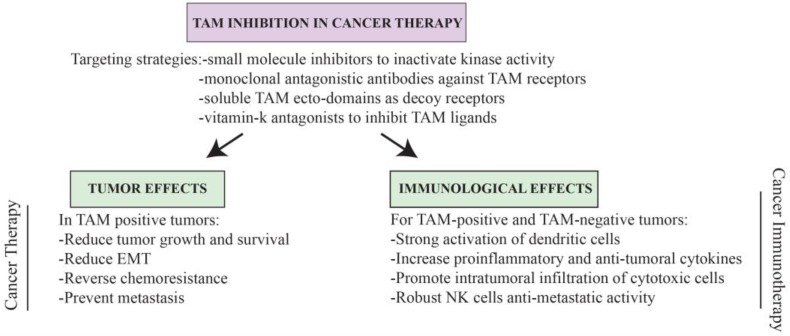
TAM signaling for cancer therapy. Different strategies for targeted TAM inactivation and the expected anti-cancer benefits of such therapies by directly affecting the tumor, or indirectly, via activation of the immune system. Possible side effects are discussed in the text. EMT: Epithelial–mesenchymal transition; NK: Natural-killer.

References

    1. Lai C., Lemke G. An extended family of protein-tyrosine kinase genes differentially expressed in the vertebrate nervous system. Neuron. 1991;6:691–704. doi: 10.1016/0896-6273(91)90167-X. - DOI - PubMed
    1. Lemmon M.A., Schlessinger J. Cell signaling by receptor tyrosine kinases. Cell. 2010;141:1117–1134. doi: 10.1016/j.cell.2010.06.011. - DOI - PMC - PubMed
    1. Angelillo-Scherrer A., Burnier L., Flores N., Savi P., DeMol M., Schaeffer P., Herbert J.-M., Lemke G., Goff S.P., Matsushima G.K., et al. ERole of Gas6 receptors in platelet signaling during thrombus stabilization and implications for antithrombotic therapy. J. Clin. Investig. 2005;115:237–246. doi: 10.1172/JCI22079. - DOI - PMC - PubMed
    1. Angelillo-Scherrer A., Burnier L., Lambrechts D., Fish R.J., Tjwa M., Plaisance S., Sugamele R., DeMol M., Martinez-Soria E., Maxwell P.H., et al. Role of Gas6 in erythropoiesis and anemia in mice. J. Clin. Investig. 2008;118:583–596. doi: 10.1172/JCI30375. - DOI - PMC - PubMed
    1. Melaragno M.G., Cavet M.E., Yan C., Tai L.-K., Jin Z.-G., Haendeler J., Berk B.C. Gas6 inhibits apoptosis in vascular smooth muscle: Role of Axl kinase and Akt. J. Mol. Cell. Cardiol. 2004;37:881–887. doi: 10.1016/j.yjmcc.2004.06.018. - DOI - PubMed