. 2017 Apr 15;81(8):693-701.
doi: 10.1016/j.biopsych.2016.08.027. Epub 2016 Aug 26.

Preadolescent Adversity Programs a Disrupted Maternal Stress Reactivity in Humans and Mice

Affiliations

Preadolescent Adversity Programs a Disrupted Maternal Stress Reactivity in Humans and Mice

Kathleen E Morrison et al. Biol Psychiatry. .

Abstract

Background: Adverse childhood experiences (ACEs) are one of the greatest predictors of affective disorders for women. Periods of dynamic hormonal flux, including pregnancy, exacerbate the risk for affective disturbance and promote hypothalamic-pituitary-adrenal (HPA) axis dysregulation, a key feature of affective disorders. Little is understood as to how stress experienced in late childhood, defined as preadolescence, alters the programming unique to this period of brain maturation and its interaction with the hormonal changes of pregnancy and postpartum.

Methods: Preadolescent female mice were exposed to chronic stress and examined for changes in their HPA axis during pregnancy and postpartum, including assessment of maternal-specific stress responsiveness and transcriptomics of the paraventricular nucleus of the hypothalamus. Translationally, pregnant women with low or high ACEs were examined for their maternal stress responsiveness.

Results: As predicted, preadolescent stress in mice resulted in a significant blunting of the corticosterone response during pregnancy. Transcriptomic analysis of the paraventricular nucleus revealed widespread changes in expression of immediate early genes and their targets, supporting the likely involvement of an upstream epigenetic mechanism. Critically, in our human studies, the high ACE women showed a significant blunting of the HPA response.

Conclusions: This unique mouse model recapitulates a clinical outcome of a hyporesponsive HPA stress axis, an important feature of affective disorders, during a dynamic hormonal period, and suggests involvement of transcriptional regulation in the hypothalamus. These studies identify a novel mouse model of female ACEs that can be used to examine how additional life adversity may provoke disease risk or resilience.

Keywords: Adolescence; HPA axis; Paraventricular nucleus; Postpartum; Pregnancy; Stress.


Figures

Figure 1
Figure 1
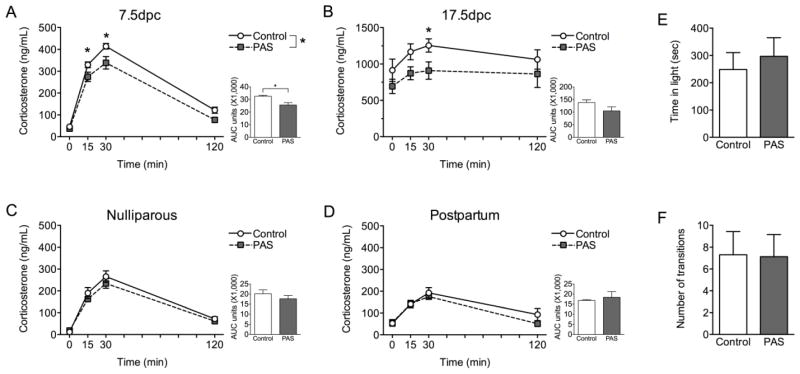
Preadolescent stress disrupted HPA axis responsiveness to acute restraint stress only during pregnancy. (A) The corticosterone response to restraint was blunted in PAS females compared to Controls at 7.5dpc (n = 6–8/group), as indicated by both a main effect on the corticosterone curve (Fstress(1,12) = 14.038, P = 0.0028; Ftime(2.3,28.0) = 280.35, P < 0.0001; Fstress*time(2.3,28.0) = 2.17, P = 0.13) as well as total area under the curve (AUC) measurement (t(12) = 3.70, P = 0.003). PAS females had lower corticosterone at both 15 min (t(12) = 2.32, P = 0.039) and 30 min time points (t(12) =2.67, P = 0.020). (B) In late pregnancy (17.5dpc, n = 8/group), preadolescent stress significantly altered the peak in corticosterone, as indicated by PAS females having blunted corticosterone at the 30 min time point compared to Controls (t(14) = 2.30, P = 0.038). There was no effect of PAS on corticosterone over time (Ftime(1.7,23.9) = 4.042, P = 0.036; Fstress(1,14) = 3.30, P = 0.090; Fstress*time(1.7,23.9) = 0.32, P = 0.70), AUC measurement (t(14) = 1.74, P = 0.10), or corticosterone at the 15 min time point (t(14) = 2.096, P = 0.055). Disruption of the corticosterone response to acute restraint stress is specific to pregnancy. (C) There was no effect of PAS in nulliparous females (n = 7–8/group), as indicated by an effect on the corticosterone curve (Fstress(1,13) = 0.82, P = 0.38; Ftime(2.4,31.7) = 120.43, P < 0.0001; Fstress*time(2.4,31.7) = 0.81, P = 0.47), AUC measurement (t(13) = 0.96, P = 0.35), or corticosterone at 15 min (t(13) = 0.92, P = 0.37) or at 30 min (t(13) = 0.90, P = 0.38). (D) Similarly, there was no effect of PAS on the postpartum corticosterone response (n = 3–4/group, Fstress(1,5) = 2.66, P = 0.16; Ftime(3,3) = 14.32, P = 0.028; Fstress*time(3,3) = 0.87, P = 0.55), AUC measurement (t(5) = 0.47, P = 0.65), or corticosterone at 15 min (t(5) = 0.08, P = 0.94) or at 30 min (t(5) = 0.68, P = 0.53). PAS effects on pregnancy stress responsiveness were specific to the HPA axis, as performance on the light-dark box test of anxiety-like behavior at 17.5dpc (n = 8–10/group) showed no effect of PAS on (E) total time in the light (t(16) = 0.52, P = 0.61) or (F) number of transitions between the light and dark chambers (t(16) = 0.058, P = 0.95). *P < 0.05.
Figure 2
Figure 2
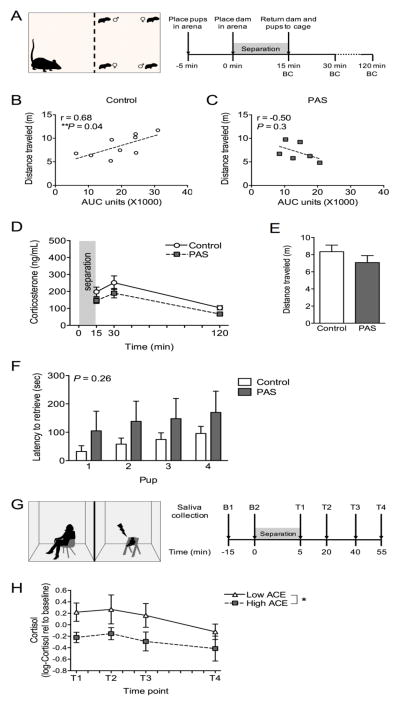
Separation from offspring resulted in disrupted postpartum stress responsiveness in both mice and humans with adverse preadolescent experience. (A) During a postpartum separation test in mice, females (n = 7–10/group) were separated from pups (2 male, 2 female, PN7) by a mesh screen for 15 min, during which distance travelled was measured, and following which there was blood collection (BC) to assess corticosterone response to the test. (B) A predicted positive correlation between total distance travelled and total corticosterone (area under the curve units, AUC) was observed in Control females (r = 0.68, P = 0.042). (C) However, this relationship was disrupted in PAS females (r = −0.50, P = 0.31). There was no effect of PAS alone on (D) corticosterone measurement over time (Fstress(1,15) = 1.23, P = 0.28; Ftime(1.6,24.0) = 30.089, P < 0.0001; Fstress*time(1.6,24.0) = 0.072, P = 0.89) or (E) distance travelled during the 15 min separation (t(13) = 1.10, P = 0.29). (F) Preadolescent stress did not alter maternal behavior, as assessed on a pup retrieval task (PN2, n = 4–6/group), as indicated by latency to retrieve pups (Fstress(1,8) = 1.48, P = 0.26; Fpup(1.5,12.2) = 9.34, P = 0.0054; Fstress*pup(1.5,12.2) = 0.041, P = 0.93). (G) Women were assessed in a similar task at 6 months postpartum (n = 9–11/group). (H) High ACE women have a significant blunting of salivary cortisol (P = 0.013). There was also a predicted significant effect of time on salivary cortisol (P = 0.011). *P < 0.05.
Figure 3
Figure 3
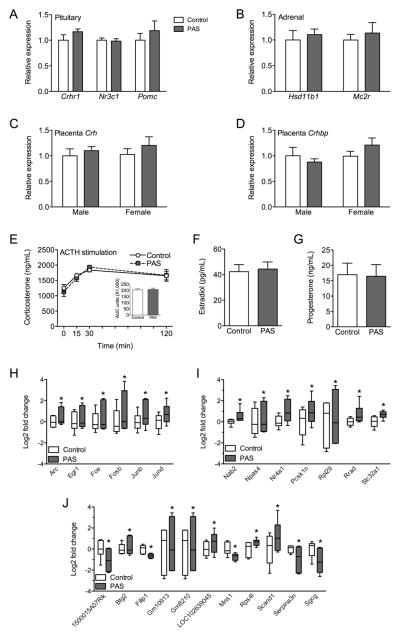
Preadolescent stress resulted in long-term reprogramming of gene expression in the PVN but did not alter peripheral regulators of HPA axis responsiveness. At 17.5dpc (n = 5–6/group), there was no effect of PAS on (A) pituitary expression (relative to Control) of Crhr1 (t(9) = 1.45, P = 0.18), Nr3c1 (t(9) = 0.27, P = 0.80), or Pomc (t(9) = 0.78, P = 0.45), nor was there an effect on gene expression in (B) the adrenal gland, including Hsd11b1 (t(9) = 0.51, P = 0.62) and Mc2r (t(9) = 0.55, P = 0.59). As the placenta can contribute CRF to maternal circulation, we also measured gene expression in the late pregnancy placenta, but there was no effect of PAS on either (C) Crh (Fstress(1,20) = 1.066, P = 0.31; Fsex(1,20) = 0.23, P = 0.64; Fstress*sex(1,20) = 0.080, P = 0.78) or (D) Crhbp expression (relative to Control male; Fstress(1,20) = 0.15, P = 0.70; Fsex(1,20) = 1.76, P = 0.20; Fstress*sex(1,20) = 1.94, P = 0.18). (E) Responsiveness of the adrenal gland to ACTH stimulation was assessed, and preadolescent stress had no effect on corticosterone response (n = 6–10/group), as indicated by corticosterone over time (Fstress(1,12) = 0.057, P = 0.81; Ftime(3,10) = 12.76, P = 0.0009; Fstress*time(3,12) = 0.82, P = 0.51) or AUC measurement (t(12) = 0.24, P = 0.82). The effect of PAS on the HPA axis is unlikely to be related to alterations in circulating hormone levels, as there was no effect of PAS on (F) plasma estradiol (t(13) = 0.25, P = 0.80) or (G) plasma progesterone (t(13) = 0.095, P = 0.93) in 18.5dpc females (n = 7–8/group). Differential gene expression analysis of RNA-Seq data revealed that 24 genes in the late pregnancy PVN differed between PAS and Control females (n = 6/group). These genes fell into three categories that suggest a broad change in gene expression as a result of preadolescent stress. (H) Of the differentially expressed genes, 6 were immediate early genes (IEGs), all of which were increased in the PVN of PAS females. Log2 fold change is relative to Control value. (I) Of the remaining genes, 7 were identified as having at least one of the six IEGs as a transcription factor. Interestingly, many of these genes (Nab2, Npas4, Nr4a1, Rpl29, and Rrad) are involved in transcriptional or translational regulation. Other genes that were identified as being regulated by the IEGs include Pcsk1, which regulates the cleavage of neuroendocrine peptide precursors, and Slc32a1, the vesicular GABA transporter. (J) Other differentially expressed genes were not directly regulated by the any of the IEGs and have a variety of biological functions, including regulation of transcription (Btg2, Scand1) and response to hormone stimulus (Serpina3n). *significantly different between Control and PAS.

Comment in

References

    1. Heim C, Shugart M, Craighead WE, Nemeroff CB. Neurobiological and psychiatric consequences of child abuse and neglect. Dev Psychobiol. 2010;52:671–90. - PubMed
    1. Janssen I, Krabbendam L, Bak M, Hanssen M, Vollebergh W, de Graaf R, van Os J. Childhood abuse as a risk factor for psychotic experiences. Acta Psychiatr Scand. 2004;109:38–45. - PubMed
    1. Chapman DP, Whitfield CL, Felitti VJ, Dube SR, Edwards VJ, Anda RF. Adverse childhood experiences and the risk of depressive disorders in adulthood. J Affect Disord. 2004;82:217–25. - PubMed
    1. McCauley J, Kern DE, Kolodner K, Dill L, Schroeder AF, DeChant HK, et al. Clinical characteristics of women with a history of childhood abuse: unhealed wounds. JAMA. 1997;277:1362–8. - PubMed
    1. Brand SR, Brennan PA, Newport DJ, Smith AK, Weiss T, Stowe ZN. The impact of maternal childhood abuse on maternal and infant HPA axis function in the postpartum period. Psychoneuroendocrinology. 2010;35:686–93. - PMC - PubMed

Publication types

MeSH terms