Association of Plasma Pentraxin-3 Levels on Admission with In-hospital Mortality in Patients with Acute Type A Aortic Dissection
- PMID: 27779166
- PMCID: PMC5125338
- DOI: 10.4103/0366-6999.192785
Association of Plasma Pentraxin-3 Levels on Admission with In-hospital Mortality in Patients with Acute Type A Aortic Dissection
Abstract
Background: Acute aortic dissection is a life-threatening cardiovascular emergency. Pentraxin-3 (PTX3) is proposed as a prognostic marker and found to be related to worse clinical outcomes in various cardiovascular diseases. This study sought to investigate the association of circulating PTX3 levels with in-hospital mortality in patients with acute Type A aortic dissection (TAAD).
Methods: A total of 98 patients with TAAD between January 2012 and December 2015 were enrolled in this study. Plasma concentrations of PTX3 were measured upon admission using a high-sensitivity enzyme-linked immunosorbent assay system. Patients were divided into two groups as patients died during hospitalization (Group 1) and those who survived (Group 2). The clinical, laboratory variables, and imaging findings were analyzed between the two groups, and predictors for in-hospital mortality were evaluated using multivariate analysis.
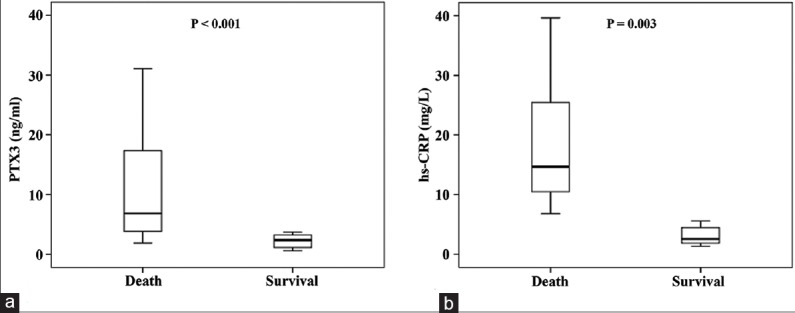
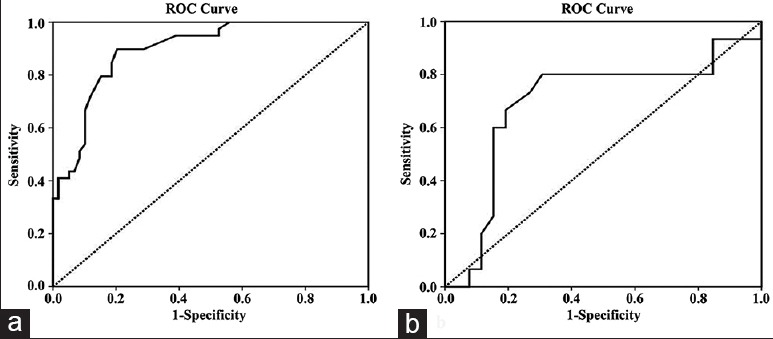
Results: During the hospital stay, 32 (33%) patients died and 66 (67%) survived. The patients who died during hospitalization had significantly higher PTX3 levels on admission compared to those who survived. Pearson's correlation analysis demonstrated that PTX3 correlated positively with high-sensitivity C-reactive protein (hsCRP), maximum white blood cell count, and aortic diameter. Multivariate logistic regression analysis demonstrated that PTX3 levels, coronary involvement, cardiac tamponade, and a conservative treatment strategy are significant independent predictors of in-hospital mortality in patients with TAAD. The receiver operating characteristic curve analysis further illustrated that PTX3 levels on admission were strong predictors of mortality with an area under the curve of 0.89. A PTX3 level ≥5.46 ng/ml showed a sensitivity of 88% and a specificity of 79%, and an hsCRP concentration ≥9.5 mg/L had a sensitivity of 80% and a specificity of 69% for predicting in-hospital mortality.
Conclusion: High PTX3 levels on admission are independently associated with the in-hospital mortality in patients with TAAD.
Figures
References
-
- Nienaber CA, Clough RE. Management of acute aortic dissection. Lancet. 2015;385:800–11. doi: 10.1016/S0140-6736(14)61005-9. - PubMed
-
- Hagan PG, Nienaber CA, Isselbacher EM, Bruckman D, Karavite DJ, Russman PL, et al. The International Registry of Acute Aortic Dissection (IRAD): New insights into an old disease. JAMA. 2000;283:897–903. - PubMed
-
- Rampoldi V, Trimarchi S, Eagle KA, Nienaber CA, Oh JK, Bossone E, et al. Simple risk models to predict surgical mortality in acute type A aortic dissection: The International Registry of Acute Aortic Dissection score. Ann Thorac Surg. 2007;83:55–61. doi: 10.1016/j.athoracsur.2006.08.007. - PubMed
-
- Deban L, Russo RC, Sironi M, Moalli F, Scanziani M, Zambelli V, et al. Regulation of leukocyte recruitment by the long pentraxin PTX3. Nat Immunol. 2010;11:328–34. doi: 10.1038/ni.1854. - PubMed
-
- Inoue K, Sugiyama A, Reid PC, Ito Y, Miyauchi K, Mukai S, et al. Establishment of a high sensitivity plasma assay for human pentraxin3 as a marker for unstable angina pectoris. Arterioscler Thromb Vasc Biol. 2007;27:161–7. doi: 10.1161/01.ATV.0000252126.48375.d5. - PubMed
MeSH terms
Substances
LinkOut - more resources
Full Text Sources
Other Literature Sources
Medical
Research Materials
Miscellaneous