


Mesenchymal stem cell-based treatments for stroke, neural trauma, and heat stroke
- PMID: 27781140
- PMCID: PMC5064338
- DOI: 10.1002/brb3.526
Mesenchymal stem cell-based treatments for stroke, neural trauma, and heat stroke
Abstract
Background: Mesenchymal stem cell (MSC) transplantation has been reported to improve neurological function following neural injury. Many physiological and molecular mechanisms involving MSC therapy-related neuroprotection have been identified.
Methods: A review is presented of articles that pertain to MSC therapy and diverse brain injuries including stroke, neural trauma, and heat stroke, which were identified using an electronic search (e.g., PubMed), emphasize mechanisms of MSC therapy-related neuroprotection. We aim to discuss neuroprotective mechanisms that underlie the beneficial effects of MSCs in treating stroke, neural trauma, and heatstroke.
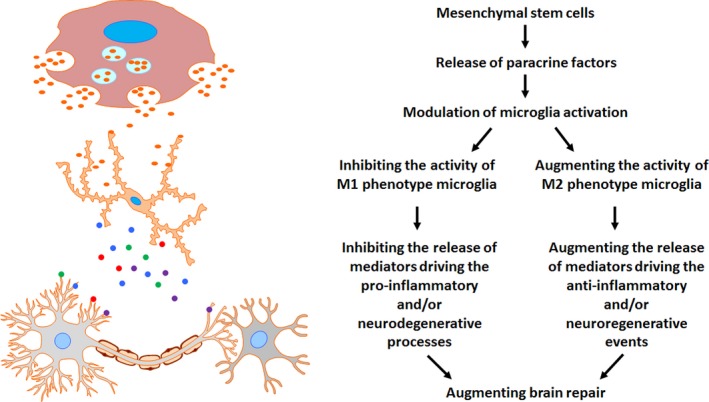
Results: MSC therapy is promising as a means of augmenting brain repair. Cell incorporation into the injured tissue is not a prerequisite for the beneficial effects exerted by MSCs. Paracrine signaling is believed to be the most important mediator of MSC therapy in brain injury. The multiple mechanisms of action of MSCs include enhanced angiogenesis and neurogenesis, immunomodulation, and anti-inflammatory effects. Microglia are the first source of the inflammatory cascade during brain injury. Cytokines, including tumor necrosis factor-α, interleukin-1β, and interleukin-6, are significantly produced by microglia in the brain after experimental brain injury. The proinflammatory M1 phenotype of microglia is associated with tissue destruction, whereas the anti-inflammatory M2 phenotype of microglia facilitates repair and regeneration. MSC therapy may improve outcomes of ischemic stroke, neural trauma, and heatstroke by inhibiting the activity of M1 phenotype of microglia but augmenting the activity of M2 phenotype of microglia.
Conclusion: This review offers a testable platform for targeting microglial-mediated cytokines in clinical trials based upon the rational design of MSC therapy in the future. MSCs that are derived from the placenta provide a great choice for stem cell therapy. Although targeting the microglial activation is an important approach to reduce the burden of the injury, it is not the only one. This review focuses on this specific aspect.
Keywords: Ischemic stroke; heatstroke; mesenchymal stem cells; neural trauma.
Figures
References
-
- Banati, R. B. , Gehrmann, J. , Schubert, P. , & Kreutzberg, G. W. (1993). Cytotoxicity of microglia. Glia, 7, 111–118. Review. - PubMed
-
- Bang, O. Y. , Lee, J. S. , Lee, P. H. , & Lee, G. (2005). Autologous mesenchymal stem cell transplantation in stroke patients. Annals of Neurology, 57, 874–882. - PubMed
-
- Bao, X. , Wei, J. , Feng, M. , Lu, S. , Li, G. , Dou, W. , … Wang, R. (2011). Transplantation of human bone marrow‐derived mesenchymal stem cells promotes behavioral recovery and endogenous neurogenesis after cerebral ischemia in rats. Brain Research, 1367, 103–113. - PubMed
-
- Barone, F. C. , Arvin, B. , White, R. F. , Miller, A. , Webb, C. L. , Willette, R. N. , … Feuerstein, G. Z. (1997). Tumor necrosis factor‐alpha. A mediator of focal ischemic brain injury. Stroke, 28, 1233–1244. - PubMed
Publication types
MeSH terms
LinkOut - more resources
Full Text Sources
Other Literature Sources
Medical
